


Sammee VanArsdale: Human FcRn Models – Advancing Long-Acting Biologics
Sammee VanArsdale, Senior Marketing Manager at The Jackson Laboratory, shared Jan Terje Andersen‘s post on LinkedIn:
“Hot off the Press!
Researchers from The Jackson Laboratory and University Hospital Oslo demonstrate how human FcRn transgenic Tg32 mice can accelerate the development of next-generation biologics using an engineered erythropoietin (EPO)-albumin fusion protein.
Learn how enhancing albumin’s interaction with human FcRn significantly extended the drug’s half-life, increased systemic exposure, and prolonged its biological activity.
Importantly, these FcRn-mediated effects could be accurately measured because the researchers used Tg32 mice, which express human FcRn and provide a more clinically relevant model for evaluating human albumin- and Fc-based therapeutics.
Key takeways:
- Tg32 mice enabled human-relevant assessment of FcRn-driven half-life extension.
- The engineered EPO-albumin fusion demonstrated substantially improved pharmacokinetics and durability.
- The study highlights the translational value of Tg32 models for de-risking biologic drug development.
- Findings may support the development of longer-acting therapies that could reduce dosing frequency and treatment burden for patients with chronic anemia.
This work underscores how specialized humanized mouse models can bridge the gap between discovery and the clinic, helping researchers make more informed decisions earlier in the development process.”
Jan Terje Andersen, Professor in Biomedical Innovation at University of Oslo, shared a post on LinkedIn, about a recent article he and his colleagues co-authored, published in Nature Communications, adding:
“Can we design protein medicines that last longer and can be delivered without needles?
In our new study in Nature Communications, we explored both possibilities by connecting the therapeutic protein erythropoietin (EPO) to an engineered version of human albumin.
The approach builds on a natural partnership: albumin binds to the neonatal Fc receptor (FcRn), which protects it from degradation but also helps transport it across cellular barriers.
By engineering albumin, we improved the properties of EPO attached to it. In mice expressing human FcRn, we show:
- A more than fivefold increase in plasma half-life compared with EPO fused to normal albumin, from 1.1 to 5.7 days.
- Uptake into the bloodstream following administration through the nose, with approximately fivefold greater exposure than the corresponding normal-albumin fusion.
- Preserved biological activity, supporting a sustained increase in red blood cells.
These are preclinical findings and show how our understanding of complex biology combined with protein engineering can open opportunities for longer-acting biologics and delivery across mucosal barriers.
Congratulations to first author Aina Karen Anthi, Daniela Bejan, Simone Mester, Sopisa Benjakul, Kristin Hovden Aaen, Inger Sandlie, and all our collaborators who contributed to this work! Tilman Schlothauer, Roche, Nijaguna Bethur, and Elena Gonzalo-Gil for a great collaboration on the use of The Jackson Laboratory human FcRn transgenic mice.”
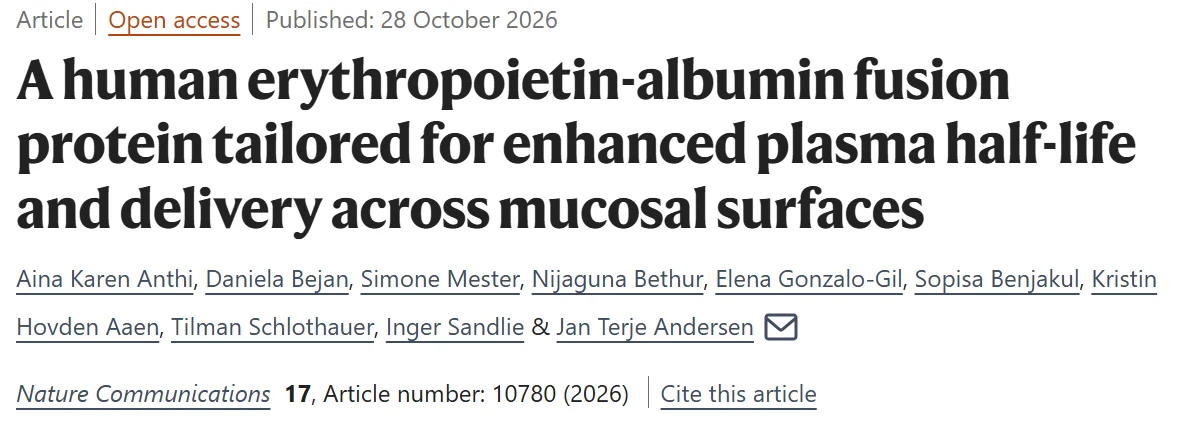
Title: A human erythropoietin-albumin fusion protein tailored for enhanced plasma half-life and delivery across mucosal surfaces
Authors: Aina Karen Anthi, Daniela Bejan, Simone Mester, Nijaguna Bethur, Elena Gonzalo-Gil, Sopisa Benjakul, Kristin Hovden Aaen, Tilman Schlothauer, Inger Sandlie, Jan Terje Andersen
Stay updated on all scientific advances with Hemostasis Today.
-
Nov 1, 2026, 05:12Lorena Costa: Anemia Is Common, but It Is Not Normal
-
Nov 1, 2026, 04:57Artificial Intelligence in Blood Donor Management – ISBT
-
Nov 1, 2026, 04:50Neda Ashayeri: Fostering Knowledge Exchange at the Benign Hematology League Summit
-
Nov 1, 2026, 04:39Young Patient Voices Shaping the Future of Healthcare – EHC
-
Nov 1, 2026, 04:25Mary Cushman: Understanding Stroke in Patients with Cancer
-
Nov 1, 2026, 04:10Oral Healthcare for Women and Girls with Bleeding Disorders – World Federation of Hemophilia
-
Nov 1, 2026, 03:29Muhammad Hamza: A Rare F11R Variant Leads to the Identification of the JAMA Blood Group System
-
Nov 1, 2026, 03:17Marcelo Carlin: Unimed Piracicaba Showcases Research in Hemotherapy at HEMO 2026
-
Oct 31, 2026, 20:00Ahmed Alaqab: Proud to Share Our Systematic Review on Medication Adherence After Switching to DOACs