


Thirunavukkarasu Angappan/LinkedIn
Nov 5, 2026, 09:10
Thirunavukkarasu Angappan: Plasminogen Deficiency – From Pathophysiology to Replacement Therapy
Thirunavukkarasu Angappan, Vice President of Operations and Manufacturing at PopVax, shared a post on LinkedIn:
“Plasminogen: the plasma protein that cleans up fibrin
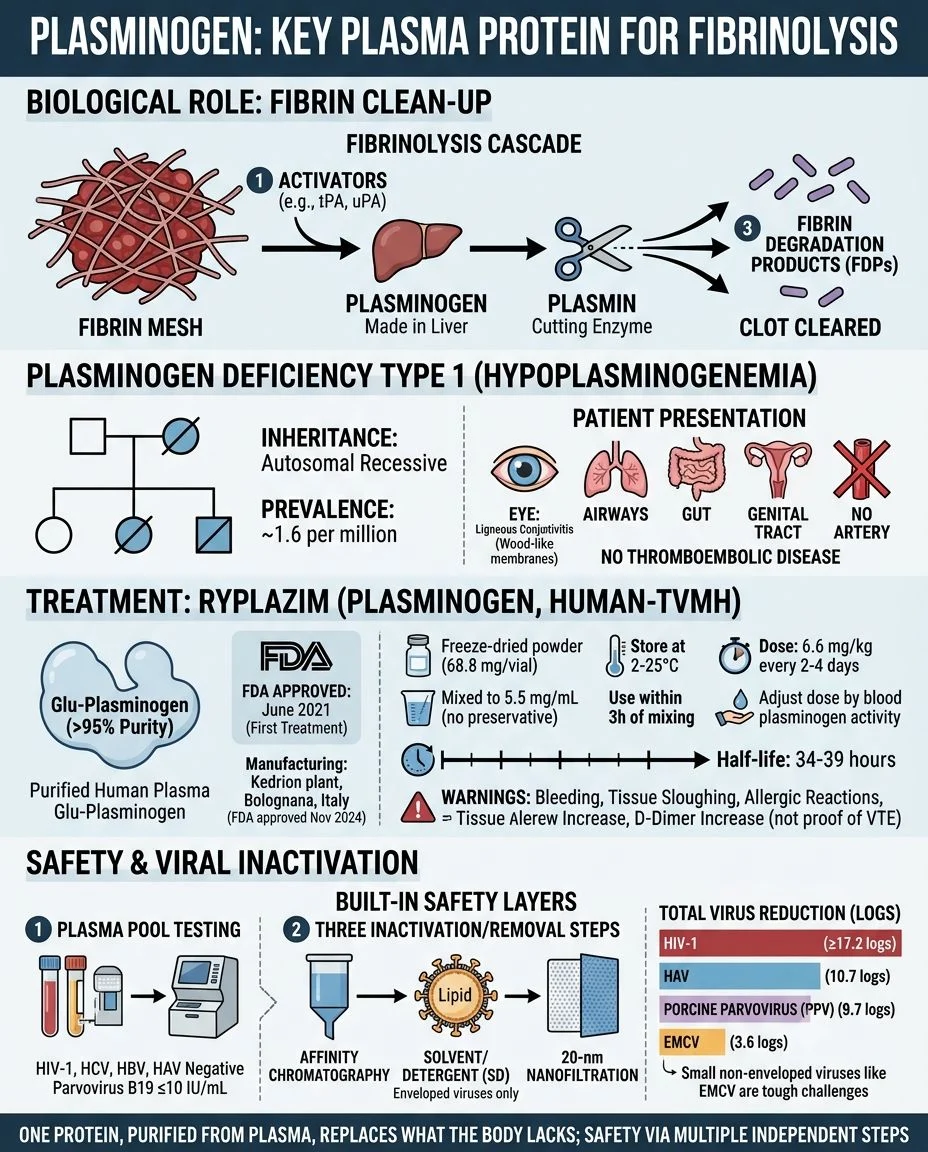
Every clot is built from fibrin, and every clot must eventually be cleared. The clean-up crew starts with plasminogen, a protein made mainly in the liver. Fibrin grabs plasminogen and its activators onto its surface, and the activators turn plasminogen into plasmin, the enzyme that cuts fibrin down.
- When it is missing: in plasminogen deficiency type 1 (hypoplasminogenemia), faulty PLG genes lower the amount and the activity of plasminogen. It is inherited as an autosomal recessive trait (a child needs a faulty copy from each parent) and is reported in about 1.6 people per million.
- What patients see: fibrin piles up on moist surfaces such as the eye, airways, gut and genital tract. In ligneous conjunctivitis, the eye lesions harden into wood-like membranes, often within the first year of life. Clots in blood vessels are not part of this picture.
- The medicine: Ryplazim (plasminogen, human-tvmh) is purified from human plasma and is more than 95% pure Glu-plasminogen. The United States Food and Drug Administration (FDA) approved it on 4 June 2021, the first treatment for this condition. Kedrion’s plant in Bolognana, Italy, won FDA approval to make it in November 2024.
- How it is given: a freeze-dried powder, 68.8 mg per vial, mixed to 5.5 mg/mL with no preservative. Store at 2 to 25°C and use within 3 hours of mixing. The dose is 6.6 mg per kilogram into a vein every 2 to 4 days, adjusted by blood plasminogen activity just before the next dose. Its half-life of about 34 to 39 hours fits this schedule.
- Good to know: the label warns of bleeding, tissue sloughing and allergic reactions. It also warns that D-dimer, a clot-breakdown marker, can rise because of the medicine’s own action, so a high result does not prove a blood clot (venous thromboembolism).
- Safety built in layers: donor plasma pools must test negative for human immunodeficiency virus 1 (HIV-1) and hepatitis C, B and A viruses (HAV is hepatitis A), with parvovirus B19 DNA at or below 10 international units (IU) per mL.
Then three steps remove or kill viruses: affinity chromatography, solvent/detergent treatment (which acts on enveloped viruses only) and 20-nanometre nanofiltration. - Reading the numbers: total virus reduction is at least 17.2 logs for HIV-1, 10.7 for HAV and 9.7 for porcine parvovirus (PPV). The exception is encephalomyocarditis virus, a small virus without an envelope, at 3.6 logs, the only value below 7.
Small non-enveloped viruses are the toughest test for any plasma process, so the whole table deserves a careful read.
The takeaway: one protein, purified from plasma, replaces what the body lacks.
Its safety does not rest on one step but on many independent ones”.
Other posts featuring Thirunavukkarasu Angappan on Hemostasis Today.
-
Nov 5, 2026, 09:48Kanza Khan: Hematology and Diagnostic Laboratory Techniques
-
Nov 5, 2026, 09:44Wade Tung: PGY2 Training in THM Prepares the Next Generation of Antithrombotic Experts
-
Nov 5, 2026, 09:13Wolfgang Miesbach: Uncovering the Role of Factor VIII in Endothelial Biology
-
Nov 5, 2026, 07:34Ravindra Prasad Thokala: Stem Cell Apheresis – 4 Donors, 4 Unique Challenges
-
Nov 5, 2026, 07:26Karina Carla Melo de Souza: Who Will Sustain Blood Stocks in the Future?
-
Nov 5, 2026, 05:44Arun V. J.: Clinical Audits and Transfusion Quality Improvement
-
Nov 5, 2026, 00:36Looking Forward to the Upcoming ERIN Webinar – EAHAD
-
Nov 4, 2026, 23:49Jyotsnaa Rao: Contributing to Advances in Transfusion Medicine Through TPE in Solid Organ Transplantation
-
Nov 4, 2026, 23:28Flávio Augusto Naoum: Discussing Digital Morphology and the Burden of Anemia in Myelofibrosis at HEMO 2026