


Ifeanyichukwu Ifechidere: The Role of Coagulation in Anaesthesia and Surgery
Ifeanyichukwu Ifechidere, Specialist Biomedical Scientist at Sheffield Teaching Hospitals, shared a post on LinkedIn:
“What does coagulation have to do with anaesthesia? more than you might think!
Imagine preparing a patient for surgery.
The anaesthetic plan is ready, the theatre is booked, and everything seems to be in place.
But one important question remains:
Is this patient’s blood able to clot appropriately, and is it safe to proceed?
This is where understanding haemostasis and coagulation becomes essential in anaesthesiology.
Coagulation isn’t just a topic for haematologists and biomedical scientists. It plays a significant role in perioperative patient safety.
Let’s look at four important areas where coagulation knowledge makes a difference.
1. Assessing coagulation before surgery
Before an operation, clinicians need to consider the patient’s bleeding history, medical conditions, medications and relevant laboratory results. investigations may include:
- PT INR
- APTT
- Platelet count
- Fibrinogen
- Specific coagulation factor assays
Understanding what these results mean helps identify potential bleeding risks and guides further investigation.
2. Guiding transfusion decisions
Unexpected bleeding during surgery can become a critical situation.
Understanding coagulation helps anaesthetists recognise whether the problem involves:
- Clotting factor deficiency
- Low fibrinogen
- Thrombocytopenia or platelet dysfunction
- Excessive fibrinolysis
This knowledge supports targeted transfusion decisions rather than simply giving blood products without understanding the underlying problem.
3. Regional anaesthesia safety
Have you ever wondered why coagulation status matters before an epidural or spinal anaesthetic?
Bleeding into a confined space around the spinal cord can cause a spinal or epidural haematoma, a potentially devastating complication.
Understanding platelet function, coagulation abnormalities and anticoagulant use is therefore essential when assessing the safety and timing of neuraxial procedures.
4. Perioperative anticoagulant management
Many patients coming for surgery are already taking anticoagulants.
Think about:
- Warfarin
- Apixaban
- Rivaroxaban
- Dabigatran
- Heparin
The anaesthetic team needs to understand the indication, last dose, renal function, bleeding risk and procedure-related risks when planning interruption and resumption.
The timing depends on the individual drug, dose, renal function and procedure. Some situations require specific laboratory investigations or specialist advice.
The Big Takeaway
Coagulation knowledge is not confined to the coagulation laboratory.
It connects the laboratory, anaesthetist, surgeon and clinical team in making safer decisions for patients.
Behind every PT, APTT, fibrinogen or anti-Xa result is information that can influence clinical management.
Save and share this post with someone working in perioperative care.
And follow me for more practical, simplified educational content on coagulation.”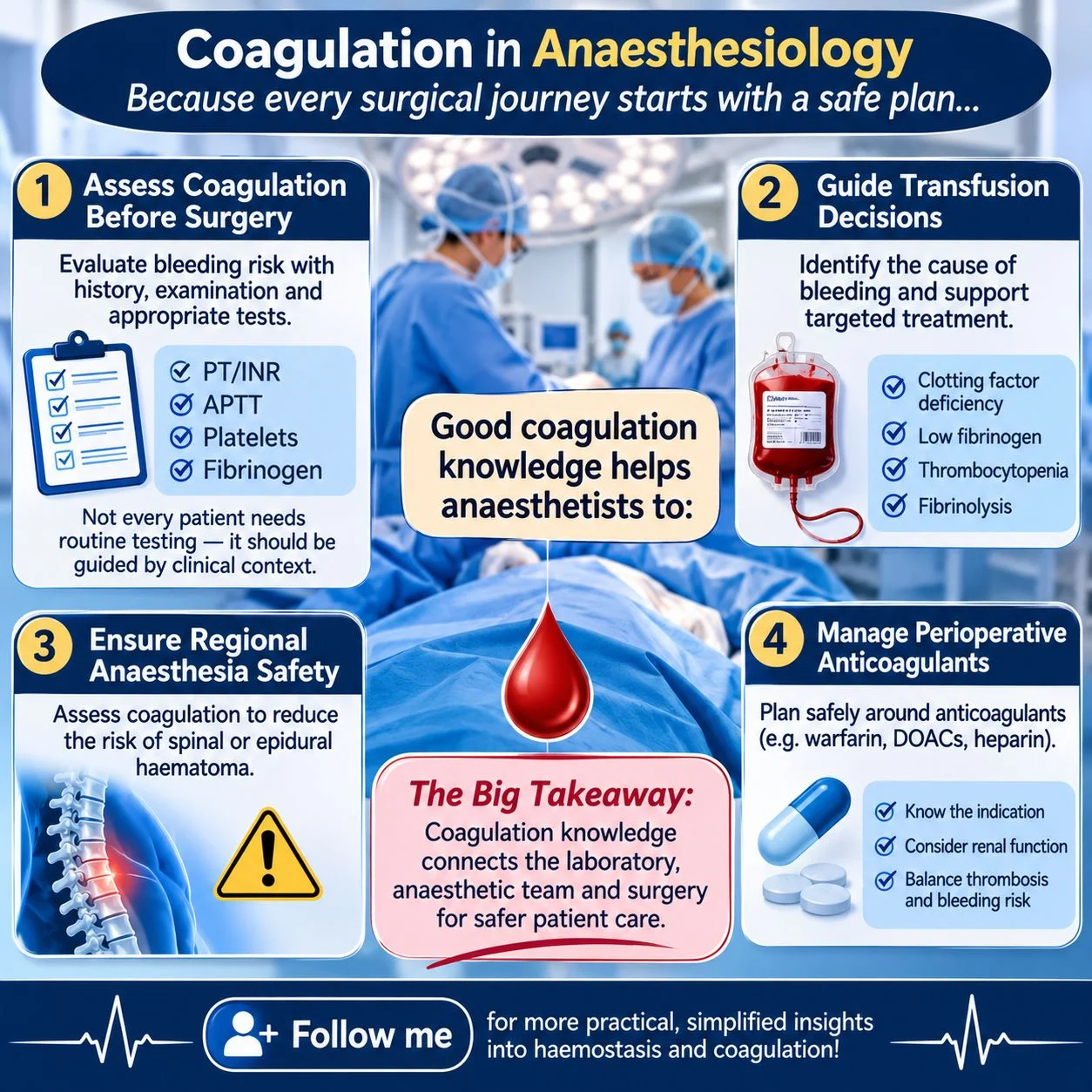
Stay updated with Hemostasis Today.
-
Nov 10, 2026, 16:28Can the VWF to ADAMTS-13 Ratio Predict Mortality in Sepsis-Induced Coagulopathy? – RPTH Journal
-
Nov 10, 2026, 16:28Ruth Willems: PhD Defence at Maastricht University on Thrombosis and Bleeding in HPB Disease
-
Nov 10, 2026, 16:09Edward Lee Carter: Factor XIa Inhibition Enters Clinical Practice
-
Nov 10, 2026, 16:08Edward C.C. Wong: Deriving Ferritin Cutoffs for Iron Deficiency Using RBC Parameters
-
Nov 10, 2026, 16:07Milad Abdalla: Decoding Hemoglobin Electrophoresis – A Practical Diagnostic Reference
-
Nov 10, 2026, 15:13Wolfgang Miesbach: Nonviral Gene Therapy for Haemophilia A Using Lipid Nanoparticles
-
Nov 10, 2026, 15:06Dahra Teles: First Speaking Experience at HEMO 2026 on First-Line Multiple Myeloma Treatment
-
Nov 10, 2026, 14:55Yazan Abou-Ismail: First FDA-Approved Factor XIa Inhibitor for Stroke Prevention
-
Nov 10, 2026, 14:37Salih Ehsan: Common Causes of Microcytic Anemia