


Edward Lee Carter: Factor XIa Inhibition Enters Clinical Practice
Edward Lee Carter, Clinical Pharmacist Practitioner at U.S. Department of Veterans Affairs, shared a post on LinkedIn:
“Factor XIa inhibition has reached clinical practice. But the indication matters.
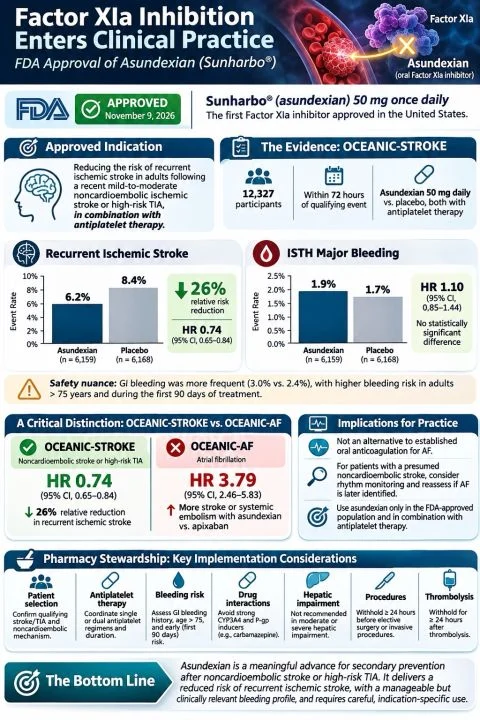
On November 9, 2026, the FDA approved Sunharbo (asundexian) 50 mg once daily, the first Factor XIa inhibitor authorized in the United States.
The indication is specific: secondary stroke prevention following recent mild-to-moderate noncardioembolic ischemic stroke or high-risk TIA, in combination with antiplatelet therapy.
The pivotal OCEANIC-STROKE trial randomized 12,327 patients.
Recurrent ischemic stroke:
- Asundexian: 6.2%
- Placebo: 8.4%
- HR 0.74 (95% CI 0.65–0.84)
A 26% relative reduction in the hazard of ischemic stroke.
ISTH major bleeding:
- Asundexian: 1.9%
- Placebo: 1.7%
- HR 1.10 (95% CI 0.85–1.44)
The overall difference was not statistically significant. However, GI bleeding was more frequent, and the FDA identified bleeding concerns in older adults and early treatment.
An important electrophysiology distinction:
OCEANIC-AF previously demonstrated substantially more stroke or systemic embolism with asundexian than apixaban in patients with atrial fibrillation (HR 3.79).
That trial was terminated early.
The new approval does not change those findings.
Asundexian is not an alternative to established oral anticoagulation for AF-related stroke prevention.
For patients whose stroke mechanism remains uncertain, rhythm monitoring and reassessment for occult AF remain essential.
The stewardship challenge now shifts to implementation:
- Confirm the qualifying stroke mechanism and labeled population.
- Coordinate asundexian with appropriate single or dual antiplatelet therapy.
- Evaluate bleeding risk, particularly GI bleeding and advanced age.
- Review drug interactions, hepatic impairment, and procedural plans.
- Reassess antithrombotic therapy when AF or another cardioembolic source is identified.
The broader lesson is important:
A successful antithrombotic mechanism in one clinical setting does not establish efficacy in another.
OCEANIC-STROKE represents a meaningful advance in secondary stroke prevention. OCEANIC-AF reminds us why indication-specific evidence and careful medication stewardship remain indispensable.
What do you see as the greatest implementation challenge: patient selection, antiplatelet coordination, or reassessment when AF is detected?”
Other posts featuring Edward Lee Carter on Hemostasis Today.
-
Nov 10, 2026, 16:08Edward C.C. Wong: Deriving Ferritin Cutoffs for Iron Deficiency Using RBC Parameters
-
Nov 10, 2026, 16:07Milad Abdalla: Decoding Hemoglobin Electrophoresis – A Practical Diagnostic Reference
-
Nov 10, 2026, 15:13Wolfgang Miesbach: Nonviral Gene Therapy for Haemophilia A Using Lipid Nanoparticles
-
Nov 10, 2026, 15:06Dahra Teles: First Speaking Experience at HEMO 2026 on First-Line Multiple Myeloma Treatment
-
Nov 10, 2026, 14:55Yazan Abou-Ismail: First FDA-Approved Factor XIa Inhibitor for Stroke Prevention
-
Nov 10, 2026, 14:49Ifeanyichukwu Ifechidere: The Role of Coagulation in Anaesthesia and Surgery
-
Nov 10, 2026, 14:37Salih Ehsan: Common Causes of Microcytic Anemia
-
Nov 10, 2026, 14:28Beyond Platelet Aggregation: Targeting Mitochondrial Pore Opening to Prevent Thrombosis
-
Nov 10, 2026, 14:13Shayan Mohammadmoradi: Jay D. Coffman Award for Emerging Vascular Researcher