


Shehab Mohamed: SGLT2 Inhibitors in Anemia Management
Shehab Mohamed, Hematologist at hammed Medical Corporation, shared a post on Linkedin about recent article he and his colleauges co-authored, published in Anemia, adding:
”Here we Go!
Can SGLT2 Inhibitors Offer a New Approach to Anemia Management in MDS and Myeloproliferative Neoplasms?
I share our recently published review article in Anemia (Wiley, 2026):
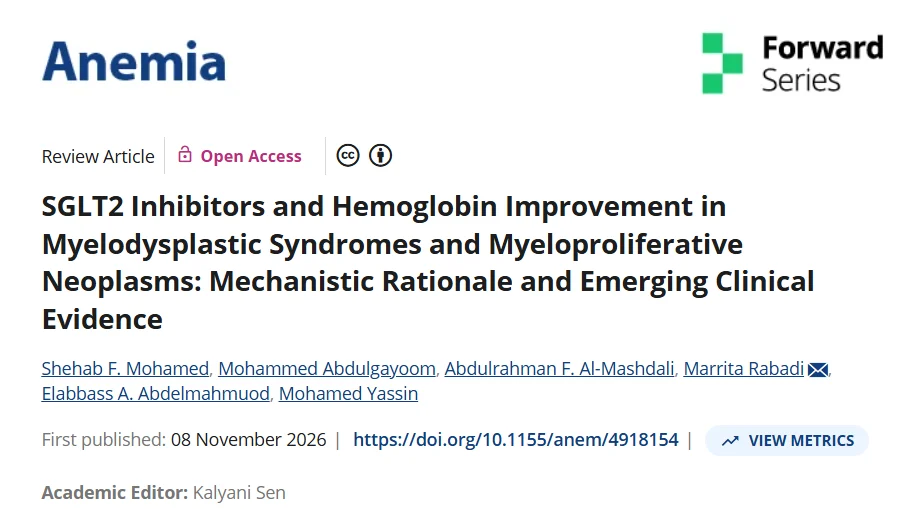
‘SGLT2 Inhibitors and Hemoglobin Improvement in Myelodysplastic Syndromes and Myeloproliferative Neoplasms: Mechanistic Rationale and Emerging Clinical Evidence.’
Our review explores the emerging role of SGLT2 inhibitors in improving hemoglobin levels in patients with myelodysplastic syndromes (MDS) and myeloproliferative neoplasms (MPNs), particularly myelofibrosis.
Key Highlights:
- Emerging observational evidence suggests hemoglobin improvements of approximately 1.0–1.6 g/dL in selected patients.
- Potential mechanisms include enhanced erythropoietin production, improved iron availability, and modulation of hepcidin and inflammatory pathways.
- These findings highlight a promising area for further investigation in anemia management, although prospective clinical trials are essential to establish efficacy and safety.
Importantly, careful monitoring is necessary, particularly in patients at risk of erythrocytosis.
Our review highlights the potential hematologic benefits of SGLT2 inhibitors beyond their established cardiovascular, renal, and metabolic indications, opening new avenues for future research in hematologic disorders.
A heartfelt thank you to all my co-authors and colleagues for their dedication, collaboration, and invaluable contributions to making this publication possible.”
Title: SGLT2 Inhibitors and Hemoglobin Improvement in Myelodysplastic Syndromes and Myeloproliferative Neoplasms: Mechanistic Rationale and Emerging Clinical Evidence
Authors: Shehab F. Mohamed, Mohammed Abdulgayoom, Abdulrahman F. Al-Mashdali, Marrita Rabadi, Elabbass A. Abdelmahmuod, Mohamed Yassin
Stay updated on all scientific advances with Hemostasis Today.
-
Nov 13, 2026, 14:58Lorena Arranz: The Power of Patient Engagement in Advancing MPN Research
-
Nov 13, 2026, 14:25Dino Mehic: Targeting TFPI in Unexplained Bleeding Disorders
-
Nov 13, 2026, 14:19Bahar Artım Esen: Rituximab in Antiphospholipid Syndrome
-
Nov 13, 2026, 14:13Tagreed Alkaltham: What If One Blood Donation Could Produce Units Of Blood?
-
Nov 13, 2026, 13:27Shirley D’Sa: Connecting European and Mayo Clinic Experts in MGCS Research and Care
-
Nov 13, 2026, 13:20Josie Sirna: Representing the Thalassemia Community at Canada’s Rare Disease Conference in Halifax
-
Nov 13, 2026, 13:14Annalisa Ruggeri: 18 Years in Haematology – Celebrating a Journey at San Raffaele
-
Nov 13, 2026, 13:08Did You Know That 20–30% of Female Hemophilia Carriers Experience Bleeding Symptoms? – Haemophilia Foundation Australia
-
Nov 13, 2026, 12:12Issac Cheong: POCUS Detection of IVC Filter Thrombosis With Right Atrial Extension