

AI generated
Apr 19, 2026, 14:34
Chokri Ben Lamine: 50 High-Yield Pearls on Hemoglobin Cutoffs for Anaemia from WHO 2024 Guideline
Chokri Ben Lamine, Adult Hematology and SCT Assistant Consultant at Oncology Center of Excellence at King Faisal Specialist Hospital and Research Center, shared a post on X:
“Anaemia Hb Cutoffs – 50 High-Yield Pearls – WHO 2024
Credits for sharing to Dr Bassim Albeirouti
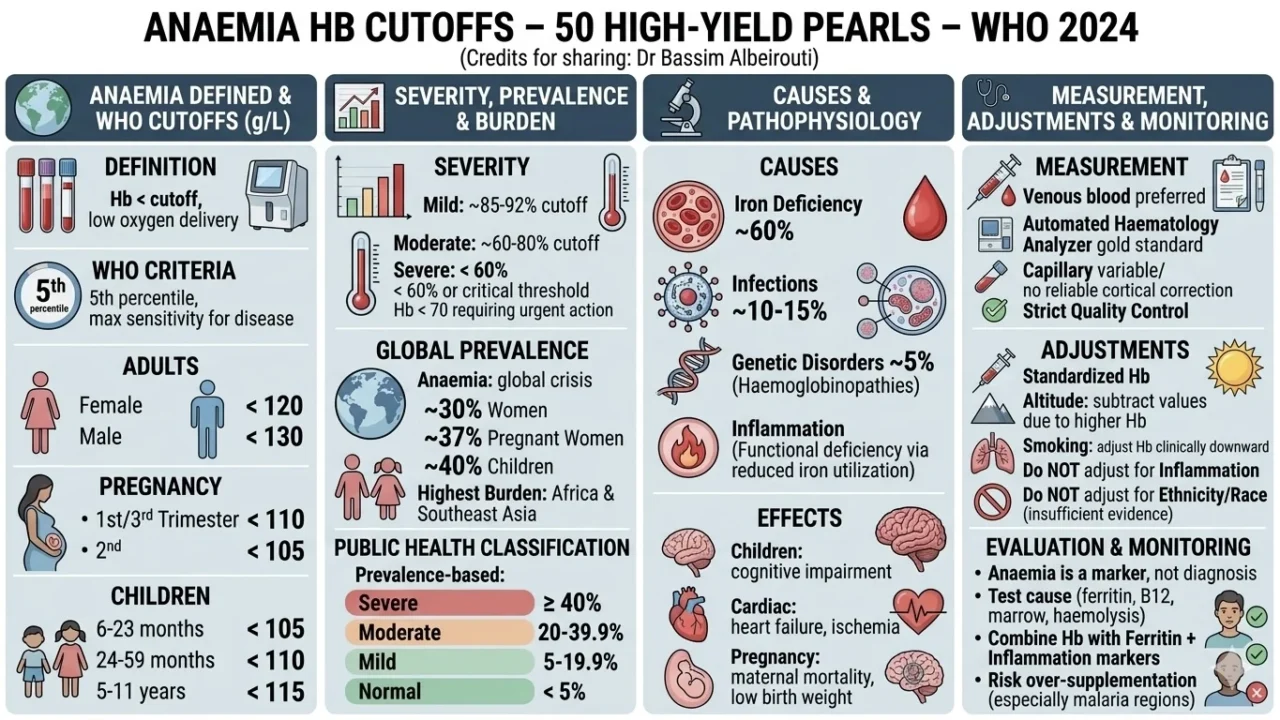
Anaemia is defined as haemoglobin below the cutoff, leading to decreased oxygen delivery.
- WHO uses the 5th percentile of a healthy population to define anaemia.
- The goal is to maximize sensitivity for detecting underlying disease.
- Adult female cutoff is haemoglobin less than 120 g/L.
- Adult male cutoff is haemoglobin less than 130 g/L.
- In pregnancy, anaemia is haemoglobin less than 110 g/L in the 1st and 3rd trimesters.
- In the 2nd trimester, the cutoff is lower at 105 g/L.
- Children aged 6 to 23 months: haemoglobin less than 105 g/L.
- Children aged 24 to 59 months: haemoglobin less than 110 g/L.
- Children aged 5 to 11 years: haemoglobin less than 115 g/L.
Severity is based on percentage of the cutoff value.
- Mild anaemia is approximately 85 to 92 percent of the cutoff.
- Moderate anaemia is approximately 60 to 80 percent.
- Severe anaemia is less than 60 percent or haemoglobin less than 70 g/L as a critical threshold.
- Severe anaemia universally defined as haemoglobin less than 70 g/L requires urgent action.
- Anaemia is a global public health crisis.
- Around 30 percent of women worldwide are affected.
- Around 37 percent of pregnant women are affected.
- Around 40 percent of children are affected.
- Highest burden is in Africa and Southeast Asia.
- Causes include iron deficiency (about 60 percent), infections, and genetic disorders.
- Infections contribute about 10 to 15 percent.
- Haemoglobinopathies are present in about 5 percent of the global population.
- Inflammation leads to reduced iron utilization, causing functional deficiency.
- Anaemia in children is associated with cognitive impairment.
- Cardiac risk increases with anaemia, including heart failure and ischemia.
- In pregnancy, anaemia is associated with maternal mortality and low birth weight.
- Anaemia is a marker, not a diagnosis.
- Always evaluate the cause, including iron deficiency, vitamin B12 deficiency, bone marrow disorders, and haemolysis.
- Haemoglobin alone is not sufficient; ferritin, soluble transferrin receptor, and CRP should be added.
- Preferred sample is venous blood.
- Gold standard measurement is an automated haematology analyzer.
- Capillary haemoglobin is variable and has no reliable correction.
- Strict quality control is needed, including pre-analytical and analytical phases.
- Haemoglobin measurement must be standardized.
- Haemoglobin should be adjusted for altitude.
- Higher altitude leads to higher haemoglobin, so adjustment involves subtracting values.
- Smoking increases haemoglobin and should be clinically adjusted downward.
- Do not adjust haemoglobin for inflammation.
- Do not adjust for ethnicity or race due to insufficient evidence.
- Haemoglobin is useful for monitoring response to iron therapy.
- However, it may miss early iron deficiency.
- Combine haemoglobin with ferritin and inflammation markers.
- There is a risk of over-supplementation, especially in malaria-endemic regions.
- Always consider context-specific causes.
- Public health classification is based on prevalence.
- Severe public health problem is prevalence greater than or equal to 40 percent.
- Moderate is 20 to 39.9 percent.
- Mild is 5 to 19.9 percent.
- Normal is less than 5 percent.”
More posts featuring Chokri Ben Lamine on Hemostasis Today.
Africa
Blood
Chokri Ben Lamine
CRP
Dr Bassim Albeirouti
Ferritin
Health
Hematology
Hemoglobin
hemoglobinopathy
hemolysis
Hemophilia
Hemostasis
Hemostasis News
Hemostasis Today
Iron-Deficiency
Medicine
Mild Anemia
Moderate Anemia
Severe anemia
Southeast Asia
Transferrin
Vitamin B12 Deficiency
WHO 2024
-
Oct 16, 2026, 12:17Exploring Endothelial Cells, Genetic Fate Mapping, and Revascularization – ISTH
-
Oct 16, 2026, 10:07Habib Bennaceur: Building a Stronger Care Pathway for Sickle Cell Disease in India
-
Oct 16, 2026, 09:59Tareq Abadl: A Simple Guide to Blood Collection Tubes
-
Oct 16, 2026, 09:50Mona Alfaraj: Distinguishing HCL from SMZL in Bone Marrow
-
Oct 16, 2026, 09:44New International Consensus on Covert Brain Infarction – International Journal of Stroke
-
Oct 16, 2026, 06:17Neha Rastogi Panda: Precision Diagnosis and Organ Preservation in Splenic Abscess
-
Oct 16, 2026, 05:53Alejandro González Veliz: Looking Beyond Coronary Anatomy to Understand Ischemia
-
Oct 16, 2026, 04:16Asmaa M. Gouda: Advancing Blood Bank Leadership at Alexandria University Hospitals
-
Oct 16, 2026, 03:52Saja Al-Zamili: Minimally Invasive Hematoma Evacuation in Intracerebral Hemorrhage