


Chukwuemeka Amarachi: Understanding Complex Blood Grouping Beyond Routine ABO And RhD Typing
Chukwuemeka Amarachi, Medical Laboratory Scientist (BMLS), shared a post on LinkedIn:
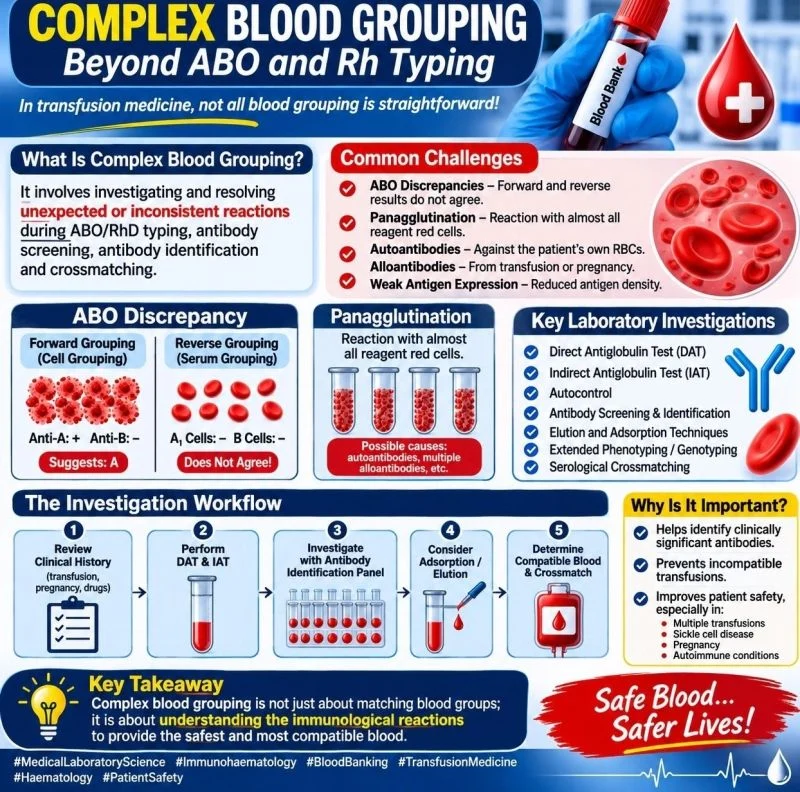
”Complex Blood Grouping: Beyond ABO And Rh Typing
In transfusion medicine, blood grouping is not always as straightforward as identifying whether an individual belongs to blood group A, B, AB or O.
Sometimes, unexpected serological reactions make routine blood grouping and compatibility testing challenging. This is where Complex Blood Grouping becomes important.
What Is Complex Blood Grouping?
Complex blood grouping involves investigating and resolving unusual or inconsistent reactions encountered during ABO/RhD typing, antibody screening, antibody identification and crossmatching.
Common Challenges in Complex Blood Grouping
- ABO Discrepancies: When forward and reverse grouping results do not agree.
- Panagglutination: When a patient’s serum or plasma reacts with almost all reagent red blood cells in an antibody identification panel.
- Autoantibodies: Antibodies directed against the individual’s own red blood cell antigens.
- Alloantibodies: Antibodies produced against foreign red blood cell antigens following transfusion or pregnancy.
- Weak Antigen Expression: Reduced expression of certain red cell antigens can make routine blood grouping difficult.
Important Laboratory Investigations
- Direct Antiglobulin Test (DAT).
- Indirect Antiglobulin Test (IAT).
- Autocontrol.
- Antibody screening and identification.
- Elution and adsorption techniques.
- Extended red cell phenotyping and genotyping.
- Serological crossmatching.
Why Is Complex Blood Grouping Important?
It helps medical laboratory scientists identify clinically significant antibodies, investigate unexpected reactions, prevent incompatible transfusions and improve patient safety.
Blood transfusion is not just about matching blood groups; it is about understanding the immunological reactions behind compatibility.”
Stay updated with Hemostasis Today.
-
Nov 19, 2026, 14:19Long-Read Sequencing Is Closing Diagnostic Gaps in Inherited Bleeding Disorders
-
Nov 19, 2026, 13:36Raja Prince: Protein S Silencing and the Future of Hemostatic Therapy
-
Nov 19, 2026, 13:26M. Sekip Altunkan: The Thrombotic Risk of Andexanet Alfa
-
Nov 19, 2026, 13:18Felice Gragnano: Personalizing Antiplatelet Therapy After PCI
-
Nov 19, 2026, 13:11When Postpartum Warning Signs Are Ignored – National Blood Clot Alliance
-
Nov 19, 2026, 12:56Batool Abuhalimeh: The Hidden Psychological Burden of Pulmonary Embolism
-
Nov 19, 2026, 12:45Pedro Perez: PE Recovery – From Acute Treatment to Long-Term Follow-Up
-
Nov 19, 2026, 12:34Edward Lee Carter: Are We Ready for FXIa Inhibitors?
-
Nov 19, 2026, 12:19Essama Telli: When a Bruise Doesn’t Heal – Recognising the Warning Signs