


Edward Lee Carter: Not Every Stroke on a DOAC Is a DOAC Failure
Edward Lee Carter, Clinical Pharmacist Practitioner at U.S. Department of Veterans Affairs, shared a post on LinkedIn:
”Not every ischemic stroke that occurs while a patient is taking a DOAC is a ‘DOAC failure.’
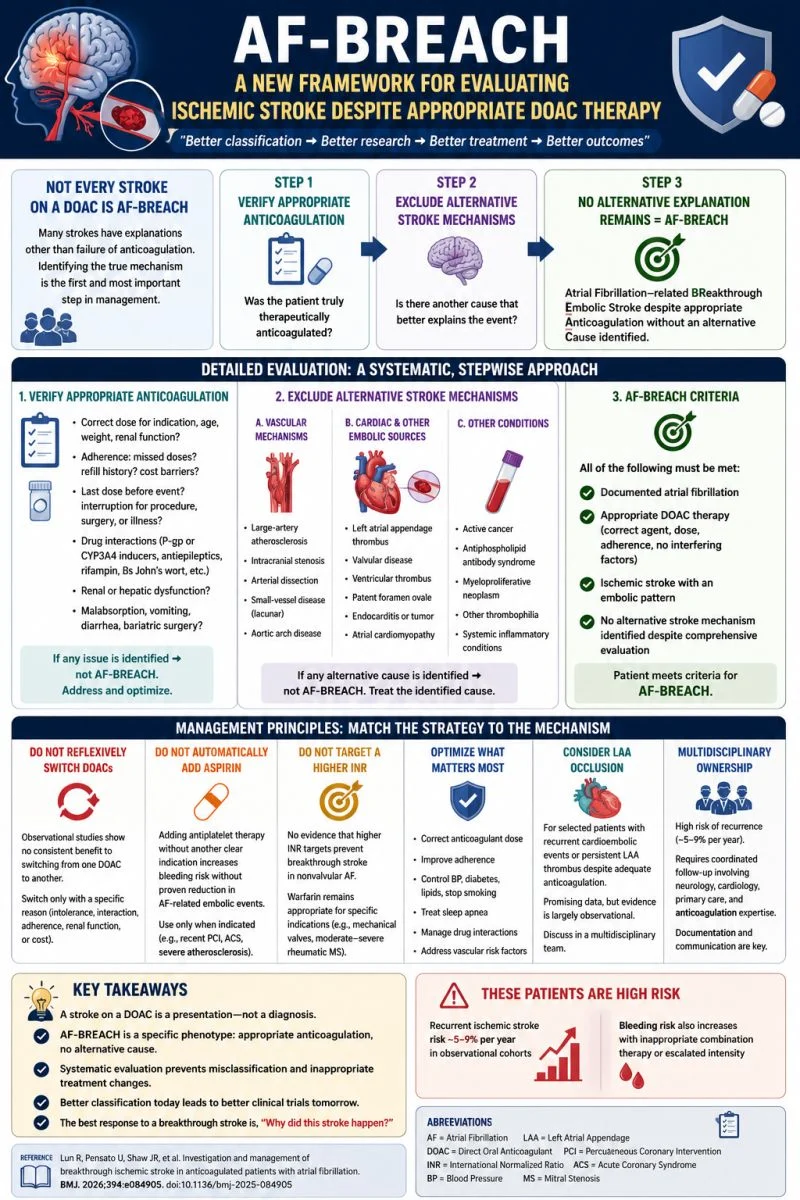
That may be the most important message from a thoughtful new BMJ State-of-the-Art Review on breakthrough ischemic stroke in patients with atrial fibrillation.
The authors introduce a new framework they call AF-BREACH:
Atrial Fibrillation-related BReakthrough Embolic Stroke despite appropriate Anticoagulation without an alternative Cause identified.
At first glance, it looks like just another acronym.
I think it’s much more important than that.
Too often, we group every ischemic stroke occurring during anticoagulation into a single category.
But these patients are remarkably heterogeneous.
Some have:
- Missed doses or recent interruption of therapy
- Inappropriate DOAC dosing
- Drug interactions affecting anticoagulant exposure
- Declining renal function
- Large-artery atherosclerosis
- Small-vessel disease
- Another cardioembolic source
- Cancer-associated thrombosis or another hypercoagulable condition
Those aren’t necessarily DOAC failures.
They’re different diseases requiring different solutions.
The AF-BREACH framework reminds us that before escalating therapy, we should first determine whether the patient truly experienced an AF-related embolic stroke despite appropriate anticoagulation and after excluding alternative mechanisms.
That changes the clinical question.
Instead of asking:
‘Which anticoagulant should we use next?’
We should first ask:
‘Why did this stroke happen?’
That distinction matters because current evidence has not consistently shown that simply switching from one DOAC to another improves outcomes, and adding antiplatelet therapy without another indication may increase bleeding without addressing the underlying mechanism.
As pharmacists, physicians, APPs, and nurses, our responsibility extends beyond prescribing anticoagulation.
It includes investigating treatment failures carefully, identifying the underlying mechanism, and matching therapy to the cause—not simply reacting to the event.
Better classification leads to better research.
Better research leads to better treatment.
And ultimately…
Better outcomes for our patients.”
Other posts featuring Edward Lee Carter on Hemostasis Today.
-
Sep 20, 2026, 09:05World Stroke Academy: Can Adjunct IAT Improve Tissue Reperfusion?
-
Sep 20, 2026, 06:46Neeraj Songara: From Donated Blood to Engineered Therapeutics
-
Sep 20, 2026, 06:24Louise St. Germain Bannon: Improving Awareness and Care for Women Across the Lifespan
-
Sep 20, 2026, 05:17Maxime Dely: When ABO Compatibility Isn’t Enough for Safe Transfusion
-
Sep 20, 2026, 04:54William Aird: What Does a Complete History and Physical Really Mean?
-
Sep 20, 2026, 04:34Hons Saurabh Kaushik: Why Uncontrolled LDL Can Be Harmful
-
Sep 20, 2026, 03:58Salih Ehsan: The Complexities of HbF and HbA2
-
Sep 20, 2026, 03:22The Voices of People Living With Bleeding Disorders – EHC
-
Sep 20, 2026, 01:18Sebastian Mafeld: Has 2026 Changed How We Treat Pulmonary Embolism?