


Edward Lee Carter: When Should Apixaban Become the Default for Acute VTE?
Edward Lee Carter, Clinical Pharmacist Practitioner at U.S. Department of Veterans Affairs, shared a post on LinkedIn:
“COBRRA settled one question.
It opened a harder one:
When should a safer choice become the default – and when should patient circumstances override it?
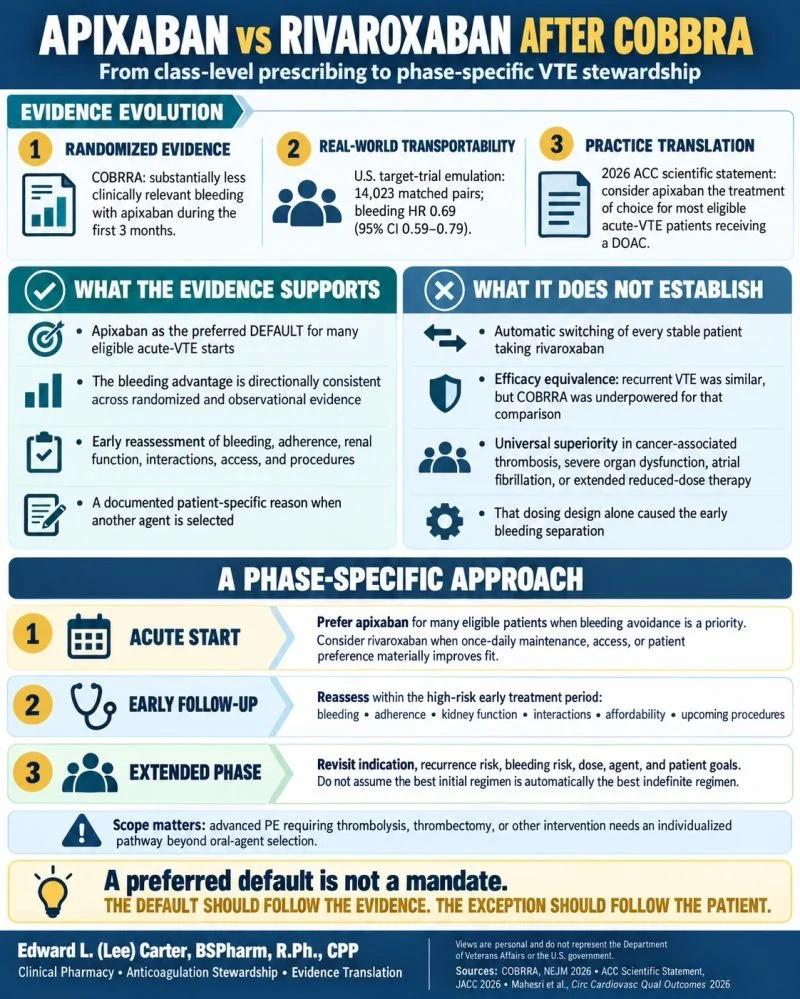
COBRRA found substantially less clinically relevant bleeding with apixaban than rivaroxaban during the first three months of acute VTE treatment. The evidence has continued to evolve.
- A U.S. target-trial emulation of more than 14,000 matched pairs found a directionally consistent, although smaller, bleeding advantage with apixaban.
- A subsequent American College of Cardiology scientific statement identified apixaban as the preferred choice for many eligible patients beginning DOAC treatment for acute VTE.
- Post-publication correspondence highlighted lower complete adherence with twice-daily apixaban. That does not negate the safety finding, but regimen simplicity can influence real-world effectiveness.
Together, these reports address three questions:
1. Is the effect likely causal?
COBRRA’s randomized design strengthens that conclusion for bleeding.
2.Does it extend beyond the trial?
The real-world analysis supports the direction of effect, although not necessarily its full magnitude.
3.How should practice change?
That requires more judgment than naming a winning drug.
For many eligible patients beginning treatment for acute proximal DVT or segmental-or-more-proximal PE, apixaban can now be defended as the preferred default when bleeding avoidance is a priority.
But a preferred default is not a mandate – or a reason to convert every stable patient taking rivaroxaban.
Rivaroxaban may remain reasonable when once-daily maintenance improves adherence, access favors it, or the patient is stable and tolerating therapy.
Important boundaries remain. COBRRA did not establish efficacy equivalence: recurrent VTE was similar, but the trial was underpowered for that comparison. Its findings should not be automatically extrapolated to cancer-associated thrombosis, severe organ dysfunction, atrial fibrillation, extended reduced-dose therapy, or acute PE requiring advanced intervention.
The stewardship opportunity is to build phase-specific pathways:
- Prefer apixaban for many eligible acute-VTE starts
- Document why another agent better fits the patient
- Reassess bleeding, adherence, renal function, interactions and access early
- Avoid disrupting successful long-term therapy without a patient-specific reason
- Revisit agent and dose in the extended phase
Much of the bleeding separation emerged early, while the drugs use different intensified regimens. That timing matters, although it does not prove that dosing design alone caused the difference.
Antithrombotic stewardship should move beyond ‘use a DOAC’ toward a defensible choice of agent, dose, phase and follow-up.
The default should follow the evidence. The exception should follow the patient.
Views are my own and do not represent the Department of Veterans Affairs or the U.S. government.”
Find more posts featuring Edward Lee Carter on Hemostasis Today.
-
Oct 7, 2026, 07:40Annette Bowyer: Exploring New Developments in Thrombin Generation
-
Oct 7, 2026, 07:06Omid Seidizadeh: When Acquired von Willebrand Syndrome Takes Different Paths
-
Oct 7, 2026, 06:49Neeraj Songara: Can a Negative Antibody Screen Be Misleading?
-
Oct 7, 2026, 04:09James P. Crowley: Could the Microbiome Protect Us From Severe EBV Infection?
-
Oct 7, 2026, 03:58Sohanur Rohanman Sohan: Explainable AI for Anemia Prediction Using Machine Learning
-
Oct 7, 2026, 03:00Sandeep Kumar: A Second Chance for a Child with Fanconi Anemia
-
Oct 7, 2026, 02:41Kemal Karaagac: Optimising DOAC Resumption After Major Bleeding in Atrial Fibrillation
-
Oct 7, 2026, 02:21Joseph Aslan: mPTP Inhibition Targets Platelet Procoagulant Activity and Thrombosis
-
Oct 7, 2026, 02:07Manuel Monreal: ECG Improves Risk Stratification in Acute Pulmonary Embolism