


Edward Lee Carter: When Normal Ferritin Does Not Rule Out Iron Deficiency
Edward Lee Carter, Clinical Pharmacist Practitioner at U.S. Department of Veterans Affairs, shared a post on LinkedIn:
”A ferritin result can be ‘normal; on the laboratory report—and still represent iron deficiency.
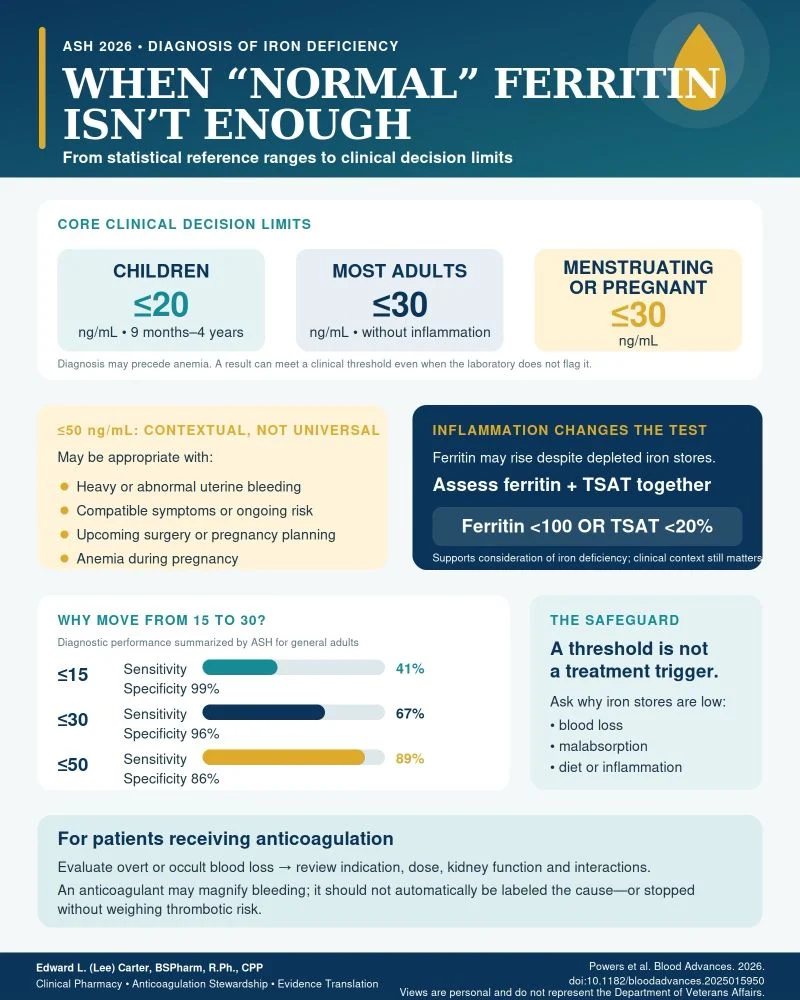
The first ASH guideline devoted to diagnosing iron deficiency asks clinicians and laboratories to move beyond population-derived reference ranges toward clinical decision limits.
The new framework:
- Children aged 9 months to 4 years: ferritin less than or equal to 20 nanograms per milliliter
- Most adults: ferritin less than or equal to 30 nanograms per milliliter
- Menstruating or pregnant individuals: ferritin less than or equal to 30 nanograms per milliliter
A threshold of less than or equal 50 ng/mL may be appropriate in selected higher-risk settings—including heavy or abnormal uterine bleeding, symptoms or ongoing risks, upcoming surgery, pregnancy planning, or anemia during pregnancy.
That is not a universal new cutoff.
Inflammation requires a different approach. Ferritin is an acute-phase reactant and may appear normal or elevated despite depleted stores. In adults with anemia of inflammation—or suspected deficiency in an inflammatory setting—ASH suggests assessing ferritin and transferrin saturation together.
Iron deficiency may be considered when ferritin is less than 100 ng/mL OR TSAT is less than 20 percent.
These values support consideration; they do not confirm the diagnosis in every patient with inflammation.
Why move the general adult cutoff from 15 to 30?
Sensitivity increased from 41 percent to 67 percent, while specificity remained high—99 percent versus 96 percent. A cutoff of 50 improved sensitivity to 89 percent but reduced specificity to 86 percent, increasing the potential for overdiagnosis.
The safeguard: these are diagnostic thresholds, not automatic treatment triggers.
In an adult without known inflammation, a ferritin of 28 should no longer be dismissed because the laboratory did not flag it.
Neither should it generate a reflex prescription without asking why iron stores are low.
- Assess symptoms and anemia status
- Identify menstrual, gastrointestinal or other blood loss
- Consider malabsorption, dietary restriction and inflammation
- Reassess response and address the cause
For patients receiving anticoagulation, newly recognized iron deficiency should prompt evaluation for overt or occult blood loss, followed by review of indication, dose, kidney function and interacting medications.
An anticoagulant may magnify bleeding, but it should not automatically be treated as the underlying diagnosis—or discontinued without weighing thrombotic risk.
Most recommendations are conditional and supported by low-certainty evidence; the inflammation recommendation rests on very-low-certainty evidence.
The guideline addresses diagnosis, not screening, and treatment guidance is still being developed.
Until laboratory flags and decision support are updated, clinicians may need to recognize iron deficiency that the report itself does not identify.
A higher ferritin threshold should lower the threshold for clinical evaluation—not eliminate the need for clinical judgment.
The views expressed are my own and do not represent the Department of Veterans Affairs.”
Find more posts featuring Edward Lee Carter on Hemostasis Today.
-
Oct 10, 2026, 13:15Meet NNHF at ASCAT 2026 – Novo Nordisk Haemophilia and Haemoglobinopathies Foundation
-
Oct 10, 2026, 11:32Thrombus Age Assessment Through Advanced Imaging and Biomarkers
-
Oct 10, 2026, 10:55Tzu-Fei Wang: How Should We Approach Anticoagulation for Cancer-Associated Gonadal and Renal Vein Thrombosis?
-
Oct 10, 2026, 10:50Robert Sidonio Joins ATHN Advanced Clinical Research Fellowship Program
-
Oct 10, 2026, 10:45Federica Fogacci: Co-Moderating at CA Meet 2026 in Padua – Elevating Lifestyle Interventions in Cardiology
-
Oct 10, 2026, 10:40Juan Cristóbal Morales Muñoz: Pharmacokinetic Profiling of Factor VIII Concentrates in Chilean Patients
-
Oct 10, 2026, 10:32Randall Schaefer: What Do Blood Product Wastage Rates Really Tell Us in Prehospital Care?
-
Oct 10, 2026, 10:26Simone Strasser: ROTEM-Guided Transfusion Cuts Blood Product Use in Patients with Cirrhosis
-
Oct 10, 2026, 10:18Jérôme S.: WHO Launches Global Roadmap to Combat Hypertensive Disorders of Pregnancy