

Is the Diagnosis Gap for Women with Bleeding Disorders Accidental? – EHC
EHC – European Haemophilia Consortium shared a post on LinkedIn:
“Is the diagnosis gap for women with bleeding disorders accidental? The answer is… No!
For decades, haemophilia was understood as a condition affecting men only.
Women were positioned as ‘mere carriers’: relevant to family history, but not patients in their own right.
That framing shaped medical education, clinical pathways, and even the design of treatment centres.
Its effects are still felt today.
When a woman presents with heavy menstrual bleeding, the underlying cause is not always investigated.
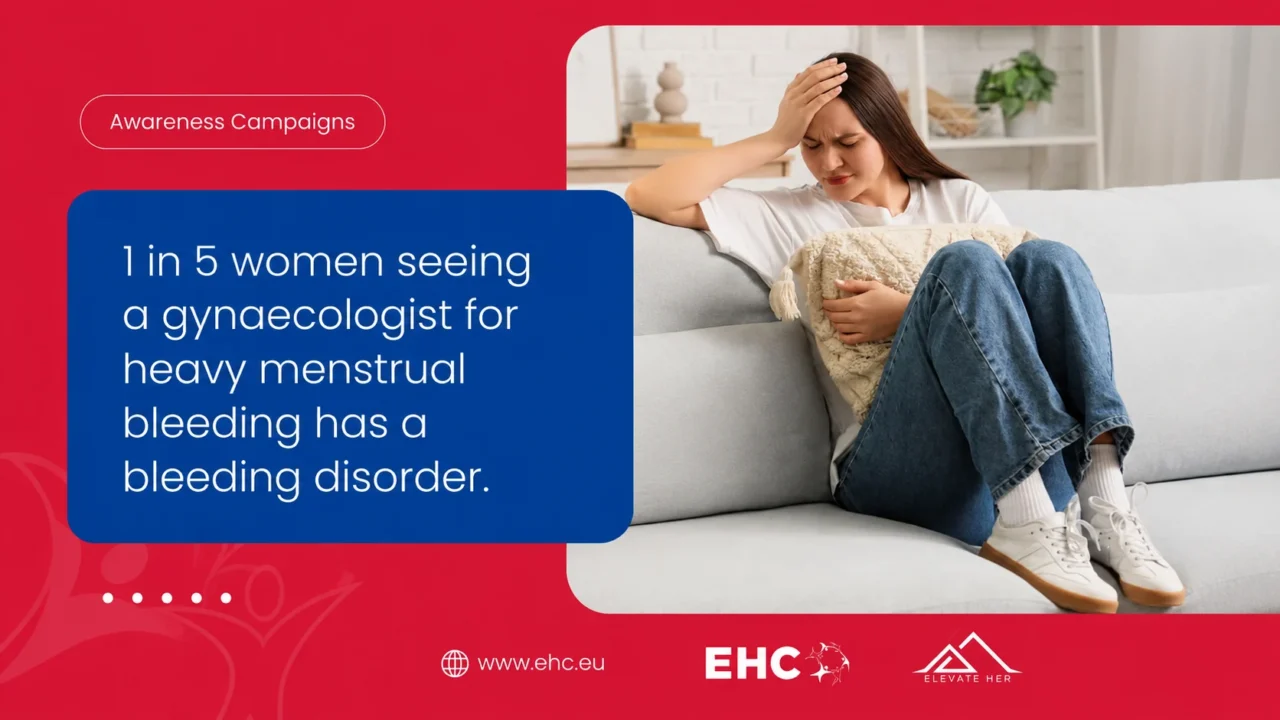
Approximately 1 in 5 women who see a gynaecologist for heavy menstrual bleeding have a bleeding disorder.
Yet they remain underdiagnosed.
Several barriers compound one another:
- Bleeding symptoms in women are frequently normalised by healthcare providers, by families, and by the women themselves.
- There is no systematic approach to family history inquiry in many clinical settings.
- Access to accurate laboratory testing is not guaranteed, even when symptoms are recognised as abnormal.
- Awareness of female-specific bleeding presentations remains uneven across specialities, from general practitioners to gynaecologists to emergency departments.
The result is a system that was not built with women in mind, and that continues to fail them.
Change is happening, but slowly.
In 2021, the International Society on Thrombosis and Haemostasis (ISTH) took an important step forward by approving a new nomenclature that defines five clinical categories for women who carry haemophilia – moving beyond the single label of ‘carrier’ to one that accounts for a woman’s personal bleeding history and her actual factor levels.
It was a long-overdue recognition that these women are patients, not just carriers.
Recognition and registration matter.
Data from haemophilia carrier registries show that when women are identified and followed, 94% of pregnancies can be managed with maternal carrier status confirmed before conception.
That outcome is possible. It is just not the norm yet.
In June, Maia Meier climbs Mont Blanc as the first expedition of a journey across all seven summits to raise global awareness of the critical importance of timely diagnosis and care for women with bleeding disorders.
As a proud partner, the EHC is sharing stories, expert voices, and perspectives from across Europe.
Follow along as this global initiative unfolds!
Stay updated with Hemostasis Today.
-
Oct 6, 2026, 07:03Laila Ahmed: Stroke Imaging – A Practical Radiology Approach
-
Oct 6, 2026, 05:52David Esposito: Can Standard Ultrasound Detect May Thurner Syndrome?
-
Oct 6, 2026, 04:33Hessam Kakavand: Rethinking Thrombotic Risk in Modern Cancer Therapy
-
Oct 6, 2026, 04:07Moussa Zein Aldine: Acute Coronary Syndrome Every Minute Matters
-
Oct 6, 2026, 03:13Patrick Taylor: Glow Stack Trend What the Evidence Really Shows
-
Oct 6, 2026, 02:59Preventing Hospital Associated Venous Thromboembolism – Thrombosis Canada
-
Oct 6, 2026, 02:42Treatment of Iron Deficiency With and Without Anemia – American Society of Hematology
-
Oct 6, 2026, 02:36Mouna Sassi: When Clinical and Laboratory Perspectives Meet in Thrombosis Care
-
Oct 6, 2026, 02:35Lucia Stefanini: Platelet Dysfunction and Oxidized Phospholipids in MASLD