


Eunice Obinna: Hemoglobin and Hematocrit – What Do They Really Tell Us?
Eunice Obinna, Chief Medical Laboratory Scientist at Michael Okpara University of Agriculture Umudike, shared a post on LinkedIn:
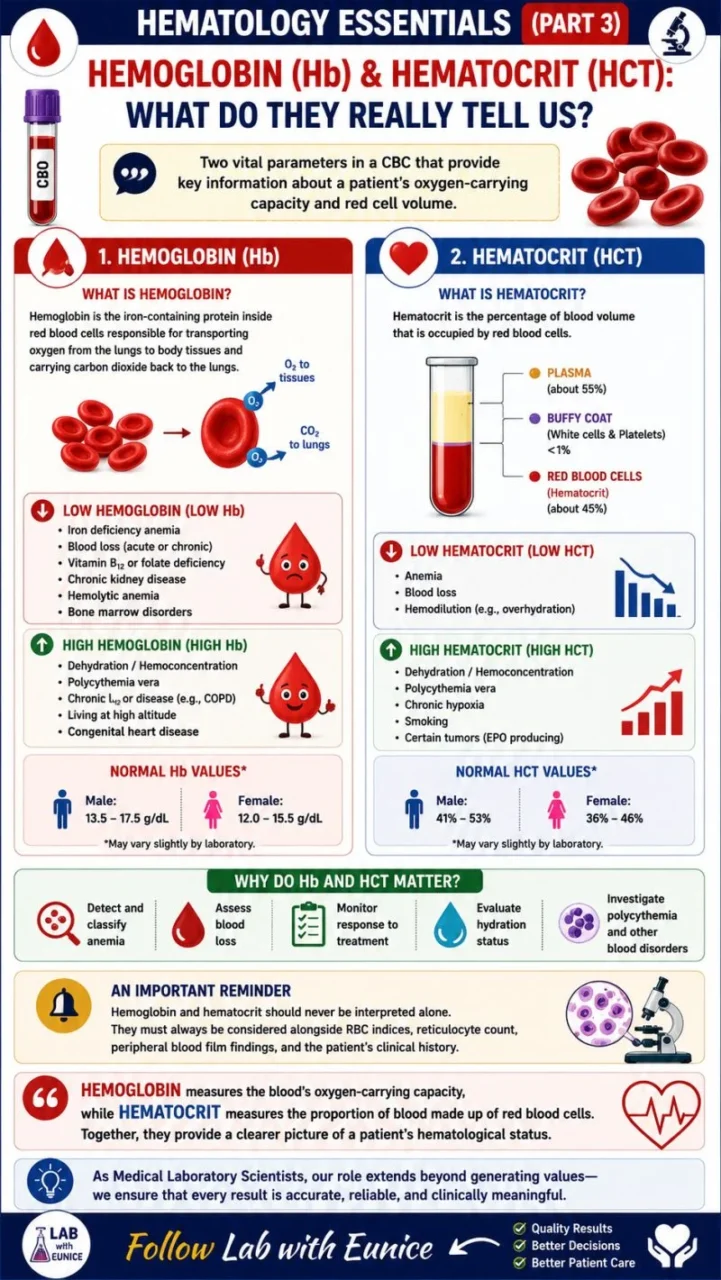
“Hematology Essentials (Part 3): Hemoglobin and Hematocrit – What Do They Really Tell Us?
Two of the most important parameters in a Complete Blood Count (CBC) are Hemoglobin (Hb) and Hematocrit (HCT). Although they are closely related, they measure different aspects of blood and provide valuable diagnostic information.
What is Hemoglobin (Hb)?
Hemoglobin is the iron-containing protein inside red blood cells responsible for transporting oxygen from the lungs to body tissues and carrying carbon dioxide back to the lungs.
Low hemoglobin may indicate:
- Iron deficiency anemia
- Blood loss
- Vitamin B₁₂ or folate deficiency
- Chronic kidney disease
- Hemolytic anemia
High hemoglobin may be seen in:
- Dehydration
- Polycythemia vera
- Chronic lung disease
- Living at high altitude
What is Hematocrit (HCT)?
Hematocrit represents the percentage of blood volume occupied by red blood cells.
A low hematocrit often accompanies anemia, while a high hematocrit may occur in dehydration or conditions associated with increased red blood cell production.
Why Do Hb and HCT Matter?
Together, they help clinicians:
- Detect and classify anemia.
- Assess blood loss.
- Monitor response to treatment.
- Evaluate hydration status.
- Investigate polycythemia and other blood disorders.
An Important Reminder
Hemoglobin and hematocrit should never be interpreted alone. They should always be considered alongside RBC indices, reticulocyte count, peripheral blood film findings, and the patient’s clinical history.
As Medical Laboratory Scientists, our role extends beyond generating values—we ensure that every result is accurate, reliable, and clinically meaningful.
Remember: Hemoglobin measures the blood’s oxygen-carrying capacity, while hematocrit measures the proportion of blood made up of red blood cells. Together, they provide a clearer picture of a patient’s hematological status.
Question: In your practice, which do you find more informative initially—Hemoglobin or Hematocrit? Why?”
Stay updated with Hemostasis Today.
-
Sep 18, 2026, 01:03Joseph R. Shaw: Study Questions Blanket “No-Bridging” Strategy for Mechanical Heart Valves
-
Sep 17, 2026, 20:38Konstantinos Bistas: Reduced Circulating Tregs in Pediatric Chronic Neutropenia
-
Sep 17, 2026, 15:33Gopal Patidar: Honoured to Contribute to the ASFA 2026 Guidelines for Therapeutic Apheresis
-
Sep 17, 2026, 20:36Cosima C. Hoch: Developing a 3D Organotypic Co-Culture Model for Pleomorphic Adenoma
-
Sep 17, 2026, 20:19Riten Kumar: Boston Children’s Hospital Ranked No. 1 in Seven Pediatric Specialties
-
Sep 17, 2026, 20:17Katrina Snow: Whole Blood or Component Therapy – Which Would You Choose?
-
Sep 17, 2026, 16:30Daria Camilli: Empowering Bleeding Disorder Advocacy Through Health Economics
-
Sep 17, 2026, 16:17Mehran Ghasemzadeh: Platelet NK Cell Crosstalk in Advanced Coronary Artery Disease
-
Sep 17, 2026, 16:16Barbara Adams Krolak: Do GLP-1s Affect Blood Clot Risk?