

Gashaw Arega: A Challenging Case of Acute Immune Thrombocytopenia in an Adolescent
Gashaw Arega, Pediatric Hematologist and Oncologist at Addis Ababa University, shared a post on LinkedIn:
“Some days remind us how challenging – and humbling – medicine can be.
A 15-year-old adolescent presented with a generalized rash a few days after vaccination.
Soon after, she developed hematuria and heavy menstrual bleeding.
Her white blood cell count and hemoglobin were normal, but her platelet count was critically low — first 10,000, then dropping to 2,000.
She was initially managed at a governmental hospital with Dexamethasone for two days.
Her platelet count improved to 29,000 and she was discharged.
But just a day later, her symptoms worsened and she came to the private facility where I work part-time.
On examination she was a well-grown adolescent with petechial rash and ecchymosis, but otherwise stable.
My attention went straight to the lab results: platelet count 10,000 and MPV 12.6.
The picture strongly suggested Acute Immune Thrombocytopenia (ITP). Secondary causes were evaluated and none were identified.
She was admitted and we started treatment again — this time pulse Methylprednisolone. But the platelet count continued to fall… 4,000 and then 1,000.
At that moment the difficult questions came.
Why was the medication not working?
Was this steroid-refractory disease?
Or could there be another problem we rarely talk about — medication quality?
In many settings, patients purchase medications from outside pharmacies, and we physicians often have no system to verify whether what they receive truly contains the active ingredient.
With platelets continuing to fall and bleeding worsening, we had no choice but to proceed to the next line of treatment: IVIG.
Two days of IVIG cost nearly 300,000 Ethiopian Birr, and unfortunately these life-saving medications are often unavailable in many public hospitals.
It is painful to see treatments that can save a life remain out of reach for many families.
She received IVIG for two days.
The bleeding stopped.
The rash resolved.
Her platelet count rose to 185,000.
She went home safely.
Cases like this remind us that medicine is not only about knowledge and guidelines.
It is about systems, access to medicines, trust in drug quality, and the difficult decisions physicians must make every day.
And sometimes, when the first line fails, the next step — though difficult — can save a life.”
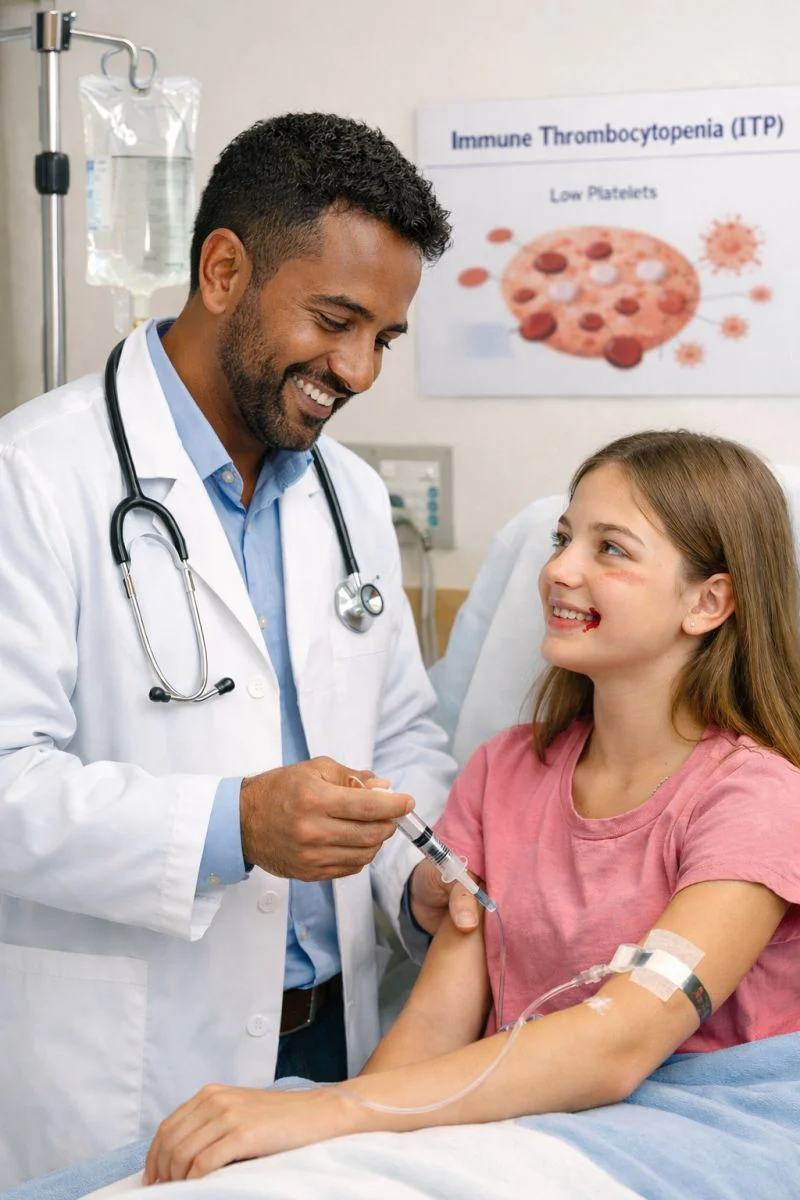
Other posts featuring Gashaw Arega on Hemostasis Today.
-
Sep 11, 2026, 03:10Chris Oung: Anticoagulation for Atrial Fibrillation with Intermediate Stroke Risk
-
Sep 10, 2026, 21:33J. Meireles-Brandao: Lp(a)HORIZON and the Role of Inflammation in ASCVD
-
Sep 10, 2026, 21:31Alejandro González Veliz: Pregnancy is a Cardiovascular Stress Test
-
Sep 10, 2026, 21:30Tareq Abadl: Did You Know That the Type of Hemoglobin in Our Blood Changes Throughout Life?
-
Sep 10, 2026, 21:30Sumyea Kabir: Apheresis Awareness Day – One Donor, One Procedure, One Therapeutic Difference
-
Sep 10, 2026, 21:30Suhasini Sil: Excited to Share Our New Publication on HLA Beyond Histocompatibility
-
Sep 10, 2026, 21:29Michael Meneghini: Your Calves Are Not Just for Walking
-
Sep 10, 2026, 21:27One month until International Plasma Awareness Week – PPTA Europe
-
Sep 10, 2026, 21:26John Strouse: Supporting Research to Improve Lives in Sickle Cell Disease