


Georgiana Toma: Addressing Iron Deficiency Without Anemia
Georgiana Toma, Hematology resident at the University Emergency Hospital of Bucharest, shared a post on LinkedIn:
“Iron Deficiency Without Anemia
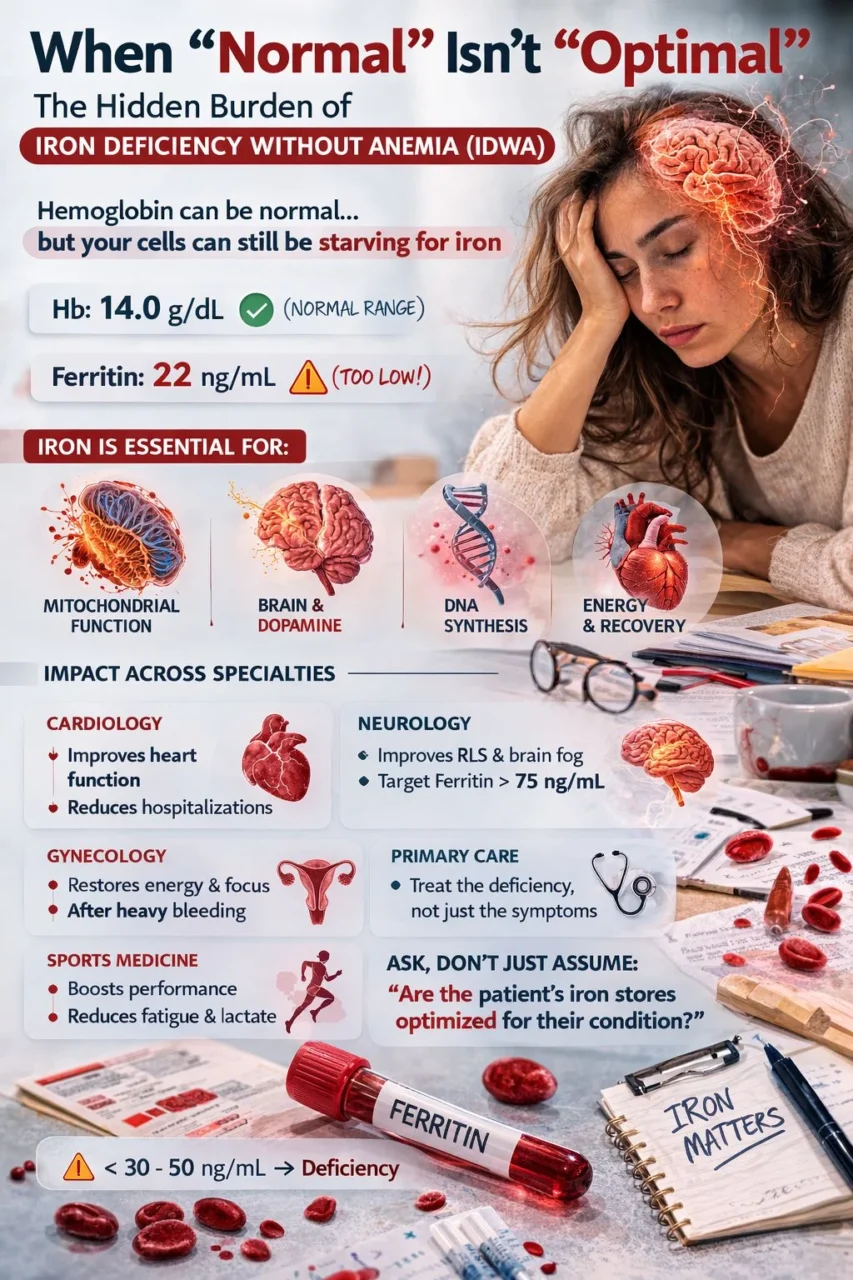
How many of our patients struggle with chronic fatigue, ‘brain fog’, or exercise intolerance, only to be told their labs are ‘perfectly normal’ because their Hemoglobin is within range?
As clinicians, we are trained to treat Anemia.
But modern Hematology is sounding the alarm on a much more subtle predator: Iron Deficiency Without Anemia (IDWA).
The ‘Normal Hemoglobin’ Trap
A patient can have a Hemoglobin of 14 g/dL and still be cellularly ‘starving’ for iron.
Iron isn’t just for making red blood cells; it’s a critical cofactor for mitochondrial function, DNA synthesis, and neurotransmitter metabolism.
When we only look at the CBC, we miss the Sideropenia that is sabotaging our patients’ recovery and quality of life.
A Multidisciplinary challenge:
The evidence for treating IDWA (typically defined as Ferritin <30–50 ng/mL) is now robust across specialties:
- cardiology: the FAIR-HF and CONFIRM-HF trials revolutionized the field. Correcting iron deficiency in heart failure patients—regardless of anemia status—improves ejection fraction and reduces hospitalizations.
- neurology: iron is the ‘engine’ for dopamine synthesis. In Restless Legs Syndrome (RLS), clinical guidelines now suggest targeting Ferritin levels above 75 ng/mL, far beyond standard ‘normal’ lab ranges.
- gynecology: we often focus on stopping the flow (menorrhagia) but neglect the cognitive and physical toll of depleted iron stores that persist long after the bleeding is managed.
- sportsmedicine : sideropenia impairs muscular oxidative capacity and increases lactate production, even when oxygen-carrying capacity (Hb) is intact.
Should we stop asking ‘Is the patient anemic?’ and start asking ‘Are the patient’s iron stores optimized for their specific pathology?’
Standard lab ranges for Ferritin (often starting at 15 ng/mL) frequently fail to account for the functional needs of a failing heart or a developing brain.”
Stay updated on all scientific advances with Hemostasis Today.
-
Sep 21, 2026, 15:56Anita Zaidi: Why Only 2% of Health Research and Development Goes to Women’s Conditions
-
Sep 21, 2026, 15:49Omid Khalafi: Gating Strategy and How Do We Decide Which Cells to Analyze
-
Sep 21, 2026, 15:44Levacetylleucine: A New Therapeutic Approach to Ataxia Telangiectasia
-
Sep 21, 2026, 15:40Andreas Tridimas: The Diagnostic Traps of Lipaemic Blood – Why a Normal Amylase Can Mislead You
-
Sep 21, 2026, 15:33Arsene Mekinian: Exploring Cardiac Involvement in Behçet’s Disease
-
Sep 21, 2026, 15:23Anis Mahjoubi: MRI Findings of Krukenberg Tumors
-
Sep 21, 2026, 15:08Fikreab Tesfaye Tefera: 10 Practical Take-Home Points for Diagnosing Iron Deficiency Anemia
-
Sep 21, 2026, 14:10Aswin K Mohan: Lessons from TRANSCON 2026 – Building Resilient Blood Supply Systems Before Crisis Hits
-
Sep 21, 2026, 14:00Vincent Lu: Beyond PT and aPTT – How Hemostasis Evolves Across a Lifetime