


Hunain Shahbaz: Extended Dual Antiplatelet Therapy Beyond 12 Months After Drug-Eluting Stent Implantation
Hunain Shahbaz, Bachelor of Medicine, Bachelor of Surgery – MBBS, Medical student, shared a post on LinkedIn:
“Accepted for publication in the journal of thrombosis and thrombolysis!
Can continuing dual antiplatelet therapy beyond 12 months reduce myocardial infarction without establishing a clear overall cardiovascular benefit?
Proud to share that our systematic review and meta analysis, ‘Continued Dual Antiplatelet Therapy Versus Aspirin Monotherapy Beyond 12 Months After Drug Eluting Stent Implantation: A Systematic Review and Meta analysis with Trial Sequential Analysis,’ has been accepted for publication in the Journal of Thrombosis and Thrombolysis.
What did we find?
We synthesized evidence from 6 randomized controlled trials involving 28,601 patients, comparing extended dual antiplatelet therapy (DAPT) with aspirin monotherapy after drug-eluting stent implantation.
Key Findings
- Non fatal myocardial infarction: 40 percent relative reduction with extended DAPT (RR 0.60, 95 percent CI 0.51 to 0.71). This was the only outcome to cross the prespecified trial sequential analysis monitoring boundary.
- MACCE: No statistically significant reduction (RR 0.89, 95 percent CI 0.72 to 1.10).
- All cause mortality: No statistically significant difference (RR 0.96, 95 percent CI 0.82 to 1.13); the evidence remains inconclusive.
- Clinically relevant bleeding: No statistically significant difference (RR 1.19, 95 percent CI 0.66 to 2.14). This does not establish that extended therapy is free of important bleeding risk.
Why does this matter?
The clearest finding was a reduction in non fatal myocardial infarction. However, the analysis did not establish an overall benefit for MACCE or mortality, and bleeding safety remains uncertain.
Exploratory post hoc analyses suggested possible differences in selected outcomes by baseline ischemic risk and predominant ethnicity; these findings are hypothesis generating and need confirmation.
The takeaway: a benefit in one outcome does not automatically establish an overall net benefit for every patient. Decisions about extending DAPT should be individualized, balancing ischemic risk and bleeding risk.
Deeply grateful to Zaryab Bacha and all my co authors and collaborators for their commitment, teamwork, and contributions to this project.
Another milestone in cardiovascular research and another reminder of the importance of rigorous evidence and careful clinical interpretation.”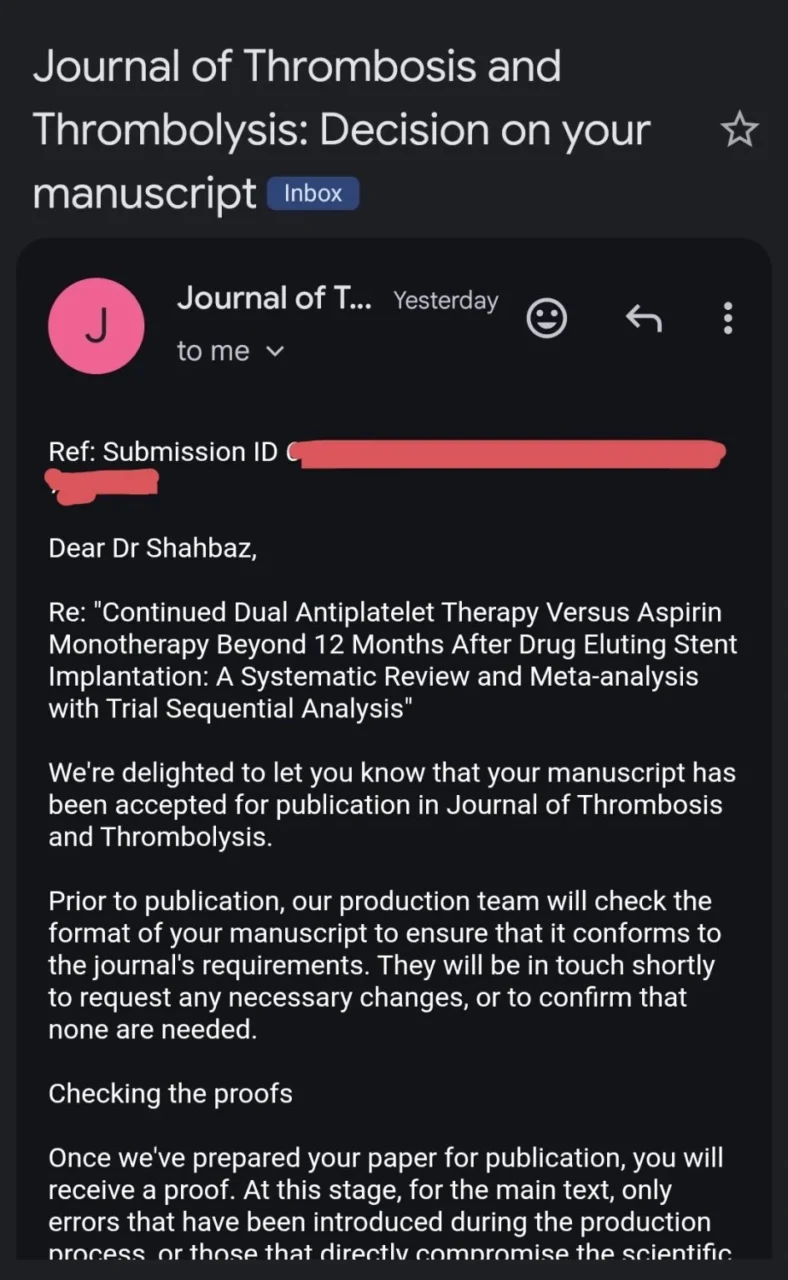
Stay updated with Hemostasis Today.
-
Oct 21, 2026, 06:19Dawood Findakly: When Should Anticoagulation Be Held or Resumed?
-
Oct 21, 2026, 03:36Steve Watson: Ligand Epitope Ratios Influence Antagonist Inhibition
-
Oct 21, 2026, 03:18Stephen D. Coombs: Superficial Venous Thrombosis in Athletes and Importance of Early Recognition and Referral
-
Oct 21, 2026, 02:52Aymar Akilimali: Bleeding During Anticoagulation as a Potential Signal of Occult Cancer
-
Oct 21, 2026, 00:58Anees Ur Rahman: Completing a Two-Week Clinical Rotation at Haemophilia Treatment Centre Rawalpindi
-
Oct 21, 2026, 00:56Caitlyn Mooney: Pulmonary Embolism in Athletes, Recognition and Return to Sport
-
Oct 21, 2026, 00:54Hani Karrar: Pleased to Share Our Review on Emicizumab in Hemophilia A Management
-
Oct 21, 2026, 00:53Akshay Sharma: HSCT Leads to Sustained Improvements in Sickle Cell Cardiomyopathy for Up to 3 Years
-
Oct 21, 2026, 00:51Prateek Meena: The F. A. T. R. N. Mnemonic for Recognizing TTP