


Ifeanyichukwu Ifechidere: Coagulation Fundamentals for Result Interpretation in Clinical Practice
Ifeanyichukwu Ifechidere, Specialist Biomedical Scientist at Sheffield Teaching Hospitals NHS Foundation Trust, shared a post on LinkedIn:
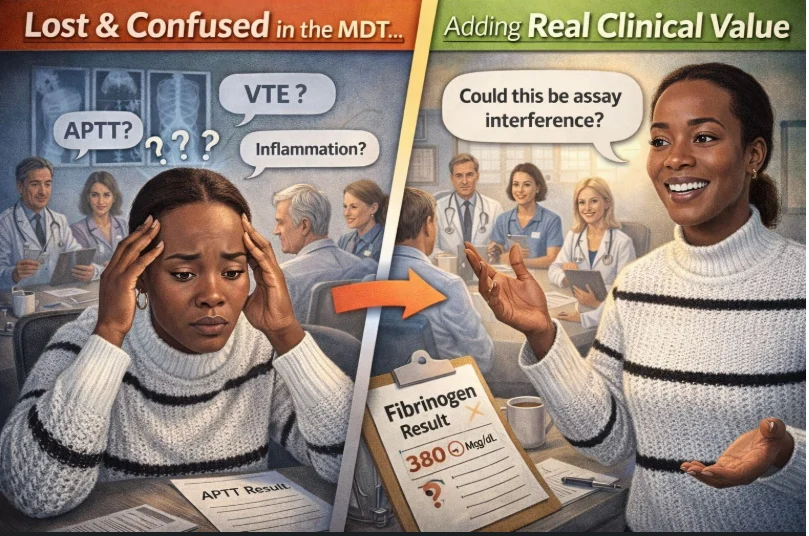
“From lost in the MDT… to adding real clinical value
I still remember my first MDT meeting as a newly qualified biomedical scientist.
I walked in thinking: ‘I know my coagulation. I’ll be fine’
Within minutes…Ahh, I was completely lost.
The room was filled with consultants, haematologists, nurses, pharmacists – speaking a language that sounded familiar, but somehow not the same as what I’d learned in the lab.
They weren’t talking about ‘results.’
- ‘Recurrent VTE despite anticoagulation…’
- ‘Possible underlying malignancy…’
- ‘Inflammatory markers trending up…’
And I sat there thinking:
My God! Where does my APTT result fit into all of this?
But here is my turning point
What changed wasn’t my technical knowledge.
It was my perspective.
I started asking different questions:
Why was this test requested?
What decision is this result influencing?
What could make this result misleading?
Suddenly, coagulation wasn’t just numbers – it was context.
From reporting results to interpreting meaning
Instead of just releasing results, I began to notice patterns:
- A short APTT in a patient with inflammation – could this reflect elevated factor VIII?
- Low fibrinogen by Clauss – interference or true deficiency?
- Unexpected results – do they fit the clinical picture?
And slowly… I started speaking up.
The first time I contributed
I still remember the moment, that quite confident.
A case was being discussed with ‘low fibrinogen.’
Something didn’t add up.
I hesitated… then said:
‘Could this be assay interference rather than true hypofibrinogenaemia?’
The room paused.
Then someone nodded.
Then the discussion shifted.
And just like that – I wasn’t invisible anymore.
Where I am now
Today, I don’t just attend MDTs – I contribute.
I flag potential interferences
I provide interpretive comments
I help connect lab data to clinical decisions
Because biomedical scientists aren’t just behind – the – scenes.
We are part of the clinical decision – making process.
I have been there
Feeling lost at the start doesn’t mean you don’t belong.
It means you’re learning to think clinically, not just analytically.
And that’s where real impact begins.
Want more insights to help you bridge the gap between lab science and clinical practice?
Subscribe for updates and pick up your well built course on coagulation fundamental in result interpretation.”
Other posts featuring Ifeanyichukwu Ifechidere on Hemostasis Today.
-
Sep 17, 2026, 20:19Riten Kumar: Boston Children’s Hospital Ranked No. 1 in Seven Pediatric Specialties
-
Sep 17, 2026, 20:17Katrina Snow: Whole Blood or Component Therapy – Which Would You Choose?
-
Sep 17, 2026, 16:30Daria Camilli: Empowering Bleeding Disorder Advocacy Through Health Economics
-
Sep 17, 2026, 16:17Mehran Ghasemzadeh: Platelet NK Cell Crosstalk in Advanced Coronary Artery Disease
-
Sep 17, 2026, 16:16Barbara Adams Krolak: Do GLP-1s Affect Blood Clot Risk?
-
Sep 17, 2026, 15:46Heghine Khachatryan: Clinical Context at the Core of Thrombosis and Thrombophilia Management
-
Sep 17, 2026, 15:33Alexandros Makis: When Microcytic Anemia Has an Inherited Cause
-
Sep 17, 2026, 15:22α2-Antiplasmin Inhibition and the Future of Thrombolysis
-
Sep 17, 2026, 15:20Fatma M. Attia: Expanding the Evidence Base for Therapeutic Plasma Exchange Across Multiple Indications