


Ifeanyichukwu Ifechidere: How Should We Monitor DOACs?
Ifeanyichukwu Ifechidere, Specialist Biomedical Scientist at Sheffield Teaching Hospitals NHS Foundation Trust, shared a post on LinkedIn:
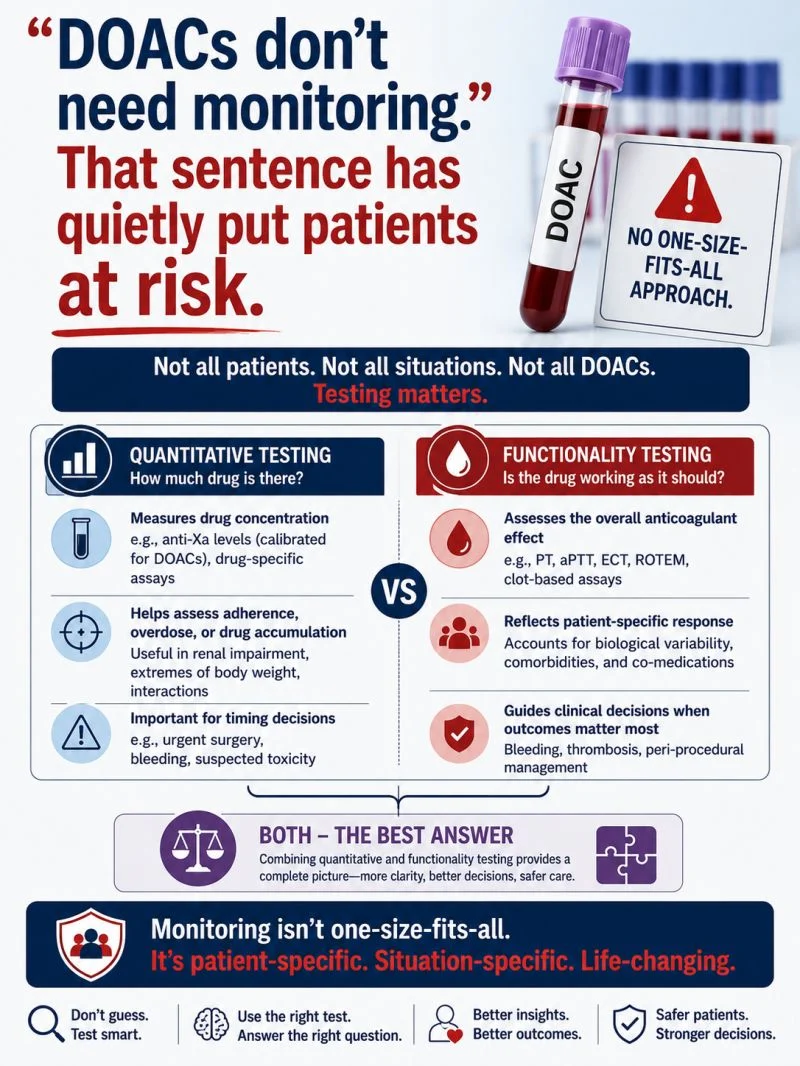
“DOACs don’t need monitoring.
That sentence has quietly put patients at risk.
For years, one of the biggest selling points of DOACs was fixed dosing, no routine monitoring. It sounded like progress.
But ask any lab scientist who’s had to interpret a coagulation screen on a bleeding patient on apixaban, and you’ll get a very different answer.
Here’s the debate the profession hasn’t fully settled.
The Case for Quantitative Monitoring
Anti-Xa assays calibrated for DOACs, or dilute thrombin time for dabigatran, give you an actual drug level — a number you can act on. In bleeding patients, pre-procedure planning, renal impairment, extremes of body weight, or suspected overdose, ‘no monitoring needed’ quickly becomes ‘we have no idea how much drug is on board.’
A quantitative result can be the difference between safely reversing anticoagulation and reversing blind.
The Case for Pharmacodynamic Assessment
The counterargument is compelling too: a drug level tells you concentration, not necessarily bleeding or clotting risk in that specific patient. Two patients with identical anti-Xa levels can have very different clinical pictures depending on age, renal function, concurrent antiplatelets, and bleeding phenotype.
Functional assays — viscoelastic testing, global haemostasis assays — arguably tell you what the drug is actually doing to that patient’s clot, not just how much of it is circulating.
Where the Tension Really Lives
Quantitative testing is more standardised, more reproducible, and easier to build reference ranges around — but it can create false reassurance if clinicians assume a ‘normal’ level means a ‘normal’ haemostatic response.
Functional/pharmacodynamic testing is more physiologically relevant — but it’s less standardised across labs, harder to interpret consistently, and still lacks the robust validation that quantitative assays have built up over the years.
The Uncomfortable Question
Are we monitoring DOACs to reassure ourselves with a number, or to actually predict what matters clinically — bleeding and thrombotic risk?
Right now, neither approach fully answers that on its own. Quantitative assays tell you exposure. Functional assays gesture toward effect. Neither reliably predicts outcome in every patient.
Until the evidence catches up, the honest answer may be: use quantitative testing for drug level and timing decisions, and functional assays for real-time bleeding management — and stop pretending either one alone gives you the full picture.
Where do you stand — quantitative, functional, or both?”
Find more posts featuring Ifeanyichukwu Ifechidere on Hemostasis Today.
-
Sep 16, 2026, 16:06Katrina Louise Manalaysay: A Few Minutes of Giving Can Mean a Lifetime
-
Sep 16, 2026, 15:45Matthew Hazell: A Brilliant Explanation of Phenotype vs Genotype Using a LEGO House
-
Sep 16, 2026, 15:23Ahmad Al-Ramahi: Presenting the Military Pharmacists Blood Training Course at the FIP World Congress
-
Sep 16, 2026, 15:21HIT Reimagined: Can 12-Lipoxygenase Inhibition Stop Immune Thrombosis?
-
Sep 16, 2026, 14:42Ruchi Punamia: Beyond the Blood Bank and The Clinical Impact of Apheresis
-
Sep 16, 2026, 14:06Kalyan Roy: Celebrating Apheresis, Advancing Care, Saving Lives
-
Sep 16, 2026, 13:38Andrew Zapfel: Advancing Sickle Cell Disease Care and Research
-
Sep 16, 2026, 13:30Thirunavukkarasu Angappan: Why Plasma-Derived Factor VIII Still Matters for Inhibitor Patients
-
Sep 16, 2026, 13:22Matthew Hazell: New BSH Guidance for Fetal, Neonatal and Paediatric Transfusion