


Ifeanyichukwu Ifechidere: AI May Soon Interpret Coagulation Results Better Than Some Healthcare Professionals
Ifeanyichukwu Ifechidere, Specialist Biomedical Scientist at Sheffield Teaching Hospitals NHS Foundation Trust, shared a post on LinkedIn:
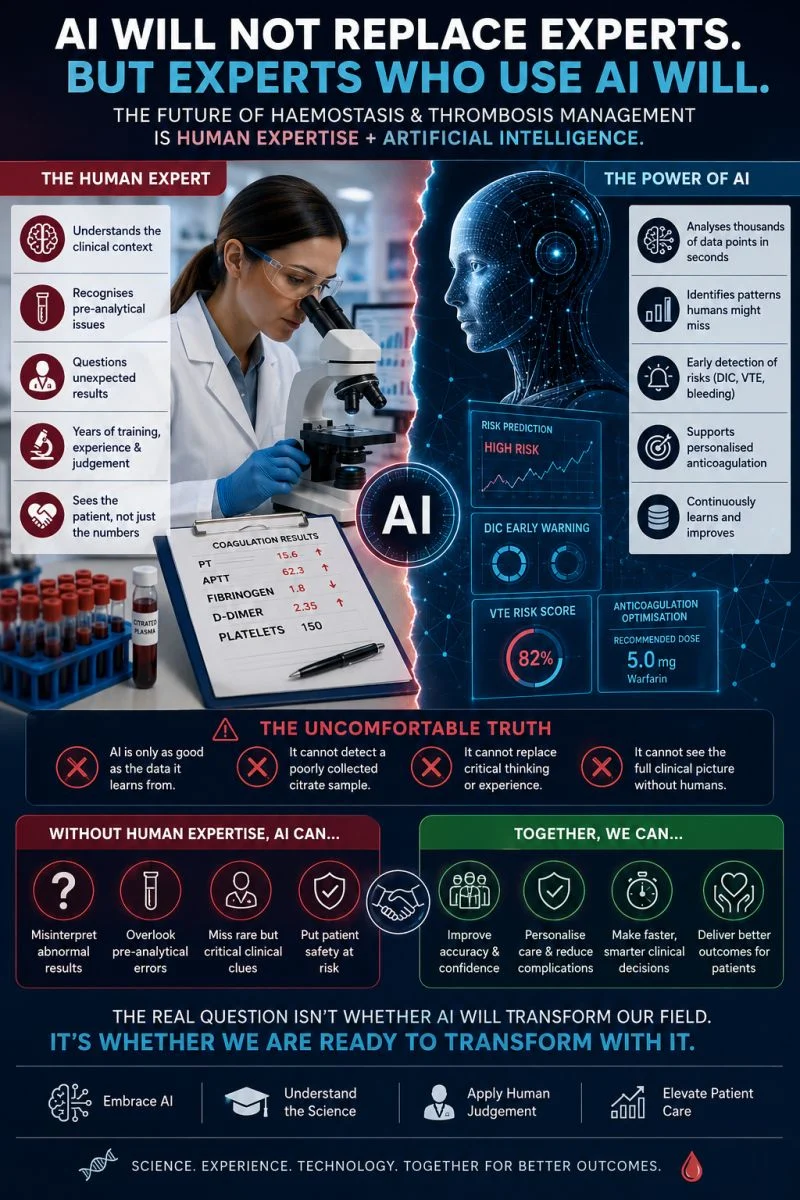
“AI may soon interpret coagulation results better than some healthcare professionals.
Before you disagree, consider this:
Artificial Intelligence can already analyse thousands of patient records, laboratory results, anticoagulation histories, and clinical variables in seconds. It can identify patterns that would take humans hours—or even days—to recognise.
In haemostasis and thrombosis management, where every minute can matter, AI has the potential to:
- Predict thrombotic risk before a clinical event occurs.
- Support early detection of Disseminated Intravascular Coagulation (DIC).
- Identify patients at increased bleeding risk.
- Optimise anticoagulation monitoring and dosing.
- Assist in interpreting complex coagulation profiles.
But here’s the uncomfortable truth:
AI is only as good as the data it learns from.
It cannot recognise a poorly collected citrate sample. It cannot question an unexpected result caused by pre-analytical error. It cannot replace the critical thinking developed through years of laboratory experience. And it certainly cannot understand the full clinical picture without human oversight.
The future of haemostasis isn’t AI versus Biomedical Scientists, Haematologists, or Clinicians.
It’s AI plus human expertise.
The laboratories and healthcare professionals who embrace AI as a decision-support tool will likely outperform those who ignore it.
Yet the professionals who rely on AI without understanding the science behind the results may become the greatest risk to patient safety.
The real question isn’t whether AI will transform haemostasis and thrombosis management.
The real question is: Are we preparing ourselves to work alongside it, or are we preparing to be replaced by those who can?
What’s your view?
Will AI become the most valuable tool in coagulation diagnostics, or is there a danger that we’re placing too much trust in algorithms?
Deepen your knowledge in coagulation interpretation by joining our newsletter using the link in my Feature section in my bio.”
Find more posts featuring Ifeanyichukwu Ifechidere on Hemostasis Today.
-
Sep 17, 2026, 13:52Ashley George: Blood Clots Remain the Leading Cause of Maternal Death in UK
-
Sep 17, 2026, 13:09Mehak Trehan: New Perspectives on Anemia Management in CKD
-
Sep 17, 2026, 10:08WFH 2027 Comprehensive Care Summit Opens Abstract Submissions – World Federation of Hemophilia
-
Sep 17, 2026, 09:56Marianne Yee: MySCDstory Expands Access to Multilingual Sickle Cell Education
-
Sep 17, 2026, 09:36Enewa Onoja: Platelet Satellitism Phenomenon, Three Misleading Counts
-
Sep 17, 2026, 09:22Emmanuel J Favaloro: Hemostasis and Thrombosis in Exercise and Athletes
-
Sep 17, 2026, 09:18Updated Iron Deficiency Diagnostic Guidelines – American Society of Hematology
-
Sep 17, 2026, 09:14Angela Weyand: ASH 2026 Iron Deficiency Guidelines
-
Sep 17, 2026, 08:18Anirban Sen Gupta: From Flow to Clot Insights Into Hemostasis and Thrombosis