


Jamal Rana: Family History and Polygenic Risk for Coronary Heart Disease
Jamal Rana, Assistant Physician in Chief at The Permanente Medical Group, in Pleasanton, California, shared a post on LinkedIn about a recent article he and his colleagues co-authored, adding:
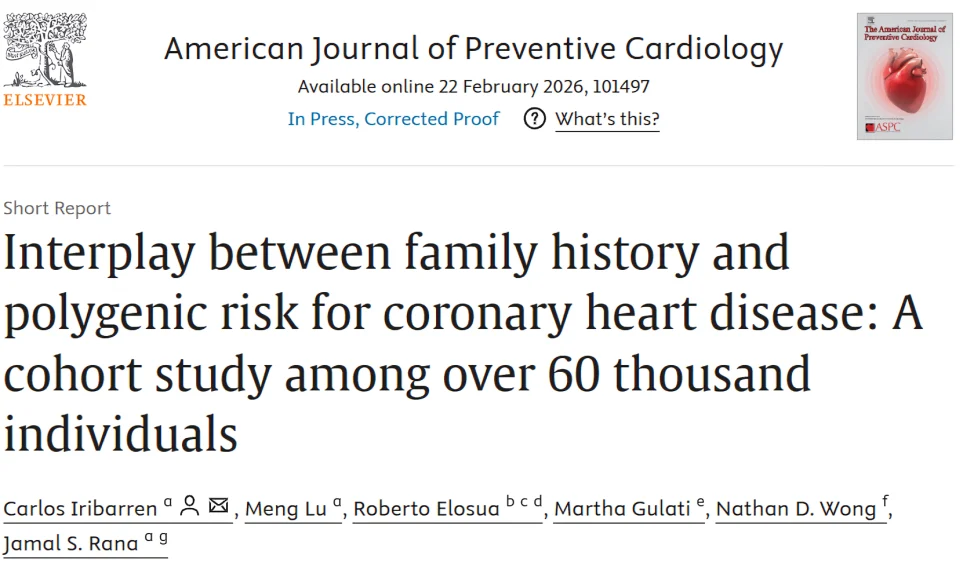
“Our another exciting paper, led by Iribarren, published in American Journal of Preventive Cardiology. Interplay between family history and polygenic risk for coronary heart disease (CHD).
Family history of heart disease is a recognized risk factor. However, it is considered to have low accuracy due to recall bias. Likely reason it is not part of the risk factor base risk calculators such as PREVENT.
Cohort comprised of 61,352 individuals from Kaiser Permanente with follow-up time of 14 years.
Individuals underwent polygenic risk scoring PRS (CARDIO inCode-Score CHD PRS, GENinCode Plc).
PRS and family history CHD were positively correlated, and both independently contribute to risk of incident CHD.
High PRS was associated with similar increased CHD risk in persons with and without family history CHD. A key finding of this study is therefore the fact that PRS adds to risk information among individuals with negative family history.
Hazard ratio, due to joint effect of positive family history CHD and high PRS was well above two.
These results have important clinical implications because relying solely on self-reported family history is insufficient to fully characterize the genetic contribution to CHD and thus the use of PRS could complement traditional risk algorithms particularly among subjects with no known family history of CHD.”
Title: Interplay between family history and polygenic risk for coronary heart disease: A cohort study among over 60 thousand individuals
Authors: Carlos Iribarren, Meng Lu, Roberto Elosua, Martha Gulati, Nathan D. Wong, Jamal S.Rana
Read the Full Article on American Journal of Preventive Cardiology.
Stay updated on all scientific advances with Hemostasis Today.

-
Oct 21, 2026, 07:15Mahmoud Saad: Successful Mechanical Thrombectomy for Right Atrial Thrombosis
-
Oct 21, 2026, 06:55Hunain Shahbaz: Extended Dual Antiplatelet Therapy Beyond 12 Months After Drug-Eluting Stent Implantation
-
Oct 21, 2026, 06:19Dawood Findakly: When Should Anticoagulation Be Held or Resumed?
-
Oct 21, 2026, 03:36Steve Watson: Ligand Epitope Ratios Influence Antagonist Inhibition
-
Oct 21, 2026, 03:18Stephen D. Coombs: Superficial Venous Thrombosis in Athletes and Importance of Early Recognition and Referral
-
Oct 21, 2026, 02:52Aymar Akilimali: Bleeding During Anticoagulation as a Potential Signal of Occult Cancer
-
Oct 21, 2026, 00:58Anees Ur Rahman: Completing a Two-Week Clinical Rotation at Haemophilia Treatment Centre Rawalpindi
-
Oct 21, 2026, 00:56Caitlyn Mooney: Pulmonary Embolism in Athletes, Recognition and Return to Sport
-
Oct 21, 2026, 00:54Hani Karrar: Pleased to Share Our Review on Emicizumab in Hemophilia A Management