


Jeff Sternlicht: The Most Powerful Time to Lower Cholesterol Is Before Anyone Thinks You Need It
Jeff Sternlicht, Emergency Physician and Medical Director at Vituity, shared a post on LinkedIn about a recent article by Dinesh K. Kalra et al, published in Journal of Clinical Lipidology:
“The Most Powerful Time to Lower Cholesterol
Is Before Anyone Thinks You Need It
We often think cholesterol treatment works best after someone already has heart disease.
But a new meta-analysis published in the Journal of Clinical Lipidology suggests something surprising.
Lowering LDL cholesterol may actually reduce cardiovascular risk even more in primary prevention than in secondary prevention.
Across pooled randomized trials, each 1 mmol/L (≈39 mg/dL) reduction in LDL was associated with about a 30% reduction in major cardiovascular events.
That relative risk reduction is greater than what is typically seen in secondary prevention populations.
Why would that be?
Because atherosclerosis is a lifetime exposure disease.
Plaque does not suddenly appear the day before a heart attack.
It builds quietly over decades as ApoB-containing lipoproteins circulate through the arteries.
Lowering LDL later in life can help stabilize plaque that already exists.
Lowering LDL earlier in life can prevent much of that plaque from forming in the first place.
Those are two very different biological situations.
Two people can have the same LDL today.
One spent 40 years with LDL around 160.
The other spent 40 years closer to 80.
Their arteries are not the same.
This is why modern cardiovascular risk reduction is increasingly focused on earlier detection and earlier action.
Look for plaque earlier.
Identify hidden risk.
Lower lifetime ApoB exposure.
The goal is not just treating heart disease.
The goal is preventing the first heart attack entirely.
Disclaimer: Views are my own. This post is for educational purposes only and is not medical advice.”
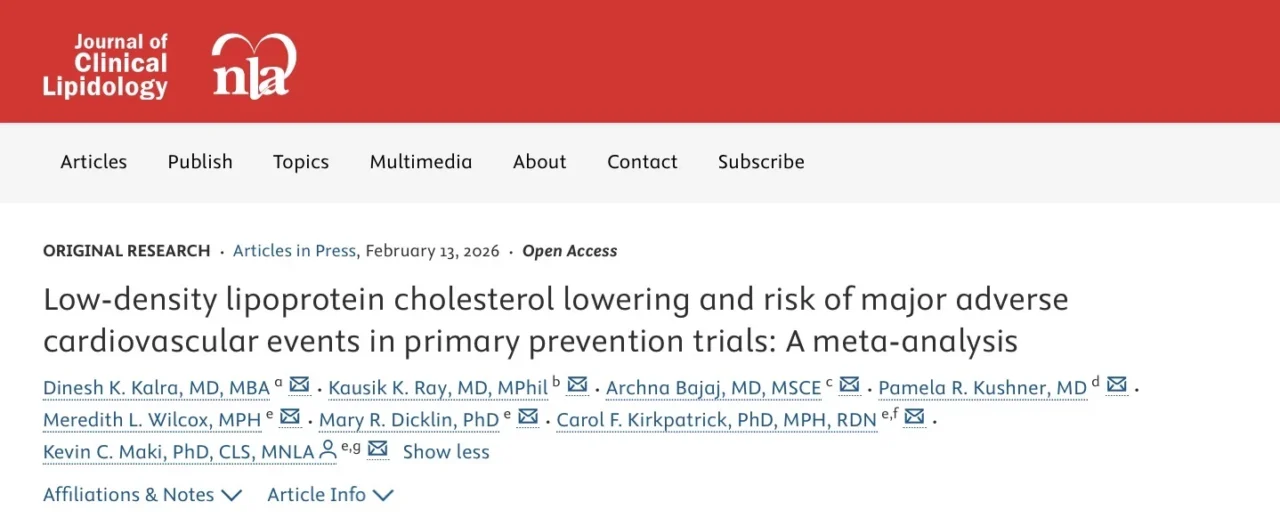
Title: Low-density lipoprotein cholesterol lowering and risk of major adverse cardiovascular events in primary prevention trials: A meta-analysis
Authors: Dinesh K. Kalra, Kausik K. Ray, Archna Bajaj, Pamela R. Kushner, Meredith L. Wilcox, Mary R. Dicklin, Carol F. Kirkpatrick, Kevin C. Maki
Read the Full Article on Journal of Clinical Lipidology
Stay updated with Hemostasis Today.

-
Sep 21, 2026, 15:56Anita Zaidi: Why Only 2% of Health Research and Development Goes to Women’s Conditions
-
Sep 21, 2026, 15:49Omid Khalafi: Gating Strategy and How Do We Decide Which Cells to Analyze
-
Sep 21, 2026, 15:44Levacetylleucine: A New Therapeutic Approach to Ataxia Telangiectasia
-
Sep 21, 2026, 15:40Andreas Tridimas: The Diagnostic Traps of Lipaemic Blood – Why a Normal Amylase Can Mislead You
-
Sep 21, 2026, 15:33Arsene Mekinian: Exploring Cardiac Involvement in Behçet’s Disease
-
Sep 21, 2026, 15:23Anis Mahjoubi: MRI Findings of Krukenberg Tumors
-
Sep 21, 2026, 15:08Fikreab Tesfaye Tefera: 10 Practical Take-Home Points for Diagnosing Iron Deficiency Anemia
-
Sep 21, 2026, 14:10Aswin K Mohan: Lessons from TRANSCON 2026 – Building Resilient Blood Supply Systems Before Crisis Hits
-
Sep 21, 2026, 14:00Vincent Lu: Beyond PT and aPTT – How Hemostasis Evolves Across a Lifetime