


Jeff Sternlicht: Why LDL-C and ApoB Remain King of the Hill?
Jeff Sternlicht, Emergency Physician and Medical Director at Vituity, shared a post on LinkedIn:
“In cardiovascular prevention, there’s one question more important than whether a biomarker predicts risk:
Does changing it improve outcomes?
Last week’s Lp(a)HORIZON results brought that question back into focus.
The trial did not meet its primary cardiovascular endpoint despite substantial lowering of Lp(a).
That matters.
But we should be equally careful about what it does not tell us.
This was one outcomes trial, testing one Lp(a)-lowering therapy in a specific population with established cardiovascular disease.
It did not prove that Lp(a) doesn’t matter. And it certainly did not prove that lowering Lp(a) will never reduce cardiovascular events.
The epidemiologic and genetic evidence linking elevated Lp(a) to ASCVD remains compelling. Other potent Lp(a)-lowering therapies and outcomes trials are still coming.
So for me, the appropriate conclusion is simple:
We still don’t know.
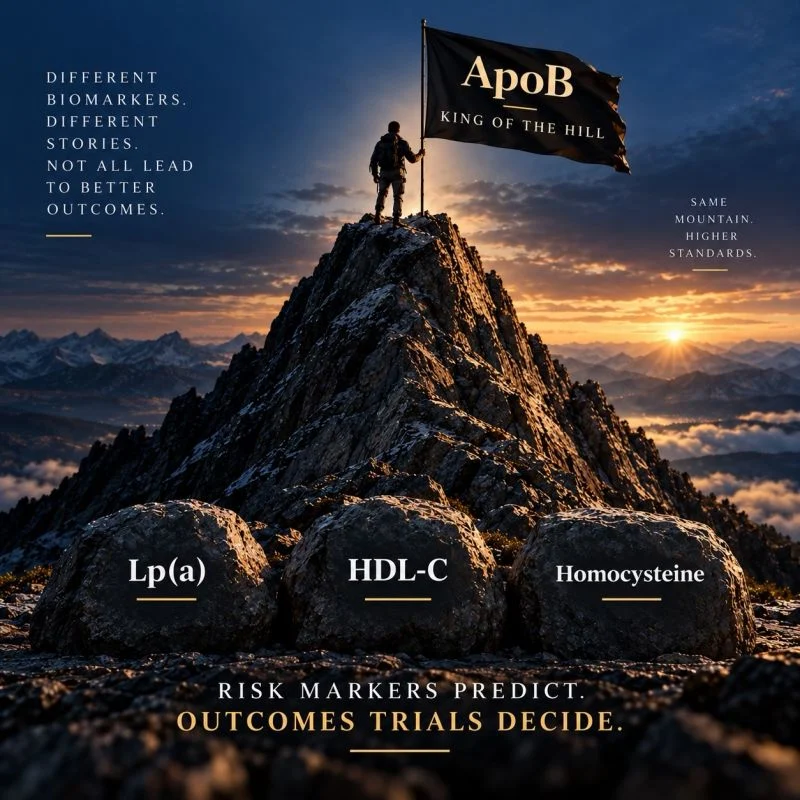
But HORIZON also reminds us just how high the evidentiary bar should be before a biomarker becomes a proven therapeutic target. And that is where LDL-C and ApoB remain king of the hill.
The evidence surrounding the apoB-containing lipoprotein pathway converges from almost every direction:
- Epidemiology.
- Genetics.
- Mendelian randomization.
- Randomized clinical trials.
- Multiple drug classes.
- Cardiovascular outcomes.
Again and again, the conclusion points in the same direction:
Lower exposure to apoB-containing lipoproteins, particularly earlier and for longer, means less atherosclerotic cardiovascular disease.
We measure many other biomarkers that provide important information about cardiovascular risk.
- Lp(a).
- Triglycerides.
- HDL-C.
- hsCRP.
- Homocysteine.
They are not equivalent, and their biology and evidence differ substantially.
Some may ultimately prove to be important therapeutic targets. Inflammation already has randomized evidence supporting specific therapeutic pathways. Lp(a) has particularly compelling genetic evidence and remains one of the most important unanswered questions in cardiovascular prevention.
But prediction, causality, and proven therapeutic benefit are different standards of evidence.
When a patient asks me today, ‘What can I actually change that has the deepest evidence for reducing my risk of atherosclerotic cardiovascular disease?’
I keep coming back to the same place:
Reduce exposure to apoB-containing lipoproteins.
And fortunately, we have more tools than ever to do it. Statins. Ezetimibe. PCSK9 monoclonal antibodies. Inclisiran. Bempedoic acid.
Different mechanisms. An extraordinary body of evidence pointing in the same direction.
There is still a lot to learn about Lp(a) and the other pathways driving residual cardiovascular risk. But today, LDL-C and ApoB remain king of the hill.
Views are my own and do not represent those of my employers or affiliates. For educational purposes only. This is not medical advice.”
Other posts featuring Jeff Sternlicht on Hemostasis Today.
-
Sep 12, 2026, 17:51Maria Sabater Lleal: Happy to Share Our Latest Work Exploring the Genetic Determinants of PE in VTE
-
Sep 12, 2026, 17:49Kalyan Roy: TRAGS – An Emerging Transfusion Safety Concern
-
Sep 12, 2026, 17:48Jason Fung: What Happened to “Statins Save Lives”?
-
Sep 12, 2026, 17:47Eric Topol: Most Supplements and Vitamins Offer Little Proven Benefit
-
Sep 12, 2026, 17:44Manuel Monreal: Clinical Characteristics, Treatment, and Outcomes in Hispanic vs Caucasian Patients With VTE
-
Sep 12, 2026, 17:43Sidi Mohamed El Amine Benlazar: CPX-351 and Ruxolitinib in Advanced-Phase Myeloproliferative Neoplasms
-
Sep 12, 2026, 17:42Elad Asher: Higher IPF Is Associated with Adverse Outcomes in ICCU
-
Sep 12, 2026, 16:40Heghine Khachatryan: From Ideal Protocols to Feasible Pathways in Hemophilia Musculoskeletal Care
-
Sep 12, 2026, 16:33Consuela A. Albright: The Strategic Value of Proclamations in Health Advocacy