

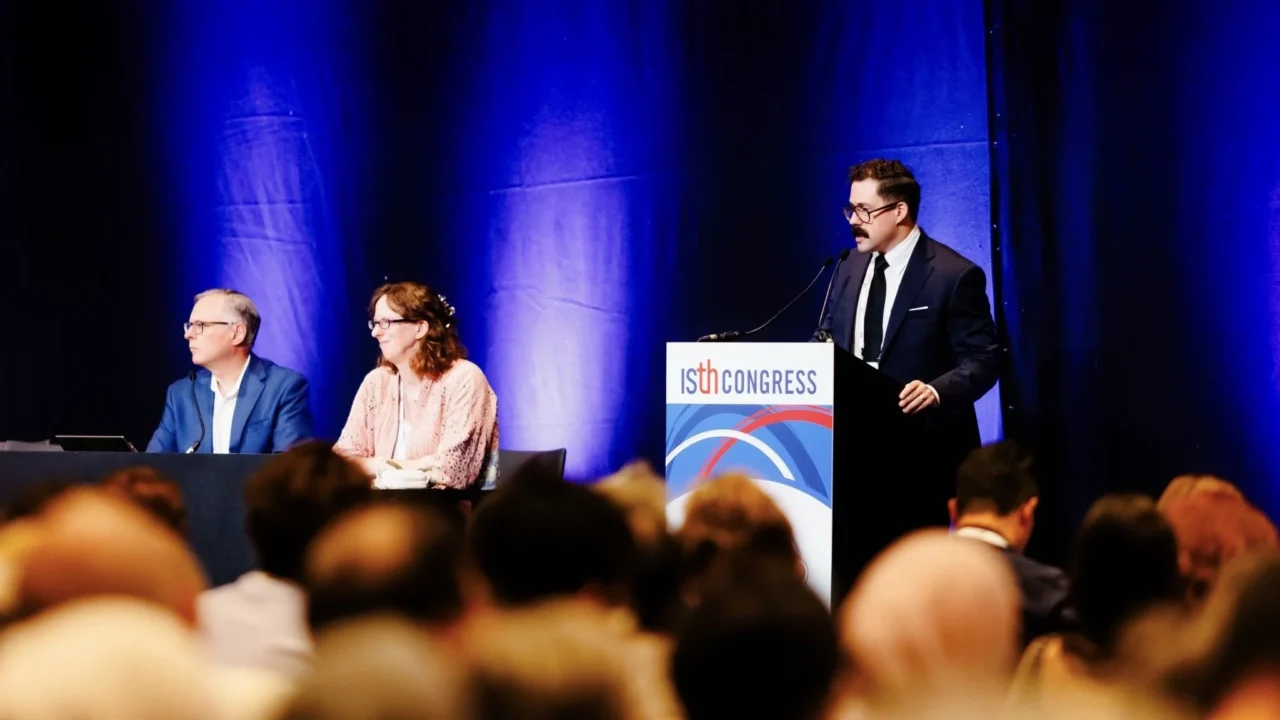
Joseph R. Shaw: Introducing New ISTH SSC Guidance for Perioperative Bleed-Risk Stratification at ISTH 2026
Joseph R. Shaw, Director of Research Plus Program at Ottawa Department of Medicine, EHJ-CVP Associate Editor at European Heart Journal, shared on LinkedIn:
”Thank you, Paris — I am deeply grateful to have had the opportunity to present this work to a packed audience at ISTH.
Following a memorable week in Paris, I am pleased to share that our ISTH SSC guidance on surgical and procedural bleed-risk stratification for anticoagulated patients is now in print in the Journal of Thrombosis and Haemostasis.
‘Surgical and procedural bleed risk stratification for anticoagulated patients undergoing planned surgery: guidance from the ISTH SSC Subcommittee on Perioperative and Critical Care Thrombosis and Hemostasis’
Procedural bleed risk is a key starting point when determining whether anticoagulation should be interrupted, how long it should be held, and when it can be safely resumed. However, existing guidance has often classified the same procedures differently, contributing to uncertainty and variation in perioperative anticoagulation management.
Our guidance aims to provide:
- A pragmatic approach informed by a structured literature review, contemporary guidance, major perioperative anticoagulation studies, and multidisciplinary procedural expertise
- A practical three-tier framework: minimal, low/moderate, and high bleed risk
- Detailed classification of commonly performed elective procedures across 11 surgical and procedural domains
- A starting point for individualized decision-making—not a substitute for patient-specific factors, procedural details, interdisciplinary discussion, or clinical judgment
- A common framework to improve consistency in clinical care and standardize procedural bleed-risk classification in future perioperative anticoagulation research
I was proud to present this guidance during the Guidelines and Guidance Highlights session at International Society on Thrombosis and Haemostasis (ISTH) —to a full house.
The interest in the room reinforced how frequently clinicians across specialties encounter these complex decisions.
I am grateful to all of our coauthors and multidisciplinary collaborators.
A special thank-you to Dr. Jim Douketis and to Chair of the ISTH SSC on Perioperative and Critical Carw Thrombosis and Hemostasis Dr. Jean Connors for the opportunity to help create what we hope will be a practical and useful document for clinicians across disciplines—and one that will ultimately improve the care of anticoagulated patients.
I hope this guidance will serve both as an accessible clinical resource and as a foundation for the next generation of perioperative anticoagulation research.”

Stay updated with Hemostasis Today.
-
Oct 17, 2026, 12:21Jalen Hurts Sidelined by a Superficial Blood Clot: What to Know
-
Oct 17, 2026, 09:33Robert Lookstein: Mechanical Thrombectomy Shows Functional Benefits in Intermediate-High-Risk PE
-
Oct 17, 2026, 09:18Sarra Hmidi: Tunisia Highlights Thrombosis Prevention on World Thrombosis Day
-
Oct 17, 2026, 09:05Addressing the Hidden Burden of Bleeding Disorders in Women – Hemophilia Society Mumbai Chapter
-
Oct 17, 2026, 08:49Maria Magnusson: Karolinska Experts Explore Gene Therapy in Sickle Cell Disease and Hemophilia
-
Oct 17, 2026, 04:07Weihao Li: Global HEPATIC Registry Findings on Post-Transplant Arterial Thrombosis
-
Oct 17, 2026, 03:56Ghaith Abu-Zeinah: ASH Publishes 2026 Guidelines for Myelofibrosis Management in Blood Advances
-
Oct 17, 2026, 03:48Tristan Siokos: Why Vascular Occlusion Is More Than Just Clots – Breakdown of the 8 Pathways
-
Oct 17, 2026, 02:36Archil Jaliashvili: Oxygen Transport in Capillaries