


Khadija Mohamed: Beyond Localized Fat – The Hidden Risks of Mesotherapy in Undiagnosed Lipedema
Khadija Mohamed, Lymphatic and Orthopedic Therapist at Jamam Healthcare Clinic, Member of Australian Physiotherapy Association, shared a post on LinkedIn:
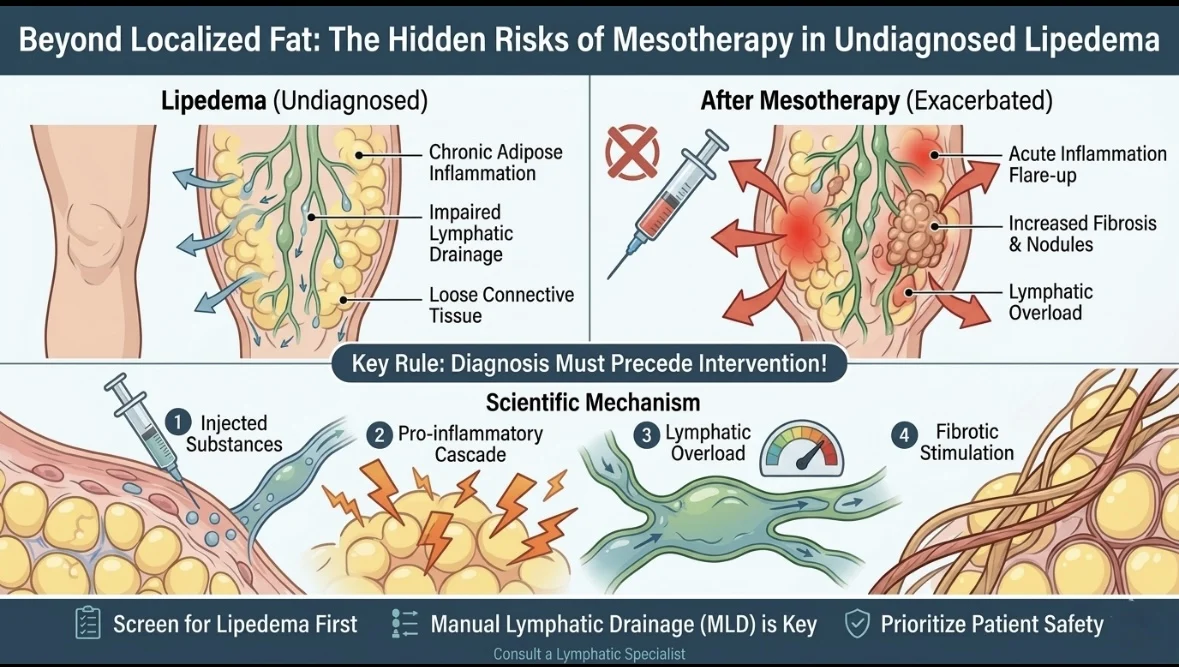
“Beyond Localized Fat: The Hidden Risks of Mesotherapy in Undiagnosed Lipedema
As Lymphatic therapists, we often encounter patients seeking solutions for localized fat deposits. However, a recent clinical case in my practice served as a stark reminder that what appears to be simple ‘stubborn fat’ can often be an underlying case of Lipedema.
The Clinical Presentation:
I recently evaluated a patient who presented with disproportionate fat distribution in her lower extremities. For years, she believed she was struggling with simple weight gain. Seeking a quick solution, she underwent several sessions of Mesotherapy for localized fat reduction.
The Turning Point:
Instead of the desired contouring, the patient experienced a rapid deterioration in her condition:
- Exacerbated Edema and Pain – The ‘painful fat‘ characteristic of Lipedema intensified significantly.
- Increased Fibrosis – The skin texture became firmer and more nodular, suggesting an accelerated fibrotic process.
- Inflammatory Response – The patient developed acute signs of inflammation, triggering the clinical manifestation of previously latent Lipedema.
The Scientific Mechanism:
Why did this happen? Lipedema is not just a fat storage disorder; it is an inflammatory condition associated with impaired lymphatic function and connective tissue dysregulation.
When we inject mesotherapeutic substances into tissue that is already struggling with lymphatic drainage, we create several issues:
- Lymphatic Overload – The injected substances increase the interstitial fluid load, further stressing an already compromised lymphatic system.
- Pro-inflammatory Cascade- Mesotherapy often relies on inducing a controlled inflammatory response to break down fat. In a patient with Lipedema—who already suffers from chronic adipose tissue inflammation—this can lead to a systemic or localized ‘flare-up.’
- Fibrotic Stimulation – The mechanical and chemical irritation of these injections can trigger the body’s healing response to produce more fibrous tissue, worsening the ‘cork-like’ or nodular texture characteristic of advanced Lipedema.
The Key Takeaway:
This case highlights a vital rule in aesthetic and clinical practice: Diagnosis must precede intervention.
Before recommending any fat-dissolving procedures (like Mesotherapy or Lipolysis), we must screen for Lipedema. Misdiagnosing it as simple obesity often leads to treatments that do more harm than good. Lipedema requires a multi-disciplinary approach focusing on lymphatic health—such as Manual Lymphatic Drainage (MLD), compression therapy, and anti-inflammatory lifestyle adjustments—rather than aggressive fat-dissolving techniques.
Let’s continue to raise awareness and prioritize patient safety by ensuring accurate diagnosis before treatment.
Have you encountered similar cases in your practice where Lipedema was initially misidentified? Let’s discuss in the comments.”
Stay updated with Hemostasis Today.
-
Oct 18, 2026, 13:0810 Posts Not to Miss This Week
-
Oct 18, 2026, 12:58Pierpaolo Di Micco: DOACs vs Vitamin K Antagonists in Long-Term Anticoagulation
-
Oct 18, 2026, 12:51Arianne Missimer: Understanding Ferritin Levels Beyond the Normal Range
-
Oct 18, 2026, 12:37Roberto C. Iglesias: Colon Cancer Prevention Beyond Supplements and Vitamins
-
Oct 18, 2026, 12:27Rafael Alejandro Camero Del Vecchio: Paroxysmal Nocturnal Hemoglobinuria Advancing Complement Inhibition with Ravulizumab
-
Oct 18, 2026, 12:26Abdul Mannan: When INR Misleads – Rethinking Bleeding Risk in Cirrhosis
-
Oct 18, 2026, 12:14Stéphane Laurent: The People and Technology Behind Safe Blood Transfusion
-
Oct 18, 2026, 12:14Abhi Kapuria: When VTE Prophylaxis Breaks Down in the ICU
-
Oct 18, 2026, 11:37Lee Anne Sorto: Beyond Compliance – Making Audits Count in Transfusion Safety