


Mohammed Alo։ How Low Should LDL Go in Secondary Prevention of Cardiovascular Disease
Mohammed Alo, Fellow of the American College of Cardiology at American College of Cardiology, shared a post on LinkedIn:
“For years, cardiology has debated a simple question:
If you already have heart disease, how low should your LDL cholesterol go?
The new Ez-PAVE trial gives us one of the clearest answers yet.
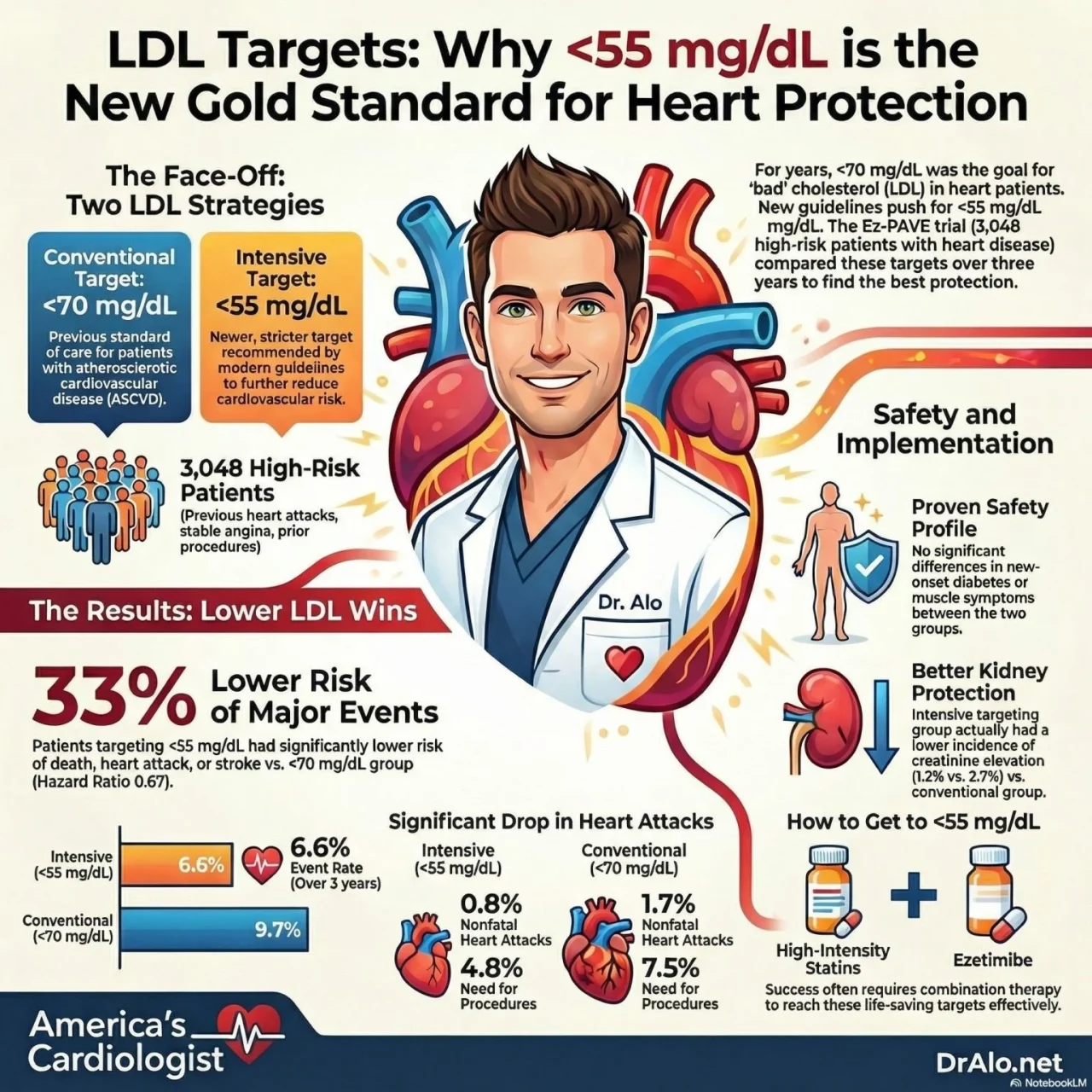
This randomized trial followed 3,048 patients with established atherosclerotic cardiovascular disease and compared 2 LDL targets:
- LDL less than 55 mg/dL vs LDL less than 70 mg/dL
After 3 years, the lower-target group had significantly fewer cardiovascular events:
- 6.6% vs 9.7%
- Hazard ratio: 0.67
That translates to:
- 33% relative risk reduction
- 3.1% absolute risk reduction
Why does this matter?
Because this was not just a ‘drug trial.’
It was a target-to-target trial.
It asked the real-world question physicians and patients face every day:
Is aiming for below 55 actually better than aiming for below 70?
The answer appears to be yes.
A few key takeaways:
- Even a modest LDL difference mattered
- Fewer heart attacks and repeat procedures occurred in the lower-target group
- Safety was reassuring
- Many high-risk patients in the real world are still nowhere near these targets
My take as a cardiologist:
If you already have coronary disease, prior stents, bypass surgery, stroke, TIA, or peripheral artery disease, an LDL of 65 or 70 should not automatically be considered ‘good enough.’
For most secondary prevention patients, under 55 mg/dL is the right goal.
The therapies already exist:
- High-intensity statins
- Ezetimibe
- PCSK9 inhibitors when needed
The issue is no longer whether lower is better.
The issue is whether we are actually getting patients there.”
Stay updated with Hemostasis Today.
-
Oct 16, 2026, 17:06Troels Wienecke: Connecting Myeloproliferative Disease and Ischemic Stroke
-
Oct 16, 2026, 17:03Only 5 Days Left to Submit Your Research for EAHAD 2027
-
Oct 16, 2026, 16:48Abdul Rahman: Reticulocyte Count and Bone Marrow Activity
-
Oct 16, 2026, 16:44DOAC Adherence in Stroke Patients With Atrial Fibrillation – International Journal of Stroke
-
Oct 16, 2026, 16:22Shannon Farmer: Driving Patient Blood Management Forward in Australia and New Zealand
-
Oct 16, 2026, 16:01Obi Light Ogbonnia: The Greatest Reward Is Changing Lives, Not Winning Awards
-
Oct 16, 2026, 15:18Carmine Liberatore: Limited Accuracy of VTE Risk Scores in Multiple Myeloma
-
Oct 16, 2026, 14:55Alex Borstein and the Bleeding Phenotype of Hemophilia A Carriers
-
Oct 16, 2026, 13:59Aya Akmal Amin: Antiphospholipid Syndrome Management and Risk Stratification