


Pedro Perez: Why the Future of PE Care Demands Individualized Strategy
Pedro Perez, Southeast Vascular Sales Manager at Argon Medical Devices, shared a post on LinkedIn:
“Are we choosing the best treatment for pulmonary embolism-or the technology we’re most comfortable using?
It’s a question worth asking as the VTE landscape continues to evolve.
Over the last several years, we’ve witnessed tremendous advancements in catheter-based PE treatment.
- Larger aspiration catheters.
- Mechanical thrombectomy systems.
- Catheter-directed thrombolysis.
- Improved imaging and risk stratification.
But here’s the challenge.
Better technology doesn’t automatically mean better patient outcomes.
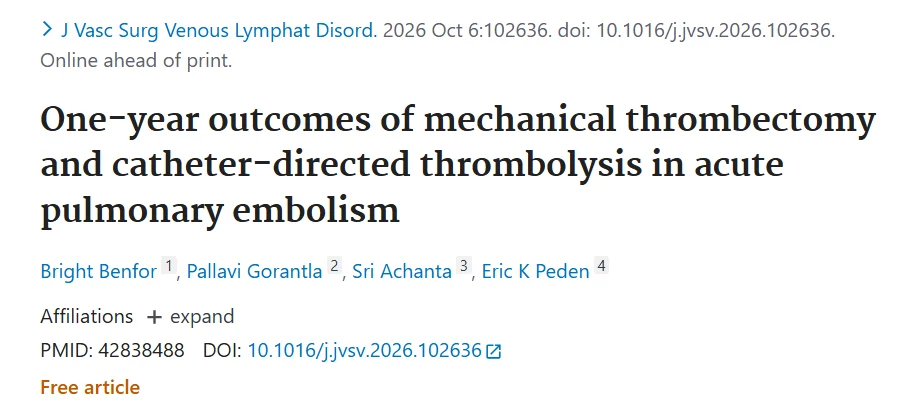
A newly published study in the Journal of Vascular Surgery:
Venous and Lymphatic Disorders evaluated 724 patients undergoing mechanical thrombectomy or catheter-directed thrombolysis for acute PE.
The findings were interesting.
Mechanical thrombectomy patients experienced significantly fewer ICU admissions.
However, they also had a higher rate of intraoperative adverse cardiac events.
At one year, there were no statistically significant differences in mortality, recurrent PE or CTEPH between the two treatment groups.
This wasn’t a randomized trial, and the patient populations differed in baseline risk.
But I believe it reinforces an important point.
The future of PE intervention shouldn’t be defined by which technology dominates the market.
It should be defined by which treatment strategy delivers the greatest benefit for the individual patient.
That requires us to think beyond clot extraction.
- What is the patient’s hemodynamic status?
- What is their bleeding risk?
- How quickly do we need to restore pulmonary blood flow?
- What are the procedural risks?
- How much hospital resource utilization is required?
- And ultimately, what happens to that patient 30 days, six months or one year later?
For those of us in the medical device industry, this creates an important responsibility.
We cannot become so focused on selling technology that we lose sight of understanding the disease.
Physicians don’t need another salesperson explaining why their catheter is superior.
They need knowledgeable clinical partners who understand the evidence, recognize the limitations of different technologies and appreciate the complexities of patient selection.
The next evolution in VTE care won’t come from technology alone.
It will come from combining better technology, stronger clinical evidence and more individualized treatment decisions.
Because ultimately, the goal isn’t to perform more procedures.
It’s to deliver better outcomes.
For physicians and PERT teams:
When choosing between mechanical thrombectomy and catheter-directed thrombolysis, what clinical factors most influence your decision?
And are we collecting enough long-term data to know which strategy truly benefits each patient?”
Title: One-year outcomes of mechanical thrombectomy and catheter-directed thrombolysis in acute pulmonary embolism
Authors: Bright Benfor, Pallavi Gorantla, Sri Achanta, Eric K Peden
More posts featuring Pedro Perez on Hemostasis Today.
-
Oct 27, 2026, 04:09Hari Trivedi: Real-World AI Performance in PE Detection
-
Oct 27, 2026, 03:50Nathalie Conrad: Uncovering 30-Year Sex Differences Across 55 ESC Nations
-
Oct 27, 2026, 03:45Melissa Barlow: Cancer Risk After Platelet Count and CRP Testing
-
Oct 27, 2026, 03:38Nnadozie Gabriel C.: What Everyone Needs to Know about BE FAST
-
Oct 27, 2026, 03:30Pouya Tahsili-Fahadan: Evolving Boundaries in Acute Stroke Care – Key Takeaways from WSC 2026
-
Oct 27, 2026, 03:27Kristin N.: Could Elritercept Change How We Manage Anemia in Lower-Risk MDS?
-
Oct 27, 2026, 03:22David J McCormack: Hybrid LAA Closure Prevents Recurrent Stroke Without Blood Thinners
-
Oct 26, 2026, 20:09Augustina Isioma Ikusemoro: Advancing PBM Through Evidence-Based, Patient-Centred Transfusion Care
-
Oct 26, 2026, 20:03David McIntosh: Outdated Plasma Collection Methods and the Global Shortage of Plasma-Derived Medicines