

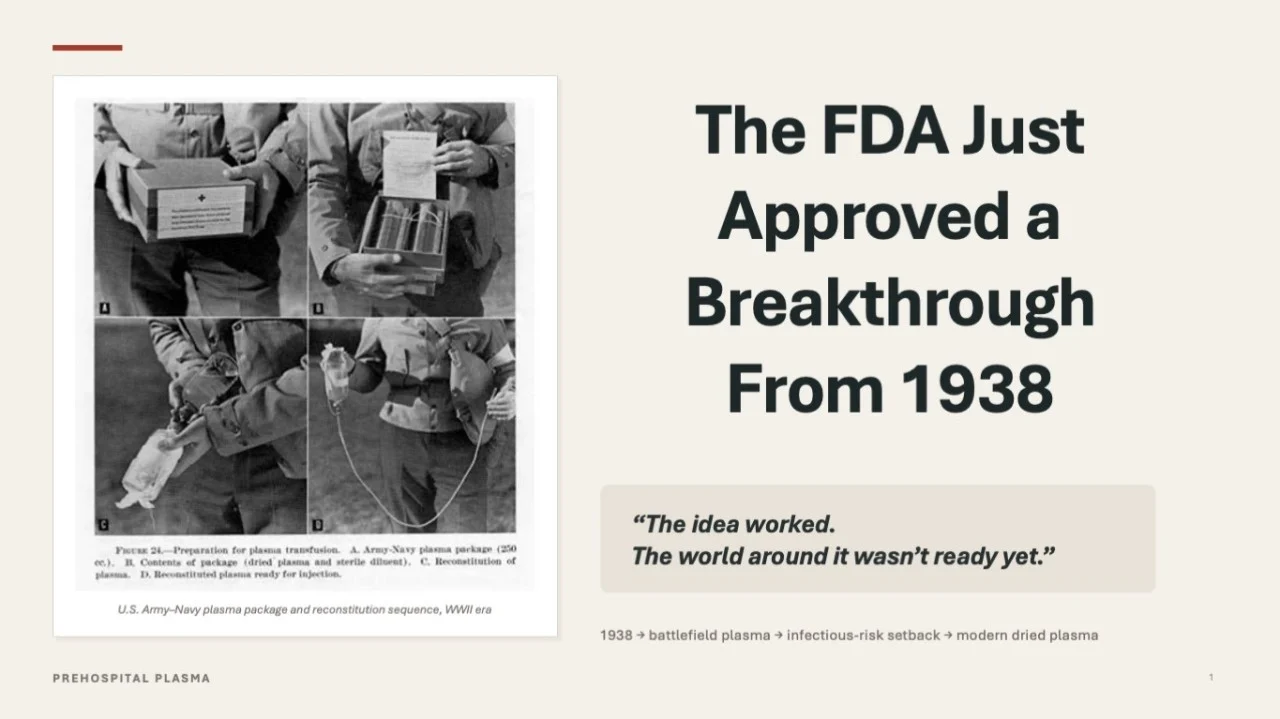
Peter Antevy: The FDA Just Approved a Breakthrough From 1938
Peter Antevy, Founder and Chief Medical Officer at Handtevy, shared a post on LinkedIn:
”Imagine being a medic in World War II.
A soldier in front of you is bleeding badly. You’re nowhere near a hospital. There is no blood bank, no refrigerator and certainly no freezer. Even if conventional plasma were available somewhere behind the lines, getting it to you in time would be nearly impossible.
But inside your medical kit is something remarkable.
A bottle containing dried plasma and another containing sterile water. You add the water, gently mix it, hang the bottle and begin the transfusion.
Plasma, at the point of injury, in the middle of a war.
In the 1940s.
The technology that made this possible had been developed just a few years earlier. In 1938, an Italian physician named Max Strumia successfully freeze-dried plasma. By removing the water, plasma could be stored for long periods, transported without refrigeration and reconstituted when it was needed.
World War II turned that clever idea into something desperately practical.
Getting conventional blood products to wounded soldiers was incredibly difficult. Refrigeration was unreliable or nonexistent, transportation could take days, and the person administering the transfusion might be working in a tent, on a ship or on the ground beside a wounded soldier.
Freeze-dried plasma changed that equation.
By the early 1940s, medics were carrying shelf-stable plasma onto battlefields and administering it at the point of injury. It wasn’t some futuristic concept or laboratory experiment waiting to prove itself. It was a practical solution to one of wartime medicine’s most difficult problems.
And then it disappeared.
Not because the idea failed, but because another part of medicine hadn’t caught up yet.
Early dried plasma was manufactured by pooling plasma from large numbers of donors. That made production possible at scale, but it also created an enormous vulnerability. One infected donor could contaminate an entire pool.
We didn’t have modern donor screening. We didn’t have today’s viral testing or pathogen-reduction technologies.
Freeze-drying preserved plasma remarkably well. Unfortunately, it could preserve hepatitis along with it.
By the Korean War, the problem could no longer be ignored, and dried plasma largely disappeared.
For decades, that seemed to be the end of the story.
Then, in 2024, researchers in Canada came across what amounted to a medical time capsule: an unopened bottle of dried serum manufactured at Connaught Laboratories in Toronto in 1943.
It had been sitting there for 81 years.
They added water.
What they found was remarkable. Albumin was still intact. So were antithrombin, plasminogen, protein C and protein S activity. They identified 71 proteins in a product manufactured while Franklin Roosevelt was president.
Then they tested it for hepatitis B.
Positive.
I can’t think of a better artifact to explain the entire history of dried plasma.
One bottle, 81 years old, contained both halves of the story.
The idea worked. The world around it wasn’t ready yet.
Over the decades that followed, the world started catching up. Donor screening became dramatically better. Viral testing became possible. Pathogen-reduction technologies emerged. Manufacturing improved. Other countries found ways to safely bring dried plasma back into use.
The United States took longer.
Then, on July 29, 2026, 88 years after Strumia first freeze-dried plasma, the FDA licensed the first freeze-dried plasma product in the United States, EZPLAZ.
When I read that announcement, my first reaction wasn’t really excitement.
It was recognition.
Because we weren’t watching medicine invent something new. We were watching medicine finally solve the problems surrounding something we had figured out almost a century ago.
And we’re already trying to improve it again.
From freeze-dried to spray-dried
Freeze-drying, or lyophilization, works by freezing plasma and then removing its water under vacuum. It works remarkably well, but it is a relatively complex manufacturing process requiring specialized equipment and controlled production.
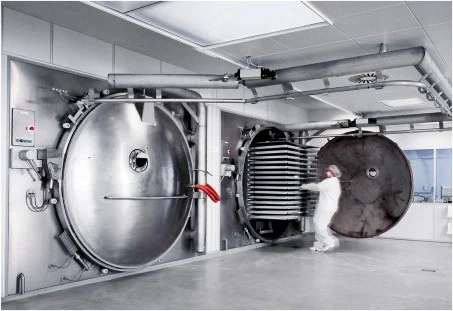
Now another approach is emerging.
Instead of freezing plasma, spray-drying atomizes it into extremely small droplets and rapidly removes the water. Velico Medical is developing this technology with FrontlineODP, an investigational spray-dried plasma product designed around a very different manufacturing model.
And that difference may ultimately be just as important as the product itself.
The goal is to allow individual units of plasma to be dried closer to where they are collected rather than relying entirely on large, centralized manufacturing facilities.
Velico has taken the concept even further with the veliPod, a deployable, containerized production facility.
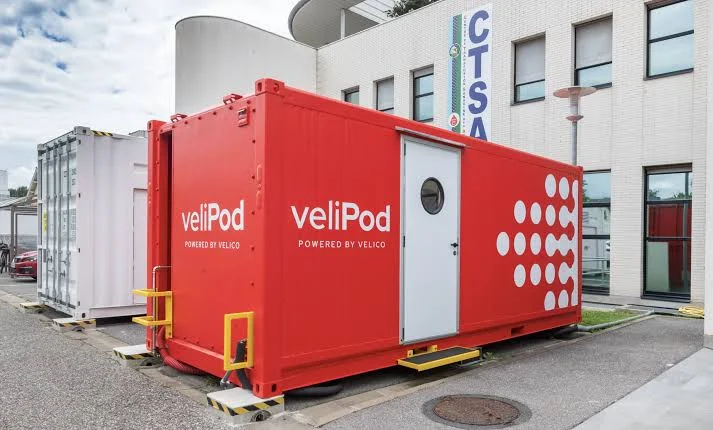
Think about that progression.
In World War II, the challenge was figuring out how to bring dried plasma to the battlefield.
More than 80 years later, we’re working on ways to bring the plasma factory closer to the battlefield.
If spray-dried plasma proves safe, effective and scalable, this type of manufacturing could eventually make dried plasma easier and faster to produce and dramatically expand where it can be available.
For EMS, rural hospitals, military medicine and disaster response, that could be transformative.
Through all of this, the fundamental idea hasn’t changed.
A bleeding patient needs plasma, and we want to get it to them as early as possible.
For nearly 90 years, we’ve just been getting better at everything required to make that happen.
The next barrier may be the hardest one: cost
For all the excitement surrounding these advances, there is an uncomfortable reality that needs to be part of the conversation.
Price.
Today, our programs can purchase cold liquid plasma for approximately $60 per unit. The newer dried formulations are likely to cost substantially more. Early estimates suggest they could cost more than a unit of whole blood, although until actual commercial pricing is established, attaching a specific number doesn’t make sense.
That price difference doesn’t mean dried plasma won’t be worth it.
In many places, it may be exactly what makes a prehospital plasma program possible.
A relatively inexpensive unit of cold liquid plasma is easy to justify if an EMS system has the refrigeration, blood-bank partnership, product rotation and logistics to support it.
But not every EMS system does.
A rural agency with long transport times and limited access to blood-bank infrastructure faces a very different equation. For them, the additional cost of shelf-stable dried plasma may be offset by what it eliminates in refrigeration, wastage and logistics.
A helicopter program will have its own equation.
So will military medicine and disaster-response teams operating in places where refrigeration and resupply may be difficult or impossible.
The right answer will depend on geography, call volume, transport times, blood-bank relationships, refrigeration, product rotation, wastage, available resources and, inevitably, cost.
That’s why freeze-dried and spray-dried plasma shouldn’t be viewed as simply replacing everything that came before them.
They expand the toolbox.
Cold liquid plasma may remain the most economical solution where the infrastructure exists to support it. Freeze-dried plasma may open the door for agencies where refrigeration and logistics have made plasma impractical. And if spray-drying ultimately makes production faster, more decentralized and eventually less expensive, it could change the equation yet again.
But I’ll go a step further and make a prediction.
I believe plasma will eventually become, by a wide margin, the most commonly carried blood product in prehospital care.
The reasons are practical as much as clinical. Plasma has the potential to reach far more EMS agencies than whole blood or packed red blood cells because the emerging formulations increasingly solve the storage, transport and availability problems that have historically limited prehospital blood programs.
That doesn’t mean low-titer O whole blood or packed red blood cells become less important. Quite the opposite.
If plasma becomes broadly available across EMS, it could allow us to be more deliberate about where we deploy our red-cell products. LTOWB and PRBCs could increasingly be directed toward the patients who truly need additional red-cell mass and oxygen-carrying capacity, while plasma becomes the blood product that can be positioned much more broadly across the prehospital system.
That distinction matters when blood is a finite resource.
Not every ambulance needs to become a mobile blood bank. But imagine a future in which having plasma available on an ambulance is no more unusual than having a critical medication available today, while whole blood and red cells are strategically positioned where the patient population and mission justify them.
That’s the future I see coming.
Plasma is going to transform prehospital care, and I believe it will ultimately become the foundational blood product of prehospital resuscitation.
The question won’t simply be whether an EMS agency carries blood. It will be which blood products it carries, where it positions them, and which patients receive them.
And that brings us to another problem we have to solve if any of this is going to happen at scale.
Reimbursement.
The RESCUE Blood Act
The next phase of this story can’t just be about technology.
It has to be about access.
The International Association of Fire Chiefs (IAFC) has been leading an important effort in Washington to address one of the biggest obstacles to expanding prehospital blood programs: reimbursement.
The proposed RESCUE Blood Act, short for the Reimbursing Emergency Services for Critical Use of Emergency Blood Act, is designed around a reality that anyone operating a prehospital blood program quickly discovers.
EMS reimbursement was never designed for this kind of care.
As of today, the legislation has not yet been formally introduced in Congress. It remains a discussion draft and is being advanced on Capitol Hill, with support from organizations including the International Association of Fire Fighters (IAFF) , the National Association of Emergency Medical Technicians (NAEMT) and the Prehospital Blood Transfusion Coalition.
Earlier this year, that effort reached Capitol Hill during EMS on the Hill Day, where Kevin Joles, FSEDI, FAEMS, Edward Herzig , Brian Gonsalves , Nicholas Cozzi, MD, MBA, FACEP, FAEMS, Alana Brown, EFO, CEMSO, PM, IC and other EMS leaders met with Senate staff to educate lawmakers about prehospital blood and why reimbursement has become one of the biggest barriers to expanding these programs.
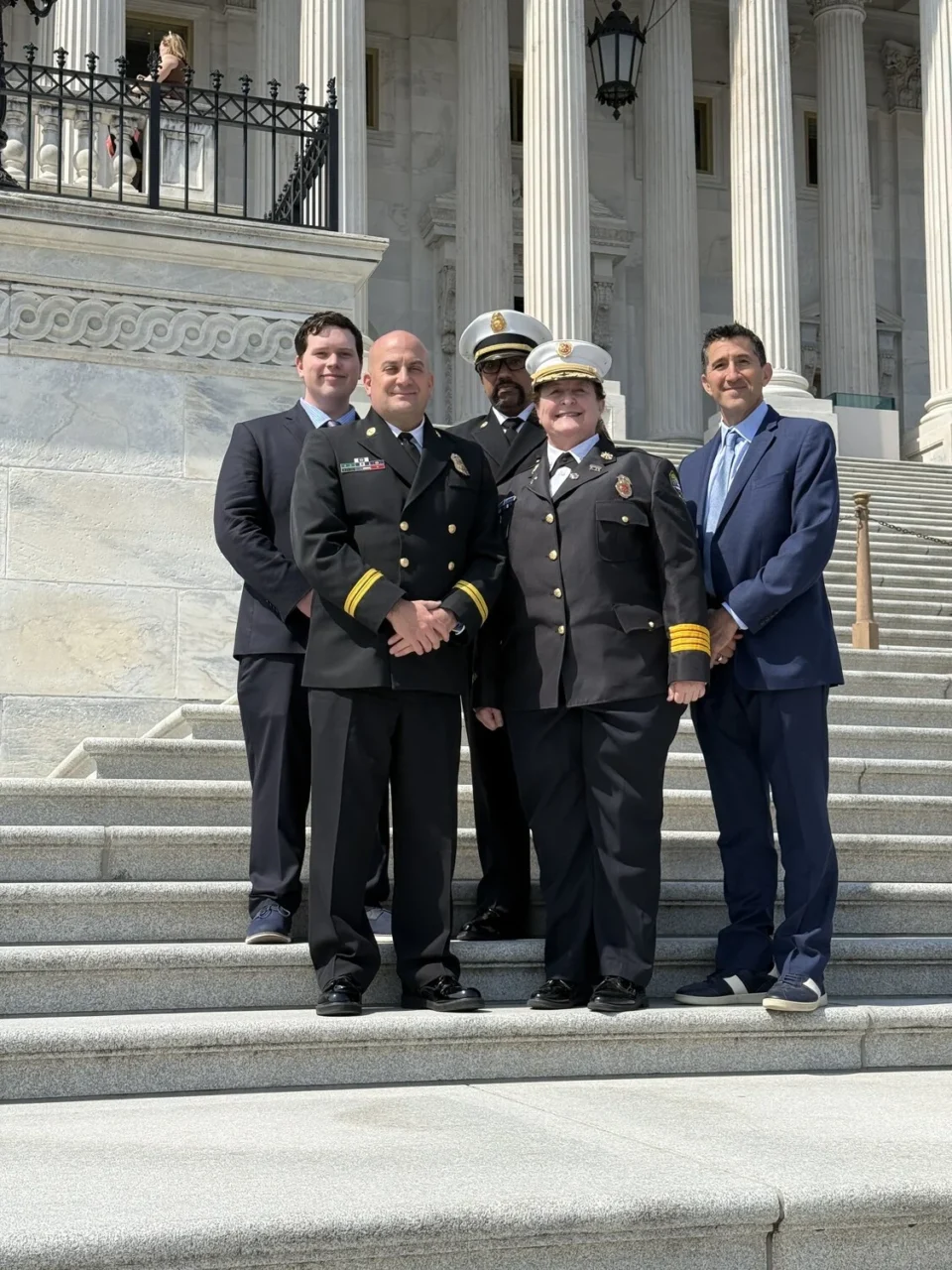
The clinical argument for bringing blood closer to critically bleeding patients is becoming increasingly straightforward.
The harder question is how to make doing it sustainable.
When an EMS agency decides to carry blood, someone has to purchase the product. Someone has to store it, monitor it, rotate it, train clinicians to administer it and maintain the program every day so it is ready for the patient who may need it tonight.
The current RESCUE Blood Act discussion draft tries to recognize that reality.
Under the proposal, when a ground ambulance service administers blood or a blood product in the field or during transport, Medicare would provide a separate payment for the blood product and associated supplies rather than forcing the agency to absorb that expense within the existing ambulance payment.
But there is another part of the proposal that may be even more important.
It recognizes readiness.
The draft includes not only the reasonable costs of acquiring and furnishing blood, but also storage and preparation costs and a professional service fee intended to recognize administration, staff training and the cost of maintaining the capability.
That’s a big deal.
Because if we want prehospital blood programs to spread across this country, we can’t build a reimbursement system that only pays an EMS agency when the spike goes into the bag.
We have to recognize what it costs to make sure that bag is there at 2:00 in the morning when someone crashes their car 40 miles from the nearest trauma center.
And as newer dried plasma products become available, that conversation becomes even more important.
Back to 1943
Which brings me back to that bottle.
For 81 years it sat unopened. When researchers finally added water, many of the proteins they hoped to find were still there.
So was hepatitis B.
The plasma wasn’t waiting for us to rediscover it.
It was waiting for us to solve everything around it.
We solved donor screening. We dramatically reduced infectious risk. We improved manufacturing. This year, we finally crossed the FDA approval threshold for freeze-dried plasma in the United States.
Now we’re working on making it easier to manufacture, easier to store and easier to get closer to the patient.
The next problem we have to solve may be the least scientific one of all:
How do we make sure EMS systems can actually afford to use it?
That’s why the work the IAFC is doing on the RESCUE Blood Act matters.
The proposal hasn’t been introduced yet, and there is a long road between a discussion draft and federal law. But it recognizes something those who have built prehospital blood programs already understand: the cost isn’t simply the bag hanging from the IV pole. It’s the entire system required to make sure that bag is there when the patient needs it.
Nearly 90 years ago, physicians and medics were trying to solve a deceptively simple problem:
How do we get plasma to a bleeding patient before it’s too late?
For most of the last century, the barriers were scientific and logistical.
Today, we are finally solving many of them.
The product may be cold liquid, freeze-dried or, eventually, spray-dried. The right answer will be different for different communities.
But the goal hasn’t changed since those first battlefield kits.
Get plasma closer to the patient, and get it there before it’s too late.
Now we have to make sure the economics don’t become the reason we stop.
- PA
Disclosure: I have no financial relationship, consulting arrangement, ownership interest or other conflict of interest with any of the plasma products or manufacturers discussed in this article.”
Stay updated with Hemostasis Today.
-
Sep 30, 2026, 01:52Javed Anees: DADA2 – When a Young Stroke Is More Than a Stroke
-
Sep 30, 2026, 01:51How a Venous Thrombus Becomes Revascularized – ISTH
-
Sep 29, 2026, 22:45Victor Agunyego: Paracetamol – The Most Common Drug We Underestimate
-
Sep 29, 2026, 22:42Nova Sinclair: Advancing the Future of Hematology – Meet Our 2027 Organizing Committee
-
Sep 29, 2026, 22:41Lorenz Räber: Intracoronary Imaging in PCI – Why, When, How, and Which Modality?
-
Sep 29, 2026, 22:31Selma Turkovic: Pleased to Deliver the Opening Presentation at Kingston Hospital
-
Sep 29, 2026, 22:31Miguel Teran: Ultrasound and Simulation in Arterial Blood Sampling
-
Sep 29, 2026, 22:28Mohammad Refaei: Navigating Your Career in Hematology From Training to Practice
-
Sep 29, 2026, 22:27Matteo Foschi: 10 Clinical Pearls for Antithrombotic Therapy in Secondary Stroke Prevention