


Pooja Choradia: 2026 Acute Pulmonary Embolism Clinical Guidelines
Pooja Choradia, Critical Care Associate at P.D. Hinduja Hospital Khar, shared a post on LinkedIn:
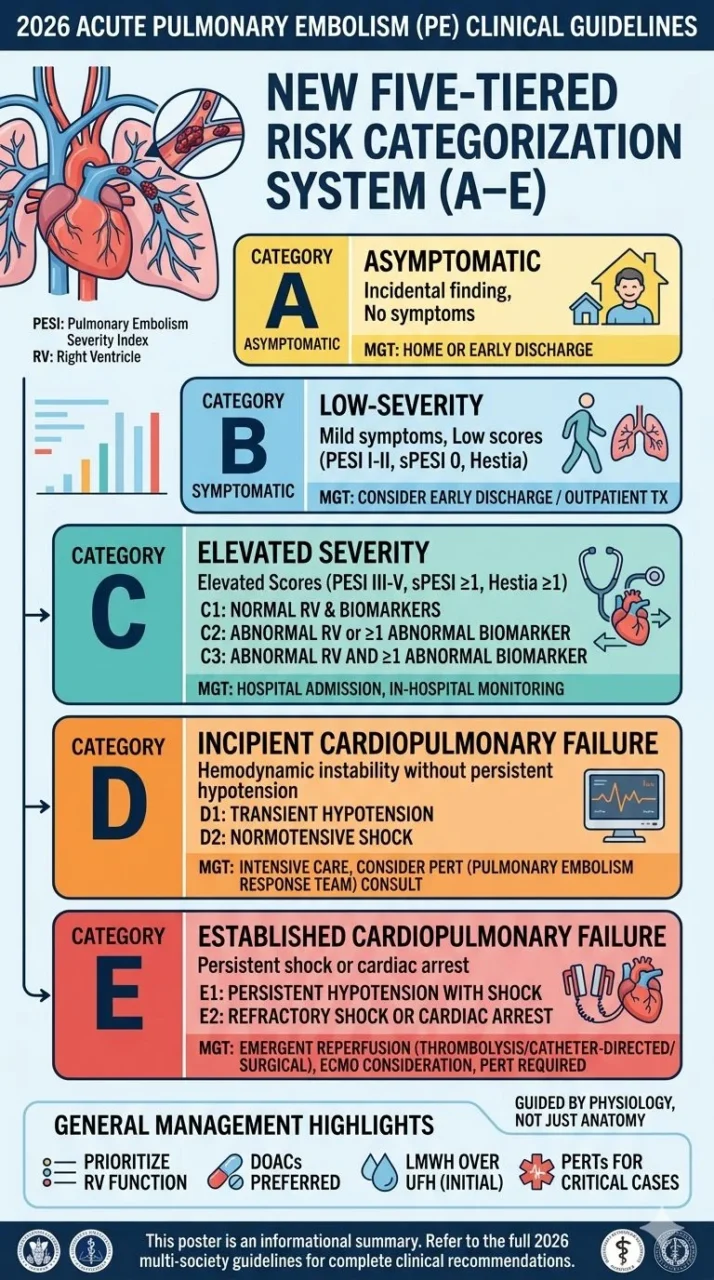
“2026 AHA/ACC Pulmonary Embolism (PE) Clinical Categories
The 2026 guidelines transition from a binary risk model to a nuanced five-tiered (A–E) classification system, focusing on hemodynamic stability and physiological markers to guide patient management.
Category A: Asymptomatic PE
- Defined as an incidental finding.
- The patient is entirely asymptomatic.
- Typically safe for emergency department discharge.
Category B: Symptomatic, Low-Severity
- The patient is symptomatic but exhibits low clinical severity.
- Based on low-risk clinical assessment tools (e.g., PESI/sPESI or Hestia criteria).
- Early hospital discharge is generally recommended.
Category C: Elevated Severity
Characterized by an elevated clinical severity score (PESI III–V, sPESI ≥1, or Hestia ≥1).
- C1: Normal right ventricular (RV) function and normal biomarkers.
- C2: Abnormal RV function or ≥1 abnormal biomarker.
- C3: Abnormal RV function AND ≥1 abnormal biomarker.
Category D: Incipient Cardiopulmonary Failure
The patient is showing signs of hemodynamic deterioration.
- D1: Transient hypotension.
- D2: Normotensive shock.
Category E: Established Cardiopulmonary Failure
Representing severe, persistent physiological failure.
- E1: Persistent hypotension accompanied by cardiogenic shock.
- E2: Refractory cardiogenic shock or cardiac arrest.
Management Highlights:
Physiological Focus: Management is driven by RV function and physiological stability rather than the anatomical clot burden.
Anticoagulation:
Direct Oral Anticoagulants (DOACs) are strongly prioritized for eligible patients.
Low-Molecular-Weight Heparin (LMWH) is preferred over Unfractionated Heparin (UFH) for initial therapy.
Extended treatment is recommended for patients with unprovoked PE or persistent risk factors.
Advanced Interventions: Therapies such as systemic thrombolysis, catheter-directed thrombolysis, mechanical thrombectomy, and surgical embolectomy are considered reasonable for Category E1 and selected Category D patients.
Systemic Care: Multidisciplinary Pulmonary Embolism Response Teams (PERTs) are recommended to streamline coordinated care.
Post-PE Surveillance: Formal screening for chronic thromboembolic pulmonary disease (CTEPD) and functional limitations is recommended for at least one year following the event.”
Stay updated with Hemostasis Today.
-
Oct 16, 2026, 18:12Adil Nawaz: Extended Dual Antiplatelet Therapy After Coronary Stenting
-
Oct 16, 2026, 17:50Elad Asher։ STORM-PE Shows Functional Benefits of Thrombectomy
-
Oct 16, 2026, 17:32Shruthi Narayan: STORM-PE and STRIKE-PE Studies Advance Understanding of Recovery After Pulmonary Embolism
-
Oct 16, 2026, 17:22Wolfgang Miesbach։ What a Near-Perfect FISH Score Fails to See
-
Oct 16, 2026, 17:06Troels Wienecke: Connecting Myeloproliferative Disease and Ischemic Stroke
-
Oct 16, 2026, 17:03Only 5 Days Left to Submit Your Research for EAHAD 2027
-
Oct 16, 2026, 16:48Abdul Rahman: Reticulocyte Count and Bone Marrow Activity
-
Oct 16, 2026, 16:44DOAC Adherence in Stroke Patients With Atrial Fibrillation – International Journal of Stroke
-
Oct 16, 2026, 16:22Shannon Farmer: Driving Patient Blood Management Forward in Australia and New Zealand