


Priya Prasad: How Frequent Blood Donors Can Prevent Hidden Iron Deficiency
Priya Prasad, Senior Specialist at Caritas Hospital, shared a post on LinkedIn:
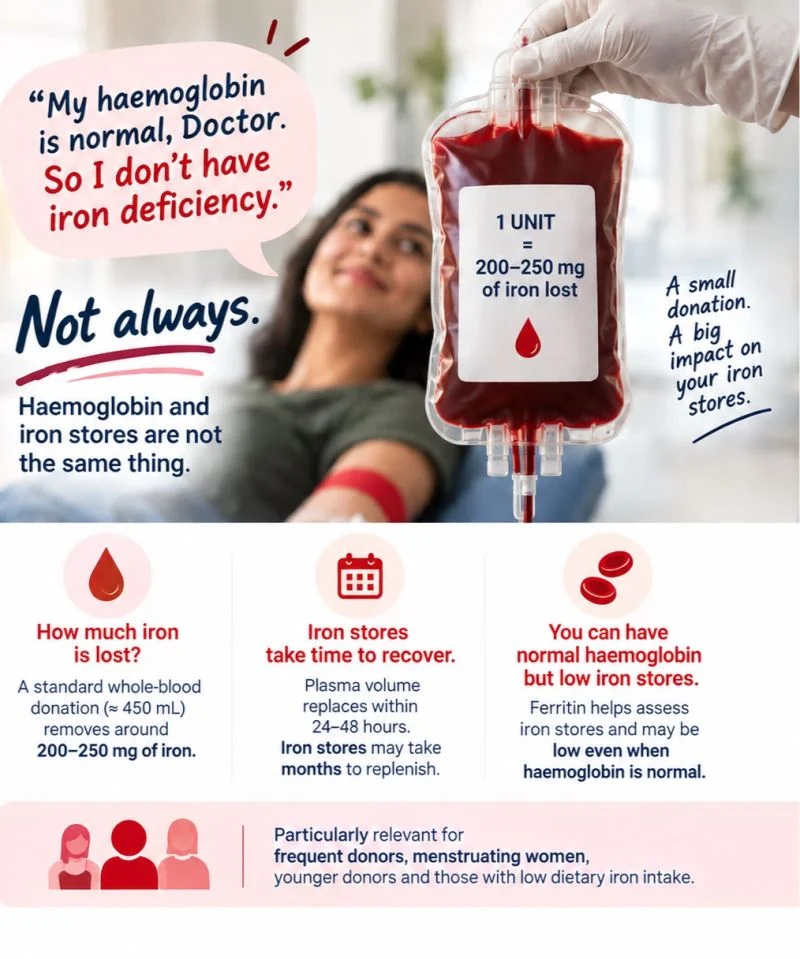
“‘My haemoglobin is normal, Doctor. So I don’t have iron deficiency.’
Not always!
One of the most important things we can teach our blood donors is that haemoglobin and iron stores are not the same thing.
What happens to iron when we donate blood?
A standard whole-blood donation removes approximately 450 mL of blood and around 200–250 mg of iron along with the red blood cells.
The donated plasma volume is replaced relatively quickly.
Red-cell mass and haemoglobin take longer to recover.
But the bigger issue is that iron stores may take considerably longer to replenish.
And repeated donations can progressively reduce those stores.
Therefore, a donor can have:
- Acceptable haemoglobin
- Low ferritin / depleted iron stores
Even before overt iron-deficiency anaemia develops.
This is why relying on haemoglobin alone may not identify every donor who is becoming iron depleted.
Who is particularly vulnerable?
Iron depletion deserves particular attention in:
- Frequent blood donors
- Menstruating women
- Women with heavy menstrual bleeding
- Younger donors
- Donors with low dietary iron intake
- Donors with a previous history of iron deficiency
Does this mean we should discourage blood donation?
Absolutely not!
Voluntary blood donation remains one of the most valuable contributions an individual can make to healthcare.
A message for donors:
If you are a frequent donor – particularly if you are a menstruating woman , talk to your healthcare professional about whether your iron stores may need assessment.
And a message for transfusion professionals:
Our responsibility does not end when the blood bag is labelled and stored.
The donor is also someone whose health we are responsible for protecting.”
Stay updated on all scientific advances with Hemostasis Today.
-
Sep 13, 2026, 16:22Tiffany Hall: Why Standard Pre-Op Labs Miss High-Risk Patients?
-
Sep 13, 2026, 16:09Dimitrios Syrengelas: Haemophilia Care Begins With Safe Movement
-
Sep 13, 2026, 15:33Christina (Tina) P.: Antiphospholipid Syndrome After Unprovoked VTE
-
Sep 13, 2026, 15:22Ioana Alexandra Voda: The Story Gets More Time at IFOS Istanbul
-
Sep 13, 2026, 14:52Omar Al Hammadi: Integrating Diabetes and Dyslipidemia in Modern Clinical Care
-
Sep 13, 2026, 14:37Mohammad Zamrood Khan: Hereditary Spherocytosis and Protein C/S Deficiency Case Report Submitted
-
Sep 13, 2026, 14:33Heghine Khachatryan: A Resource-Adapted Approach to Hemophilia Joint Care
-
Sep 13, 2026, 14:23Simon Fletcher: The Unmet Burden of Factor VII Deficiency
-
Sep 13, 2026, 14:10Azusa Nagao: The Evolving Burden of Haemophilia Prophylaxis