


Saleh Shamse Basha: Severe Neonatal Anemia – When the Analyzer Tells a Story Before the Slide Does
Saleh Shamse Basha, Senior Hematology Technologist (Reference Lab, HQ) at PureLab, shared a post on LinkedIn:
“Case Discussion: Severe Neonatal Anemia – When the Analyzer Tells a Story Before the Slide Does
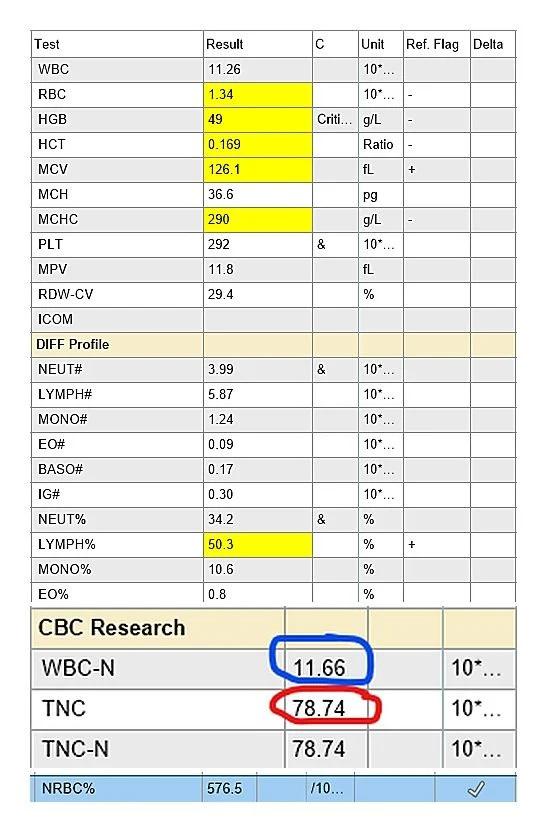
A newborn presented with Hb: 49 g/L, a critical value that immediately raises the question: hemolysis or hemorrhage?
Analyzer Findings (Sysmex XR-9000)
By looking at the WDF and WNR scattergrams, I felt something unusual – more striking than the critically low hemoglobin itself.
- TNC (Total Nucleated Cell): 78.74
- WBC: 11.26
- NRBC : 576/100 WBC
- Reticulocytes: 14%
The WNR channel is where the story begins.
It uses a lysing reagent that strips RBC and reticulocyte membranes but leaves NRBC nuclei intact, so both WBCs and NRBCs are counted together as the Total Nucleated Cell (TNC) count.
A related but separate issue appears on the WDF scattergram: immature NRBCs have larger nuclei that fall close to the WBC populations, sometimes overlapping the lymphocyte region and triggering a “WBC Abnormal Scattergram” flag.
When this happens, manual slide review and a true differential are essential in cases with marked NRBCs. The manual differential was very close to the analyzer count.
Blood Film
Marked anisopoikilocytosis with an elevated MCV, consistent with reticulocytosis.
Occasional target cells and schistocytes were also noted.
DAT: Negative, ruling out alloimmune hemolytic disease of the newborn.
Clinical History
Documented feto-maternal hemorrhage (FMH).
Interpretation
Putting it all together: severe anemia accompanied by reticulocytosis, marked NRBCs, a negative DAT, and a clinical history of feto-maternal hemorrhage is most consistent with acute or chronic blood loss anemia in the neonate secondary to massive FMH, rather than immune hemolysis.
The marrow response, evidenced by reticulocytosis together with marked NRBCs, is compensatory rather than causative.”
Stay updated with Hemostasis Today.
-
Sep 16, 2026, 16:06Katrina Louise Manalaysay: In Your 20s, You Might be Given the Opportunity to Donate Blood for the First Time
-
Sep 16, 2026, 15:45Matthew Hazell: A Brilliant Explanation of Phenotype vs Genotype Using a LEGO House
-
Sep 16, 2026, 15:23Ahmad Al-Ramahi: Presenting the Military Pharmacists Blood Training Course at the FIP World Congress
-
Sep 16, 2026, 15:21HIT Reimagined: Can 12-Lipoxygenase Inhibition Stop Immune Thrombosis?
-
Sep 16, 2026, 14:42Ruchi Punamia: Beyond the Blood Bank and The Clinical Impact of Apheresis
-
Sep 16, 2026, 14:06Kalyan Roy: Celebrating Apheresis, Advancing Care, Saving Lives
-
Sep 16, 2026, 13:38Andrew Zapfel: Advancing Sickle Cell Disease Care and Research
-
Sep 16, 2026, 13:30Thirunavukkarasu Angappan: Why Plasma-Derived Factor VIII Still Matters for Inhibitor Patients
-
Sep 16, 2026, 13:22Matthew Hazell: New BSH Guidance for Fetal, Neonatal and Paediatric Transfusion