


Salih Ehsan: Bradykinin-Mediated Transfusion Reactions in Patients on ACE Inhibitors
Salih Ehsan, Chief Executive Officer at Kulsoom Society of Hematology, shared Caitlin Raymond’s post on LinkedIn:
“Thanks for this information.
When an anemic patient comes to a transfusion center, take a look on the drugs that patient is taking regularly (ACE inhibitors, diuretics).
If the patient is taking ACE inhibitors, be ready for hypotensive transfusion reaction in the middle of transfusion.
Correct measures are:
- stop transfusion
- watch for BP, pulse, respiration, oxygen saturation, temperature, subjective feeling of patient.
If everything is okay, except BP then go for IV fluids (volume expander like normal saline).”
Caitlin Raymond, Assistant Professor of Pathology and Transfusion Medicine at University of Wisconsin-Madison, shared a post on LinkedIn:
“The transfusion reaction with the cleanest workup and the most interesting mechanism.
BP drops 40 points mid-transfusion.
No fever. No rash. No hemolysis.
DAT negative. Everything comes back normal.
This is a hypotensive transfusion reaction — and it’s not immunologic.
It’s pharmacologic.
Here’s what’s happening:
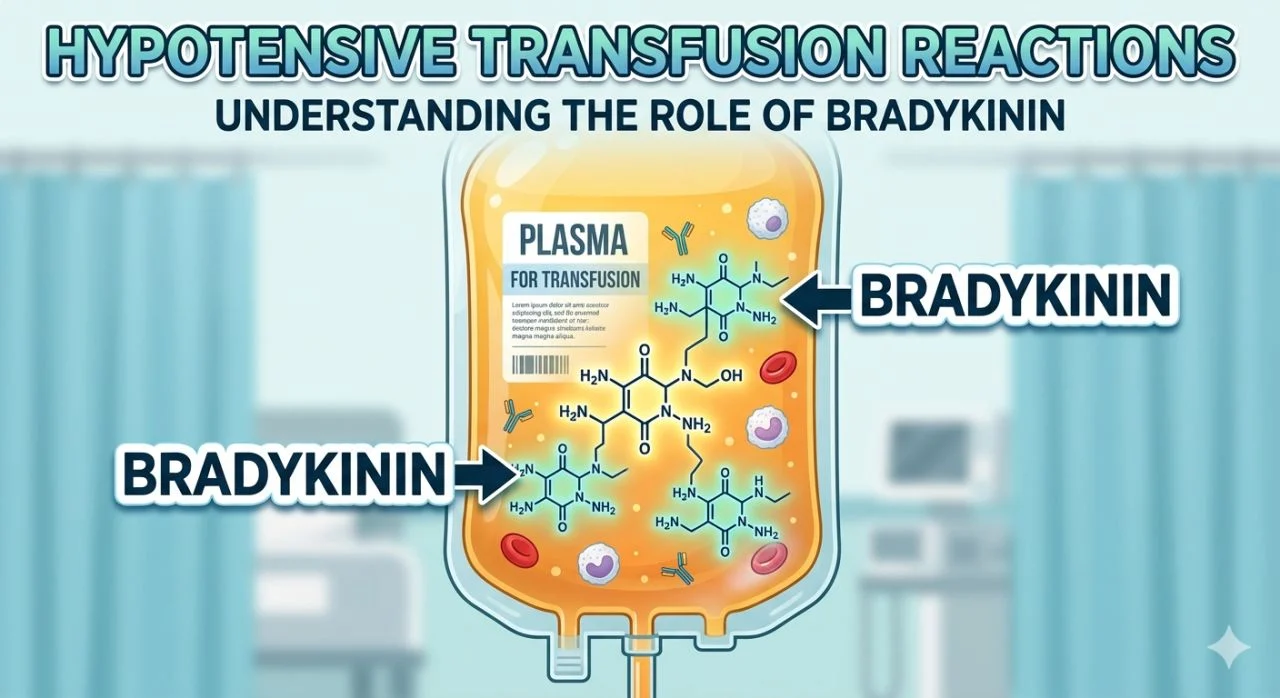
- Transfusion tubing and leukoreduction filters present a negatively charged surface to blood
- That contact activates Factor XII – kallikrein – bradykinin
- Bradykinin is a potent vasodilator with a half-life measured in seconds
- ACE normally clears it — but patients on ACE inhibitors can’t
- Result: bradykinin accumulates, vessels dilate, pressure drops
This is why ACE use is the most consistently identified risk factor for hypotensive transfusion reactions.
It’s not an allergy.
The drug is doing exactly what it was prescribed to do.
Management is straightforward: stop, fluids, recover.
No pre-medications indicated — Benadryl and acetaminophen do nothing for bradykinin-mediated hypotension.
The harder question is how many of these reactions we’re missing.
Hypotension is common in sick patients.
A modest BP dip in a patient on antihypertensives and diuretics may never trigger a workup.
New post on Blood Bytes Beyond.”
Stay updated with Hemostasis Today.
-
Sep 6, 2026, 18:17Aryabhatta Sadhu: Irradiation of Blood Components – From Clinical Indication to Laboratory Release
-
Sep 6, 2026, 18:15Ashenafi Tazebew Amare: A Year of Progress, Transformation and Renewed Commitment
-
Sep 6, 2026, 18:13Emilio Osorio: Can Anticoagulation Be Safely Discontinued After Surgical Left Atrial Appendage Occlusion?
-
Sep 6, 2026, 18:11Razan Alolyani: Our Research on Anticoagulation After Acute Ischemic Stroke Receives 2nd Place
-
Sep 6, 2026, 18:10Chayakrit Krittanawong: Have You Heard of Blood Clots in the Legs?
-
Sep 6, 2026, 18:08Trilok Chand: Microplastics Found in Human Testes and Blood Clots
-
Sep 6, 2026, 18:07Sarah Moharem Elgamal: Cardiovascular Imaging Beyond Anatomy Toward Earlier Risk Prediction
-
Sep 6, 2026, 16:41Christina P.: APS – How it Happens in Your Blood, the Warning Signs, and What to Do about It
-
Sep 6, 2026, 16:33Jose Angel Nicolas Avila: How Tissue Mitochondrial Activity Dictates Macrophage Pool Size