


Sally Mandour: Lupus Anticoagulant-The Tree Key Diagnostic Criteria
Sally Mandour, Associate Professor, Head of Hematology Unit at Clinical Pathology Department of National Liver Institute, Monofeya University, shared a post on LinkedIn:
“Lupus Anticoagulant Understanding
‘A positive test for a negative name’.
One of the most counterintuitive concepts in coagulation:
a ‘lupus anticoagulant‘ doesn’t cause bleeding in vivo – it’s associated with thrombosis.
The name comes purely from its behaviour in vitro, where it prolongs phospholipid-dependent clotting tests.
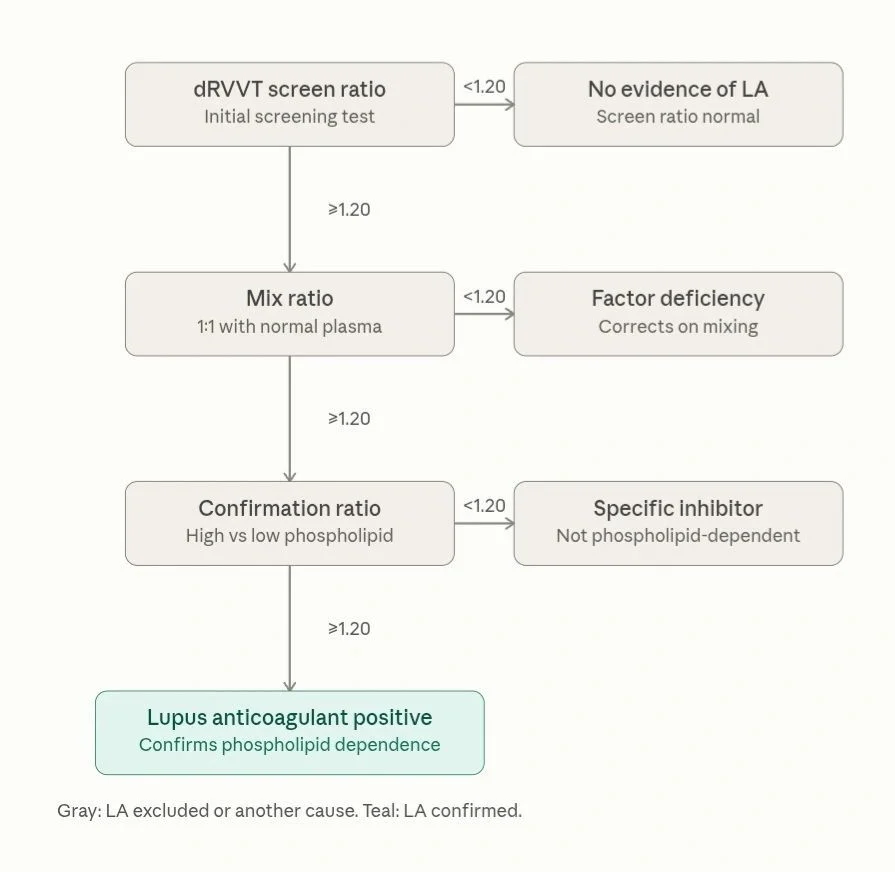
The ISTH minimum diagnostic criteria require proving three conditions:
- An abnormality in phospholipid-dependent coagulation (a prolonged APTT or PT).
- That the abnormality is caused by an inhibitor, not a factor deficiency.
- That the inhibitor is phospholipid-dependent, not a specific factor inhibitor.
How each criterion gets tested:
- Criterion 1 – A phospholipid-based clotting assay (APTT, PT, dRVVT, KCT, or PTT-LA)
- Criterion 2 – A 1:1 mixing study with normal plasma. If the clotting time corrects then factor deficiency. If it stays prolonged then an inhibitor is present. (A second tube is incubated 1–2 hours to also exclude a specific-factor inhibitor.)
- Criterion 3 – Repeating the test with varying phospholipid concentrations. If adding more phospholipid shortens the clotting time, the inhibitor is phospholipid-directed – consistent with LA.
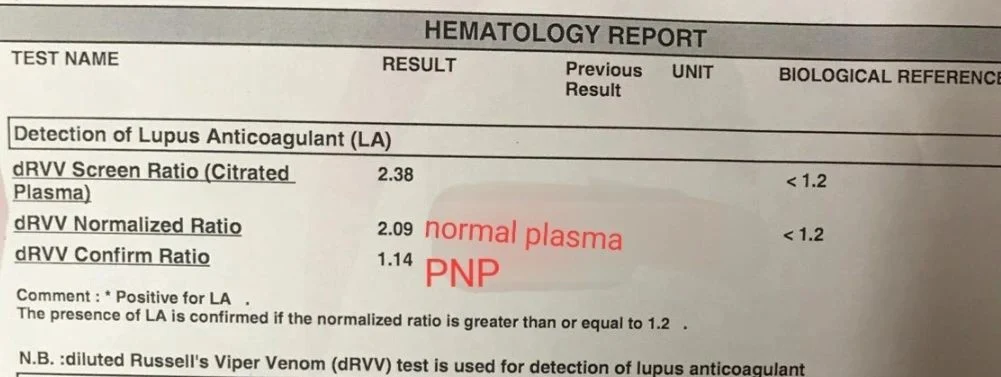
The workhorse test: dRVVT.
Russell’s viper venom directly activates Factor X, bypassing the intrinsic pathway’s earlier steps.
The result is reported as
- a screen ratio,
- a mix ratio (patient plus normal plasma, 1:1), and
- a confirmation ratio (high vs low phospholipid concentration).
And the pattern across all three determines the interpretation, not any single number in isolation.
Common traps:
- Residual platelets in frozen plasma – false negatives (hence double centrifugation before freezing).
- Anticoagulants (heparin, warfarin, DOACs) -false positives.
- dRVVT alone cannot distinguish LA from a Factor V or VIII inhibitor.
- LA must be confirmed as persistent (at least 12 weeks apart) before diagnosing antiphospholipid syndrome.
Other posts featuring Sally Mandour on Hemostatis Today.
-
Oct 26, 2026, 15:37Aryabhatta Sadhu: Intrauterine Red-Cell and Platelet Transfusion in Fetal Medicine
-
Oct 26, 2026, 15:25Christine Tunkl: Telestroke – Expanding Access to Evidence-Based Stroke Care
-
Oct 26, 2026, 15:13Heghine Khachatryan: Approaching Thrombocytopenia Through Mechanism and Clinical Context
-
Oct 26, 2026, 15:03Quentin Eichbaum։ AABB 2026 Annual Meeting Personal Highlights
-
Oct 26, 2026, 14:57A Father’s Marathon Journey Inspired by His Son – National Bleeding Disorders Foundation
-
Oct 26, 2026, 14:48Fran Huelsmeyer: The Clinical Importance of Blood Donation in Maternal Care
-
Oct 26, 2026, 14:45Maria Elisa Mancuso: Shaping the Future of Hemophilia Care with Patients
-
Oct 26, 2026, 14:35Choosing the Right VTE Risk Assessment Model for Clinical Practice
-
Oct 26, 2026, 14:29Ilenia Calcaterra: HEMOPLATE Explores Biological Factors Behind Bleeding Variability in Haemophilia A