

Tareq Abadl: Kell System and Anti-K Alloimmunization
Tareq Abadl, Medical Lab Specialist, shared a post on LinkedIn:
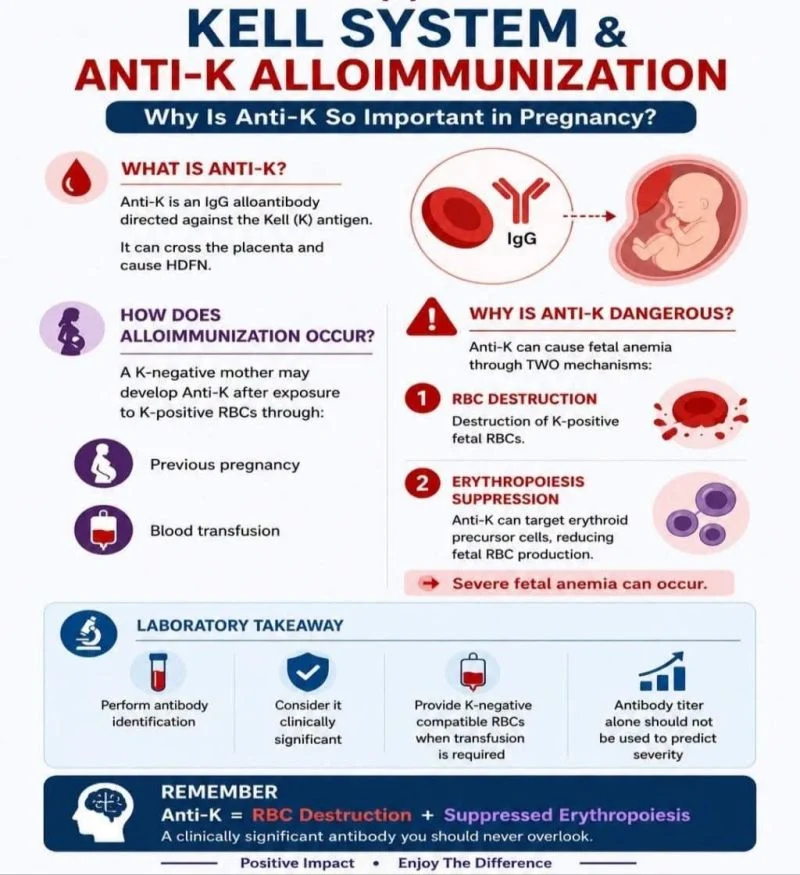
”Kell System and Anti-K Aloimunization
Why Is Anti-K So Important in Pregnancy?
What is anti-K
Anti-K is an IgG alloantibody directed against the Kell (K) antigen.
It can cross the placenta and cause HDFN.
How does alloimminization occur?
A K-negative mother may develop Anti-K after exposure to K-positive RBCs through:
- Previous pregnancy
- Blood transfusion
Why is anti-K dangerous?
Anti-K can cause fetal anemia through TWO mechanisms:
RBC Destruction
Destruction of K-positive fetal RBCs.
Erythropoiesis suppression
Anti-K can target erythroid precursor cells, reducing fetal RBC production.
Severe fetal anemia can occur.
Laboratory takeaway
When Anti-K is detected during pregnancy:
- Perform antibody identification
- Consider it clinically significant
- Provide K-negative compatible RBCs when transfusion is required
- Antibody titer alone should not be used to predict severity
Remember
Anti-K causes red blood cell destruction and suppression of red blood cell production.
A clinically significant antibody you should never overlook.”
Other posts featuring Tareq Abadl on Hemostasis Today.
-
Sep 21, 2026, 04:06Allison Lewin: How Gender Shapes the Way We Receive Medical Care
-
Sep 21, 2026, 03:49Jessica Lee: Walking Together for a Stronger Bleeding Disorders Community
-
Sep 21, 2026, 03:36Syed Asif Ali Shah: From Pakistan to Australia – A Clinical Haematology Milestone
-
Sep 21, 2026, 03:22Katie Baca-Motes: Estradiol Fluctuations May Help Explain Menstrual Migraine
-
Sep 21, 2026, 03:00Family History Can Reveal Hidden Risk of Aortic Dissection – The Marfan Foundation
-
Sep 21, 2026, 02:47Transitioning from Paediatric to Adult Haemophilia Care – Haemophilia Foundation Australia
-
Sep 21, 2026, 02:29Diana Castro Paupério: A New Era for Patient Blood Management
-
Sep 21, 2026, 00:29Iheanyichukwu Ike: Childhood Anaemia in Nigeria Through an Analysis of the 2018 NDHS
-
Sep 21, 2026, 00:27Nicole De Vita: The Global Burden of Iron Deficiency and Anemia in Women at SABM