


Thirunavukkarasu Angappan: Why Hemophilia B Still Needs Both Plasma-Derived and Recombinant Factor IX
Thirunavukkarasu Angappan, Vice President of Operations and Manufacturing at PopVax, shared a post on LinkedIn:
“BeneFIX Is Recombinant. Mononine Isn’t. Hemophilia B Patients Still Need Both on the Shelf.
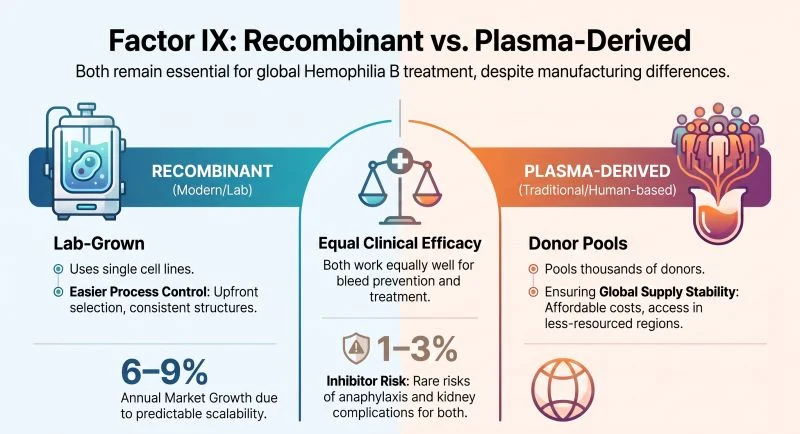
Every vial of plasma-derived Factor IX carries a bit of thousands of different donors in it. Every vial of recombinant Factor IX, like BeneFIX, comes from just one carefully chosen cell line grown in a lab.
- Plasma-derived products pool thousands of donors into each batch, which means small differences — in sugar structures on the protein, in donor variation — that manufacturers have to control for every single time.
- Recombinant products come from one fully characterized cell bank. RIXUBIS, for example, is made in a CHO (Chinese hamster ovary) cell line and doesn’t use any human or animal material in its manufacturing. There’s still some batch-to-batch variation even here, but it’s the kind you can select for and control upfront, not something that changes with every new donor pool.
- Recombinant Factor IX keeps growing its market share — about 6 to 9% a year — largely because that kind of control is easier to build a process around.
But here’s where it gets more interesting than ‘manufacturing wins’.
Plasma-derived and recombinant Factor IX actually work equally well for normal bleed prevention and treatment — that’s well established. The real complication shows up with inhibitors.
Hemophilia B inhibitors are rare, about 1 to 3% of patients, but when they happen, they bring a real risk that Factor VIII inhibitors don’t carry the same way — anaphylaxis, and sometimes kidney complications like nephrotic syndrome, and this can happen whether the product is plasma-derived or recombinant.
Trying to build immune tolerance in these patients is much harder and riskier in hemophilia B than in hemophilia A, with fairly unpredictable success. So for these patients, doctors usually don’t just give more Factor IX of either kind — they turn to bypassing agents instead.
I’ve spent my career validating both mammalian cell platforms and reviewing plasma product quality systems, and here’s my honest read: the case for keeping plasma-derived Factor IX around isn’t about it being clinically better for any one group of patients.
It’s about keeping supply steady, keeping costs manageable, and making sure patients in places where recombinant supply isn’t always reliable still have a treatment option.
As recombinant manufacturing keeps scaling up, does plasma-derived Factor IX still have a real clinical reason to stick around — or does it end up being mainly a backup option for less-resourced healthcare systems?”
Other posts featuring Thirunavukkarasu Angappan on Hemostasis Today.
-
Oct 16, 2026, 16:01Obi Light Ogbonnia: The Greatest Reward Is Changing Lives, Not Winning Awards
-
Oct 16, 2026, 15:18Carmine Liberatore: Limited Accuracy of VTE Risk Scores in Multiple Myeloma
-
Oct 16, 2026, 14:55Alex Borstein and the Bleeding Phenotype of Hemophilia A Carriers
-
Oct 16, 2026, 13:59Aya Akmal Amin: Antiphospholipid Syndrome Management and Risk Stratification
-
Oct 16, 2026, 13:10Emanuel Sueldo: CAHT 2026 Celebrates Scientific Progress and Team Achievements
-
Oct 16, 2026, 13:05Maha Othman: Queen’s Health Sciences Advances CAT Risk Models and Pediatric ISTH-BAT Cut-Offs
-
Oct 16, 2026, 13:03Thrombosis Awareness Must Lead to Timely Action – Roche
-
Oct 16, 2026, 12:49Wolfgang Miesbach: 5-Year CBDR Data Confirms Emicizumab Safety and Efficacy in Hemophilia A
-
Oct 16, 2026, 12:40Edward Lee Carter: How Factor XI Inhibition Could Transform Anticoagulation Therapy