


Thirunavukkarasu Angappan: Factor VIII and IX Didn’t Get Viral-Safety Rules Until the 1980s
Thirunavukkarasu Angappan, Vice President – Operations and Manufacturing at PopVax, shared a post on LinkedIn:
”Factor VIII and IX Didn’t Get Viral-Safety Rules Until the 1980s. The Hemophilia Community Paid Twice For That Delay.
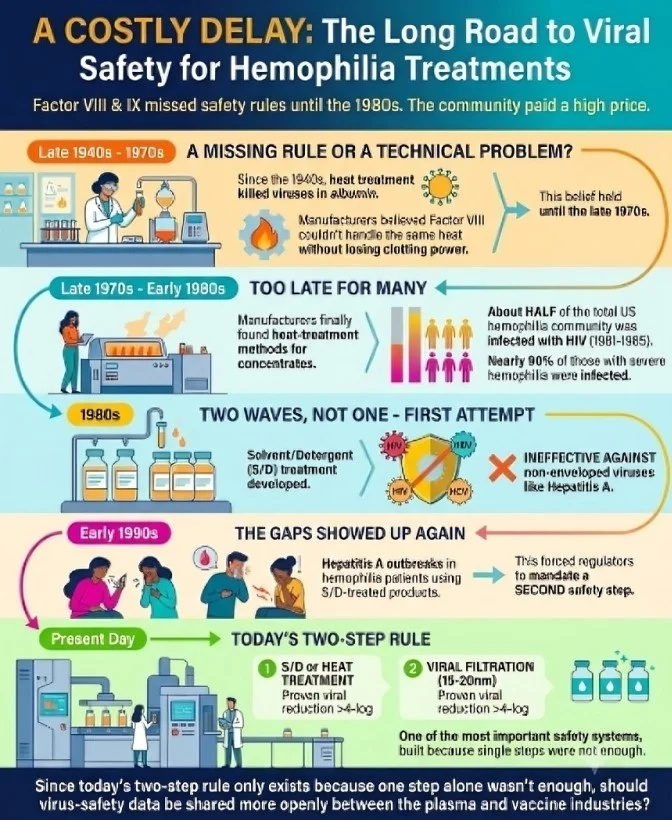
Heat treatment to kill viruses in blood products has been used since the late 1940s — but only for albumin. As documented in the Penrose Inquiry, manufacturers believed Factor VIII simply couldn’t handle the same heat without losing its clotting power — a real technical problem, not just a missing rule.
As per the same Penrose Inquiry findings, that belief held until the late 1970s, when manufacturers finally worked out how to heat-treat factor concentrates — but the fix came too late for what had already happened.
As reported by the Institute of Medicine and confirmed by the National Bleeding Disorders Foundation, about half of the entire US hemophilia community got infected with HIV between 1981 and 1985, and close to 90% of those with severe hemophilia were infected.
The safety response came in two waves, not one. As mentioned by Applied Clinical Trials, solvent/detergent (S/D) treatment, developed in the 1980s, worked well against HIV, Hepatitis B, and Hepatitis C — but did nothing against non-enveloped viruses like Hepatitis A.
That gap showed up again in the early 1990s, when Hepatitis A outbreaks hit hemophilia patients despite S/D-treated products. As said by Tuna et al. in Annals of Blood, this forced regulators to mandate a second, different safety step — the direct origin of today’s two-step rule.
As per FDA guidance, most plasma products now go through two steps — S/D or heat treatment, plus filtering down to 15–20nm (nanofiltration) — each proven to cut virus levels by more than a 4-log reduction, as per BioProcess International’s viral clearance standards.
This is one of the most important, least talked-about safety systems in biologics manufacturing — built not ahead of time, but because one step failed, and then a second wasn’t enough either.
Since today’s two-step rule only exists because one step alone wasn’t enough, should virus-safety data be shared more openly between the plasma and vaccine industries — or do companies still have good reason to keep it private?”
Stay updated with Hemostasis Today.
-
Oct 19, 2026, 11:37Beth Faiman: APSHO Fellows Celebrated for Advancing Hematology and Oncology Practice
-
Oct 19, 2026, 11:26Emanuele Pacini: Myelodysplastic Syndromes Research Featured at JSH Annual Meeting in Kyoto
-
Oct 19, 2026, 10:57Jesmond Dalli: How Erythroblasts Shape Neutrophil Development and Function
-
Oct 19, 2026, 10:41Hisham Fahmi: SCD – Should Gene Editing Begin Before Organ Damage?
-
Oct 19, 2026, 10:33Pallavi Madhiraju: YARTEMLEA Faces Another European Rejection Despite FDA Approval
-
Oct 19, 2026, 10:28Brig Tathagata Chatterjee: Acute Leukemias in AYAs at the Japanese Society of Hematology Conference
-
Oct 19, 2026, 10:27Heather M. Johnson: Join the Discussion on Optimizing the CTEPH Diagnostic Pathway
-
Oct 19, 2026, 10:18Flora Peyvandi: Unravelling the Complexity of VWF Through Genetics
-
Oct 19, 2026, 09:55High DOAC Adherence in Patients With Ischemic Stroke and AF – International Journal of Stroke