


William Wallace: Vitamin C and Collagen Work as One Biological System
William Wallace, Co-Founder and Chief Scientific Officer at Supplement Success Solutions, shared a post on LinkedIn:
“Vitamin C and collagen are really part of the same machine.
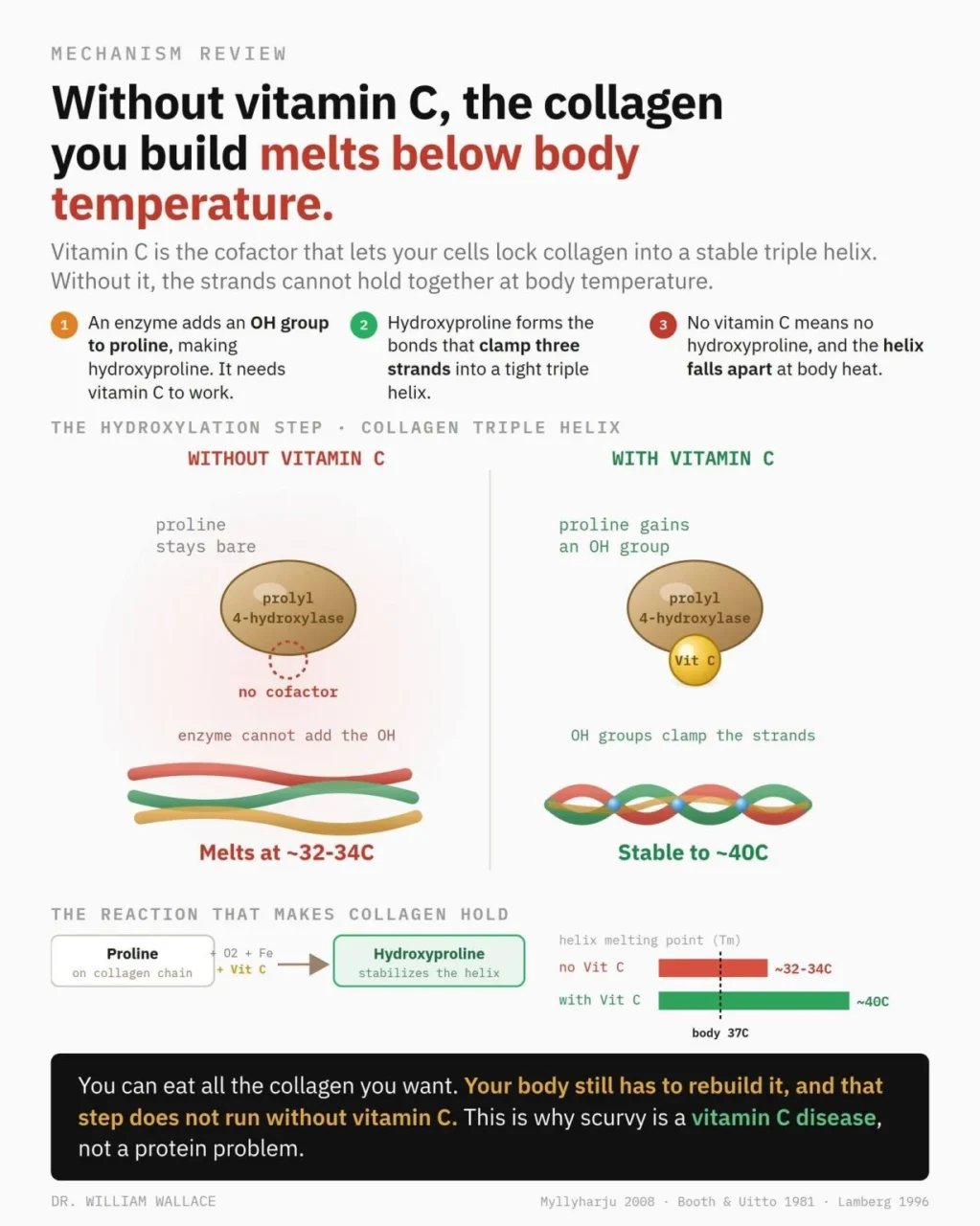
Collagen is built from three protein strands that wind into a tight triple helix. That helix is what gives collagen its strength. But the strands do not hold together on their own. They need a chemical modification first, and that modification is where vitamin C comes in.
An enzyme called proly 4-hydroxylase grabs proline residues on the collagen strands and adds an OH group, turning them into hydroxyproline.
Those hydroxyproline residues are what lock the three strands into a stable helix. The enzyme cannot run without its cofactors, and vitamin C is one of them. No vitamin C, no hydroxyproline.
Collagen that has not been properly hydroxylated does not hold its shape at body temperature. In a recombinant human collagen system, under-hydroxylated triple helices melted at around 32 to 34 degrees C. With vitamin C present and the enzyme working, the melting point rose to about 40 degrees C. Your body runs at 37.
So without enough vitamin C, the collagen you build comes apart at the temperature you live at.
This is the actual mechanism behind scurvy. It is not a protein deficiency. Sailors with scurvy were eating plenty of protein. They were not making stable collagen because they had no vitamin C, so wounds reopened, gums broke down, and old scars failed. The fix was not more meat. It was a lime.
So if you are taking collagen for skin, joints, or connective tissue, the vitamin C is not an optional add-on. It is the cofactor that makes the collagen step run at all. Eating collagen gives your body raw material. Vitamin C is what lets your body build with it.
The exact melting point numbers come from a lab expression system, not a measurement inside a living person. Under-hydroxylated collagen is unstable at body temperature, and that is textbook biochemistry.
- Myllyharju, Ann Med, 2008
- Booth and Uitto, Biochim Biophys Acta, 1981
- Lamberg et al., J Biol Chem, 1996.”
Stay updated with Hemostasis Today.
-
Sep 23, 2026, 16:04Monia Ezzalfani: Advancing Patient-Centered Care in Hemophilia A and B
-
Sep 23, 2026, 15:49Bilge Başak: How Activated PRP Modulates Osteoarthritic Chondrocyte Function
-
Sep 23, 2026, 14:50Mbonjo Bitsie Dora: Strengthening Sickle Cell Care Through Education, Awareness and Innovation
-
Sep 23, 2026, 13:58The New B12 Diagnostic Algorithm: From Serum Cobalamin to Functional Deficiency
-
Sep 23, 2026, 13:56Noha Soror: Preparing for Hematology and Medical Oncology Board Certification
-
Sep 23, 2026, 13:46Ugochi Ogu: What Can Platelet Proteomics Reveal about Pain and Neurocognitive Vulnerability in Sickle Cell Disease?
-
Sep 23, 2026, 13:42Melissa Hollo: Connecting Obesity and Anemia for Earlier Maternal Risk Intervention
-
Sep 23, 2026, 13:16Beverley Hunt: Advances in Haemostatic Management of Postpartum Haemorrhage
-
Sep 23, 2026, 13:13Ioanna Mela: Recruiting a Research Associate on DNA nanotechnology