


Wolfgang Miesbach: Base Editing Expands Therapeutic Targets for Hemophilia B
Wolfgang Miesbach, Professor of Medicine at Frankfurt University Hospital, shared a post on LinkedIn:
“Base editing for haemophilia B at ISTH 2026.
Tsukasa Ohmori (Jichi Medical University) presented OC 58.3, with Satoshi Omura, Hiroshi Nishimasu and Osamu Nureki (University of Tokyo).
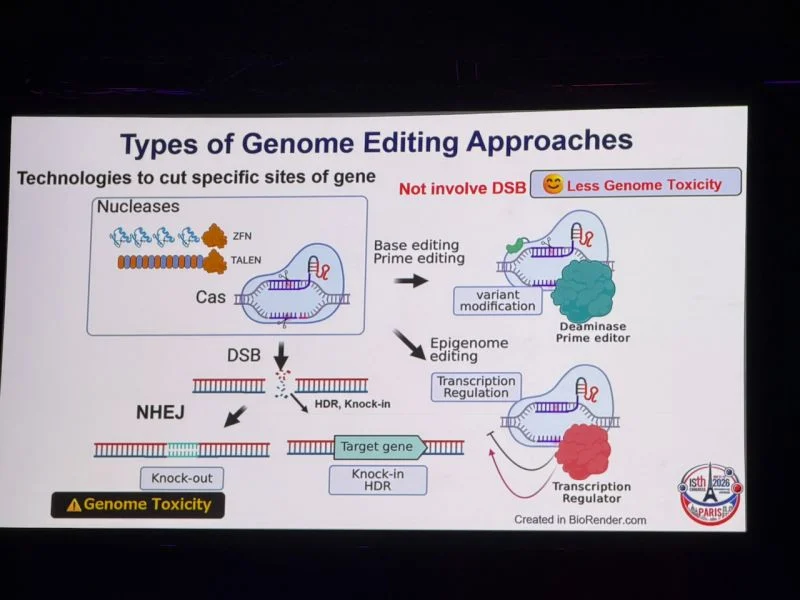
The rationale Haemophilia B is mostly caused by single-nucleotide variants in F9. Base editing rewrites the base without a double-strand break, resulting in less genome toxicity.
In the EAHAD database: 4,151 of 4,657 F9 variants (89.1%) are point mutations, and 67.2% are in principle base-editor-correctable.
The obstacle: The PAM (protospacer adjacent motif) is a short DNA motif next to the target that Cas9 must recognise before it can bind. It fixes the editing window – and decides which variants are reachable at all. SaCas9 fits into AAV (1,053 aa, 3.2 kb) but demands NNGRRT, which excludes most variants.
The advance Structure-guided engineering resulted in SaCas9-NNG, requiring only a single G.
Results
- Efficient hepatic cleavage at NNGA, NNGT, NNGC sites – not achieved by wild-type SaCas9
- Adenine base editor with sgRNA in a single AAV8 vector, liver-specific promoter
- F9 c.280G>A: corrected in approximately 60% of hepatocytes, significant rise in FIX activity (wild type: 0%)
- F9 c.364G>A: approximately 40%, higher than wild type but not significant
- Non-viral arm: ABE8e-SpRY by lipid nanoparticle restored 52–70% FIX activity across three patient variants (Hiya-Kawaguchi et al., JTH, in press)
PAM compatibility decides how many patients a base editor can serve. A previously untargetable variant corrected in most hepatocytes, from one vector, is a real step forward.”
Other posts featuring Wolfgang Miesbach on Hemostasis Today.
-
Sep 17, 2026, 07:37Jim Hoffman: Could NET Removal Help Restore Vascular Homeostasis?
-
Sep 17, 2026, 04:43Tom Tang: Preventing Post Thrombotic Syndrome Starts With Early DVT Prevention
-
Sep 17, 2026, 04:35Veronica Sanchez: Menopause as a Risk for Heart Disaese
-
Sep 17, 2026, 03:20Jessica Frye: Understanding VTE in Pregnancy and the Postpartum Period
-
Sep 17, 2026, 03:04Leonardo Roever: Exploring the Role of Glutamine Metabolism in Atherosclerosis
-
Sep 17, 2026, 02:36Wolfgang Miesbach: Effectiveness of Avatrombopag in ITP Treatment
-
Sep 17, 2026, 02:34Aleksandar Sič: The Endothelium and Cardiovascular Toxicity in Blood Cancers
-
Sep 16, 2026, 15:45Matthew Hazell: A Brilliant Explanation of Phenotype vs Genotype Using a LEGO House
-
Sep 16, 2026, 15:23Ahmad Al-Ramahi: Presenting the Military Pharmacists Blood Training Course at the FIP World Congress