

Reduced-Dose DOACs in GI Malignancies: Toward Personalized Anticoagulation
Heghine Khachatryan reflects on emerging evidence presented at ISTH 2026 supporting reduced-dose direct oral anticoagulants for extended anticoagulation in patients with gastrointestinal malignancies.
Balancing Thrombosis Prevention and Bleeding Risk in Cancer-Associated VTE
Venous thromboembolism (VTE) remains a major complication among patients with cancer and anticoagulation is a cornerstone of management.
However, the optimal duration and intensity of anticoagulant therapy continue to present significant clinical challenges, particularly in patients with gastrointestinal (GI) malignancies.
Patients with gastrointestinal cancers represent one of the most complex populations for anticoagulation management due to their increased susceptibility to bleeding complications.
While extended anticoagulation reduces the risk of recurrent VTE, maintaining long-term therapy requires careful consideration of the individual patient’s thrombotic and hemorrhagic risks.
During the ISTH 2026 Congress in Paris, new insights were presented regarding the potential role of reduced-dose direct oral anticoagulants (DOACs) as a strategy to improve the safety of extended anticoagulation in this high-risk population.
Evidence Supporting Reduced-Dose DOAC Strategies
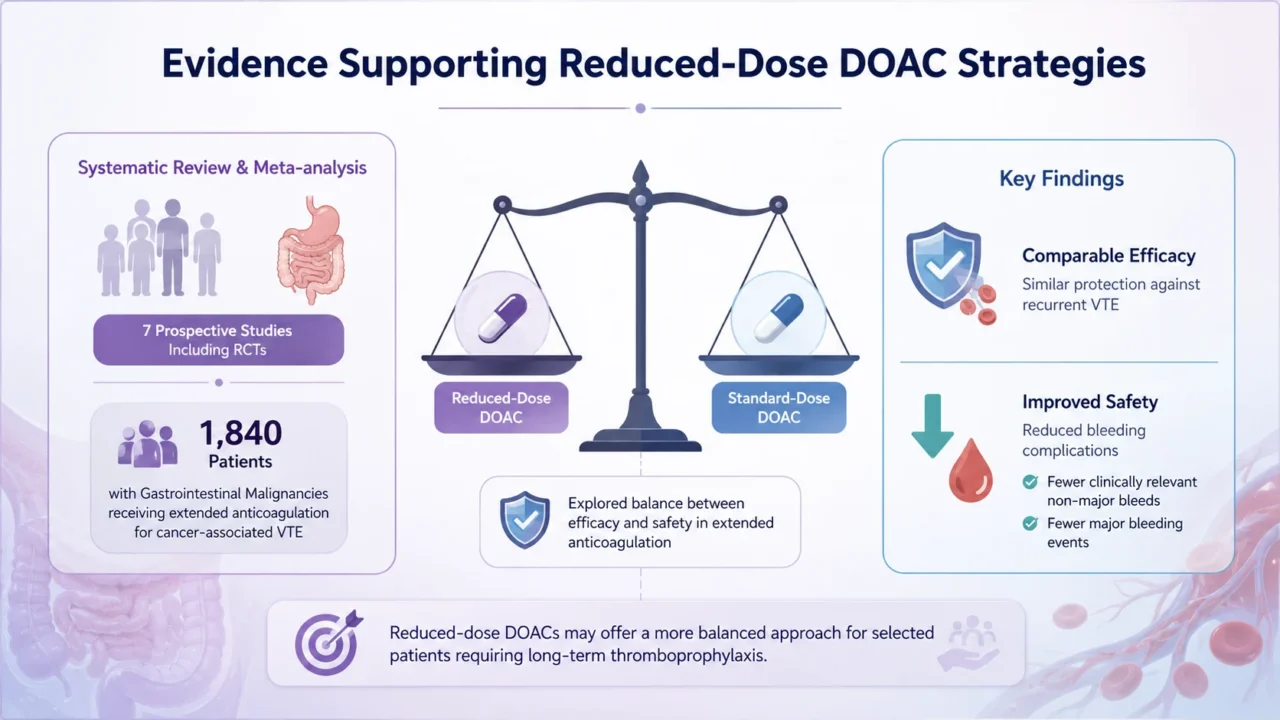
The presented systematic review and meta-analysis evaluated evidence from seven prospective studies, including randomized clinical trials, involving 1,840 patients with gastrointestinal malignancies receiving extended anticoagulation after cancer-associated VTE.
The analysis explored whether reduced-dose DOAC regimens could maintain effective protection against recurrent thrombotic events while reducing bleeding complications compared with standard-dose treatment.
The findings demonstrated that reduced-dose DOACs provided comparable efficacy in preventing recurrent VTE, while showing a favorable safety profile. Patients receiving reduced-dose therapy experienced fewer bleeding complications, including reductions in both clinically relevant non-major bleeding and major bleeding events.
These results highlight the possibility that lower-intensity anticoagulation may provide a more balanced approach for selected patients requiring long-term thromboprophylaxis.
Moving Toward Individualized Anticoagulation
The concept of a fixed anticoagulation strategy for all patients is increasingly being challenged by modern thrombosis care. Cancer-associated thrombosis is a dynamic condition, where both thrombotic and bleeding risks can change throughout the patient’s disease course.
For individuals with gastrointestinal malignancies, factors such as tumor location, treatment modalities, disease progression, and overall clinical status may significantly influence the safety of anticoagulant therapy.
The findings presented at ISTH 2026 reinforce the importance of personalized anticoagulation, where treatment intensity is adapted according to each patient’s risk profile rather than relying exclusively on standardized dosing approaches.
Current Evidence and Remaining Questions
Despite these promising findings, several important questions remain unanswered. Current evidence is limited by differences among study populations, variations in treatment protocols, and relatively small numbers of patients within specific gastrointestinal cancer subgroups.
Further large-scale randomized clinical trials and prospective real-world registries will be needed to determine which patients are most likely to benefit from reduced-dose DOAC strategies and to define how these approaches should be incorporated into future clinical guidelines.
The Future of Precision Medicine in Cancer-Associated Thrombosis
The discussions at ISTH 2026 reflected a broader transformation occurring in thrombosis management: the shift from uniform anticoagulation approaches toward precision-based treatment decisions.
For patients with cancer, the goal of anticoagulation extends beyond preventing recurrent thrombosis. It also involves minimizing treatment-related complications, maintaining quality of life, and adapting therapy to the evolving needs of each individual.
Reduced-dose DOAC strategies represent an important step toward achieving this balance—offering the potential to preserve antithrombotic protection while improving safety for some of the most vulnerable patients receiving long-term anticoagulation.
Written by Heghine Khachatryan, MD, PhD, Editor-in-Chief at Hemostasis Today.
Stay Updated with the Latest ISTH 2026 Updates on Hemostasis Today.
-
Oct 11, 2026, 10:44Logesh. M: Managing Warfarin-Associated Recurrent Epistaxis and Anticoagulant Safety
-
Oct 11, 2026, 10:28Sébastien Béland: Validating RUDAS for Detecting Neurocognitive Impairment in Sickle Cell Disease
-
Oct 10, 2026, 17:58Archo Farzana Batool: Exploring Medical Writing Through an Article on Iron Deficiency Anemia
-
Oct 10, 2026, 17:53Assessing Frailty in Adults With Hemophilia – JTH
-
Oct 10, 2026, 17:52Fatma Sadeghi: Reducing Maternal Health Inequalities Through Nursing Advocacy
-
Oct 10, 2026, 17:50Grzegorz Hensler: How Apheresis Transformed Blood Cell Separation and Collection
-
Oct 10, 2026, 17:47Hemant K Sharma: Japan’s Universal Artificial Blood Research – A Potential Breakthrough in Transfusion Medicine
-
Oct 10, 2026, 17:40John Strouse: Learning About Bleeding Disorders and Sickle Cell Disease at FWGBD
-
Oct 10, 2026, 17:34Mae Caime: Speaking at the Annual Women’s Retreat for the Hemophilia Community in Florida