


Salvatore Massimo Petrina: High D-Dimer, Negative CT Scan – What’s Your Next Move?
Salvatore Massimo Petrina, Hospital Physician Cardiology ASP Ragusa, shared on LinkedIn:
”Title: High D-Dimer, Negative CT Scan: What’s Your Next Move?
It’s a scenario every clinician knows well: a patient has a high D-dimer, you order a CT to rule out PE, and the scan comes back negative.
Do you discharge the patient and breathe a sigh of relief?
Not so fast.
A negative CT is a crucial data point, but it’s not always the end of the diagnostic journey.
A high D-dimer is a non-specific marker of coagulation activation, and we have a responsibility to investigate further.
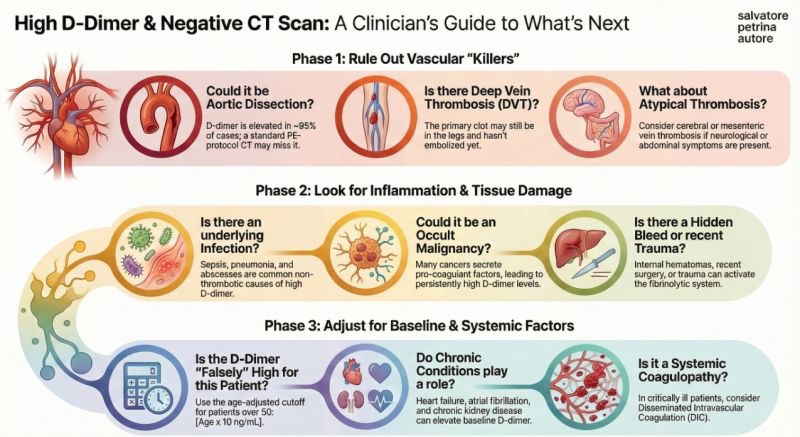
This guide provides an excellent 3-phase framework for navigating this clinical puzzle:
Phase 1: Rule Out Other Vascular Risks
Before moving on, double-check for other life-threatening conditions that could have been missed or present concurrently.
Aortic Dissection: A critical can’t-miss diagnosis.
Deep Vein Thrombosis (DVT): Was a DVT ruled out, or was the focus solely on the PE?
Other VTE Events: Consider less common thrombotic events.
Phase 2: Search for Inflammation and Injury
The D-dimer is often elevated due to significant systemic stress.
It’s time to broaden the differential.
Infection/Sepsis: A very common cause of high D-dimer levels.
Occult Malignancy: Always consider this, especially in patients with no prior history.
Covert Bleeding or Trauma: Look for internal bleeding or injuries that aren’t immediately obvious.
Phase 3: Adjust for Baseline and Systemic Factors
Sometimes, the high D-dimer reflects the patient’s chronic state rather than an acute event.
Chronic Inflammation: Conditions like rheumatoid arthritis or IBD.
Systemic Coagulopathies: Underlying clotting disorders.
Patient-Specific Factors: Advanced age or post-surgical state can keep levels elevated.
The key takeaway: A high D-dimer is a signal to keep looking.
A systematic approach ensures we don’t stop our search prematurely and provide the best care for our patients.
How do you approach this situation?
Share your clinical pearls and go-to differentials below!”
Stay updated with Hemostasis Today.
-
Oct 10, 2026, 09:48Ahmed Alotaibi: Can We “Remove” the ABO Problem from Group O Platelets?
-
Oct 10, 2026, 09:31Help Shape the New ASH Iron Deficiency Guidelines – American Society of Hematology
-
Oct 10, 2026, 09:05Wolfgang Miesbach: Moving from Bleed Control to Comprehensive Joint Health
-
Oct 10, 2026, 07:59Leila Caroline Souza Reis: Enoxaparin Dosing for VTE Prevention in Adults With Obesity
-
Oct 10, 2026, 07:41Adeeb Bazuhair: New Evidence for Catheter Directed Thrombolysis in Acute PE
-
Oct 10, 2026, 07:22Poppy Clarke: Turning Steps Into Support for Thrombosis Awareness
-
Oct 10, 2026, 07:12Hamzah Khan: The Role of Genuine Curiosity in Driving High-Impact Academic Research
-
Oct 10, 2026, 06:58Nita Radhakrishnan: Turning Evidence Into Action for Hemophilia Care in India
-
Oct 10, 2026, 06:48Nutan Kaushik: HemeNext 2.0 Brings Global Perspectives to Hematology