


Abdulla A. Damluji Summarizes CORAL Reef Trial
Abdulla A. Damluji, Director of the Cardiovascular Center on Aging at Cleveland Clinic, shared on LinkedIn:
”CORAL reef trial – NEJM Group
Here is the summary
Lowering low density lipoprotein cholesterol remains one of the most reliable strategies for reducing the risk of myocardial infarction, ischemic stroke, and cardiovascular death. Contemporary recommendations advise very low targets for patients at highest risk.
Yet many individuals who receive statins, and often additional lipid lowering agents, continue to have levels above those thresholds.
Therapies that inhibit proprotein convertase subtilisin kexin type 9 have transformed care, but their uptake in routine practice has been limited in part because available options require injection.
A phase three trial published in the New England Journal of Medicine evaluated a potential solution.
CORALreef Lipids tested enlicitide decanoate, a once daily oral macrocyclic peptide designed to block the interaction between proprotein convertase subtilisin kexin type 9 and the low density lipoprotein receptor.
The central question was straightforward.
Can an oral agent deliver reductions in atherogenic lipoproteins comparable to those seen with injectable therapies while maintaining acceptable safety?
Trial Design
Investigators enrolled adults with a history of major atherosclerotic cardiovascular disease or with clinical characteristics that conferred high predicted risk for a first event.
Entry required low density lipoprotein cholesterol at or above contemporary thresholds despite background therapy.
Participants continued usual lipid management, which in nearly all cases included moderate or high intensity statins.
A total of 2909 participants underwent randomization at 168 sites across fourteen countries.
Patients received enlicitide at a dose of twenty milligrams once daily or placebo in a two to one ratio.
Treatment continued for fifty two weeks.
The primary end point was the percent change in low density lipoprotein cholesterol at twenty four weeks.
Population
The mean age was approximately sixty three years. Women comprised about forty percent of the cohort.
More than half of the participants had already sustained a major cardiovascular event.
Baseline low density lipoprotein cholesterol averaged roughly ninety six milligrams per deciliter, underscoring persistent risk despite widespread use of established therapies.
Lipid Effects
The magnitude of reduction in low density lipoprotein cholesterol was large. At twenty four weeks, participants assigned to enlicitide experienced a mean decrease of 57.1 percent from baseline.
In contrast, those assigned to placebo had a small increase of about three percent. The adjusted difference between groups was 55.8 percentage points, with strong statistical support.
Importantly, the effect persisted. At fifty two weeks, the separation between groups remained 47.6 percentage points.
Other atherogenic measures moved in parallel. Non high density lipoprotein cholesterol fell by 53.4 percentage points relative to placebo, and apolipoprotein B declined by 50.3 percentage points. Lipoprotein a levels were also lower, with a median reduction of 28.2 percentage points.
Goal attainment reflected these shifts.
Approximately seventy percent of treated participants achieved a low density lipoprotein cholesterol level below seventy milligrams per deciliter along with at least a fifty percent reduction.
Two thirds reached values below fifty five milligrams per deciliter with that same proportional decline.
Safety and Adherence
Adherence exceeded ninety seven percent and was similar in both groups. The frequency of adverse events, serious adverse events, discontinuations, and deaths did not appear different between enlicitide and placebo.
Investigators monitored new or worsening diabetes and liver injury, and rates were comparable.
Context Within Current Therapy
The reductions observed in this trial approach those reported with monoclonal antibody therapies directed at the same pathway.
For many clinicians, the key distinction lies in route of administration.
A once daily pill may fit more naturally into chronic preventive care, particularly for patients who hesitate to initiate injectable treatment or who face logistical barriers.
The trial did not evaluate cardiovascular outcomes. An event driven study is underway and will determine how these lipid changes translate into clinical benefit.
Key implications helpful to clinical practice
- An oral inhibitor of proprotein convertase subtilisin kexin type 9 can reduce low density lipoprotein cholesterol by roughly one half in patients already treated with statins.
- The effect remains durable for at least one year.
- Large proportions of patients can achieve targets below fifty five milligrams per deciliter.
- Reductions extend beyond low density lipoprotein cholesterol to non high density lipoprotein cholesterol, apolipoprotein B, and lipoprotein a.
- Safety signals in this trial resembled placebo.
- Oral administration may lower barriers to treatment initiation and long term persistence.
- Definitive evidence regarding prevention of myocardial infarction and stroke awaits completion of the outcomes trial.”
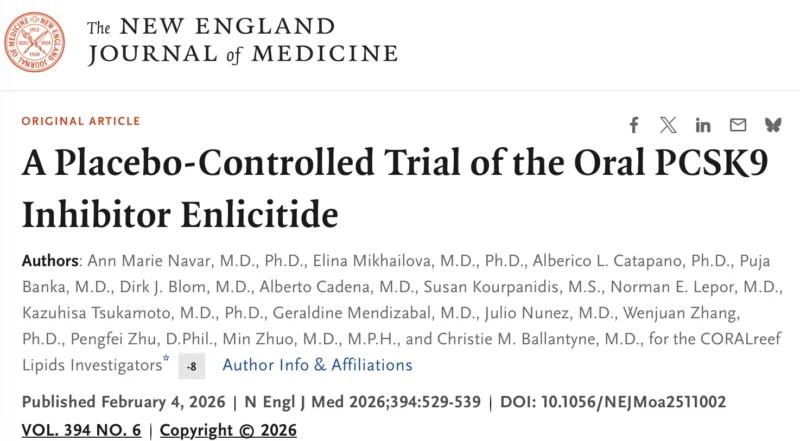
Title: A Placebo-Controlled Trial of the Oral PCSK9 Inhibitor Enlicitide
Authors: Ann Marie Navar, Elina Mikhailova, Alberico L. Catapano, Puja Banka, Dirk J. Blom, Alberto Cadena, Susan Kourpanidis, Norman E. Lepor, Kazuhisa Tsukamoto, Geraldine Mendizabal, Julio Nunez, Wenjuan Zhang, Pengfei Zhu, Min Zhuo, Christie M. Ballantyne
Read the Full Article on NEJM
Stay updated on all scientific advances with Hemostasis Today.
-
Oct 7, 2026, 16:44Amor Salah: 2026 NCS/SCCM Guidelines for Managing Antithrombotic-Associated ICH
-
Oct 7, 2026, 16:04NETs in Thrombosis: From Mechanism to Therapeutic Target
-
Oct 7, 2026, 15:28Amir Samimi: Prognostic Value of Platelet Count in Resected HNSCC
-
Oct 7, 2026, 15:21Eloïse Laouenan: Bridging Immunity and Thrombosis in MVTE
-
Oct 7, 2026, 15:10Uthra Sundaram: Honouring Donors During International Plasma Awareness Week
-
Oct 7, 2026, 15:04Daniel Victor Ortigoza: Should Frail Older Patients With AF Switch From VKA to DOACs?
-
Oct 7, 2026, 14:53Susan Noone: Donor Turned Recipient Shares Lifesaving Transfusion Story
-
Oct 7, 2026, 14:49Aimee Burtenshaw: The Impact of the Infected Blood Inquiry on Hospital Transfusion Laboratories
-
Oct 7, 2026, 14:41Vikash Jaiswal: Does Timing Matter for Calcium in Pre-Eclampsia Prevention?