


Could Albuminuria Be an Overlooked Marker of Thrombotic Risk? – RPTH Journal
RPTH Journal shared a post on LinkedIn about a recent article by Xiu Hong Yang et al, adding:
”Could albuminuria be an overlooked marker of thrombotic risk?
We usually think of the urine albumin-to-creatinine ratio (UACR) as a kidney or cardiovascular marker.
But what if it also reflects systemic thrombotic vulnerability?
A new prospective RPTH study of 419,282 UK Biobank participants examined the relationship between albuminuria and future arterial thromboembolism (ATE) and pulmonary embolism (PE).
Here’s the key signal:
- Moderate albuminuria (UACR 3–30 mg/mmol) increased ATE risk
- Severe albuminuria (>30 mg/mmol) increased the risk of both ATE and c
- Risk intensified further with reduced kidney function or low serum albumin
What’s changing under the hood:
- Albuminuria reflects endothelial dysfunction and vascular injury
- Associated with platelet activation and hypercoagulability
- Linked to inflammatory pathways (CRP, VWF, ADAMTS13)
- Suggests a systemic prothrombotic state – not just kidney disease
(Figures 1–3 show dose-dependent increases in thrombotic risk with rising UACR)
Translation:
Albuminuria may not simply mark renal injury; it may identify patients with heightened endothelial and thrombotic dysfunction.
Big questions for the field:
- Should UACR be incorporated into thrombosis risk assessment?
- Is albuminuria a mediator of thrombosis – or a marker of systemic vascular injury?
- Could aggressive treatment of albuminuria reduce thromboembolic events?”
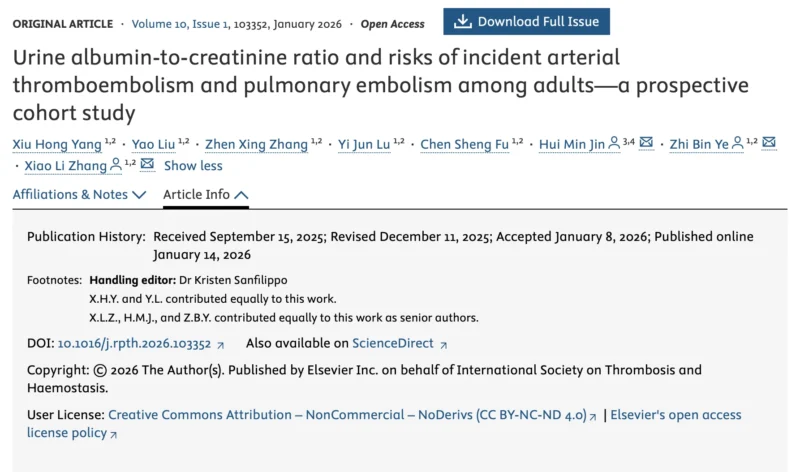
Title: Urine albumin-to-creatinine ratio and risks of incident arterial thromboembolism and pulmonary embolism among adults—a prospective cohort study
Authors: Xiu Hong Yang, Yao Liu, Zhen Xing Zhang, Yi Jun Lu, Chen Sheng Fu, Hui Min Jin, Zhi Bin Ye, Xiao Li Zhang
Stay updated on all scientific advances with Hemostasis Today.
-
Nov 8, 2026, 12:22Marc Carrier: Advancing Catheter-Related Thrombosis Prevention Through Factor XI Inhibition
-
Nov 8, 2026, 11:56Why Genetic Predisposition Does Not Always Lead to Thrombosis – Stork Genetics
-
Nov 8, 2026, 11:45Sher-Lu Pai: Investigating Intracardiac Thrombosis and Its Management in Liver Transplantation
-
Nov 8, 2026, 11:25Mehmet Cilingiroglu: Navigating Anticoagulation Choices in Acute Coronary Syndrome PCI
-
Nov 8, 2026, 07:16Gilberto de lima Lopes Junior: The Cardiovascular Consequences of Cancer in Younger Patients
-
Nov 8, 2026, 06:51Haney Mallemat: Key Principles and Pitfalls of LVAD Emergencies
-
Nov 8, 2026, 06:31Maria Omer: Clinical Recognition and Management of Cavernous Sinus Thrombosis
-
Nov 8, 2026, 06:16Natasha Jolakoski: University of New Mexico Hospital Promotes PGY-2 Thrombosis and Hemostasis Management Pharmacy Residency
-
Nov 8, 2026, 05:47Safaa Hilal: POCUS in the Evaluation of Perioperative Troponin Elevation