


Alfonso J. Tafur: New Biomarkers Transform Pulmonary Embolism Risk Prediction
Alfonso J. Tafur, Board Member VAS European Independent Foundation in Angiology and Vasculearn Network, shared RPTH Journal’s post on LinedIn about a recent article he and his colleagues co-authored, adding:
“Proud to be a co-author on this important publication led by Fakiha Siddiqui Congratulations
This study moves beyond traditional clinical risk scores by showing that thromboin flammation and hemostatic activation are major drivers of early mortality in acute PE. Among the most clinically relevant findings:
- Neutrophil-to-lymphocyte ratio (NLR) above 7 emerged as one of the strongest and most accessible predictors of 30-day mortality.
- Combining NLR, PAI-1, and TNF-α identified a subgroup with markedly higher mortality, highlighting the value of integrated biomarker assessment.
- The work supports incorporating biologic markers of inflammation, endothelial injury, coagulation, and fibrinolysis into future PE risk stratification models. Precision Medicine
Excited to see how these findings help shape the next generation of personalized pulmonary embolism care.”
RPTH Journal shared a post on LinkedIn:
“Pulmonary embolism mortality: can thromboinflammation biomarkers do better than current scoring systems?
Despite advances in diagnosis and treatment, pulmonary embolism (PE) still carries significant mortality, and current prognostic models remain poorly predictive of who will deteriorate. A new study in RPTH Journal takes a comprehensive biomarker approach to address this gap.
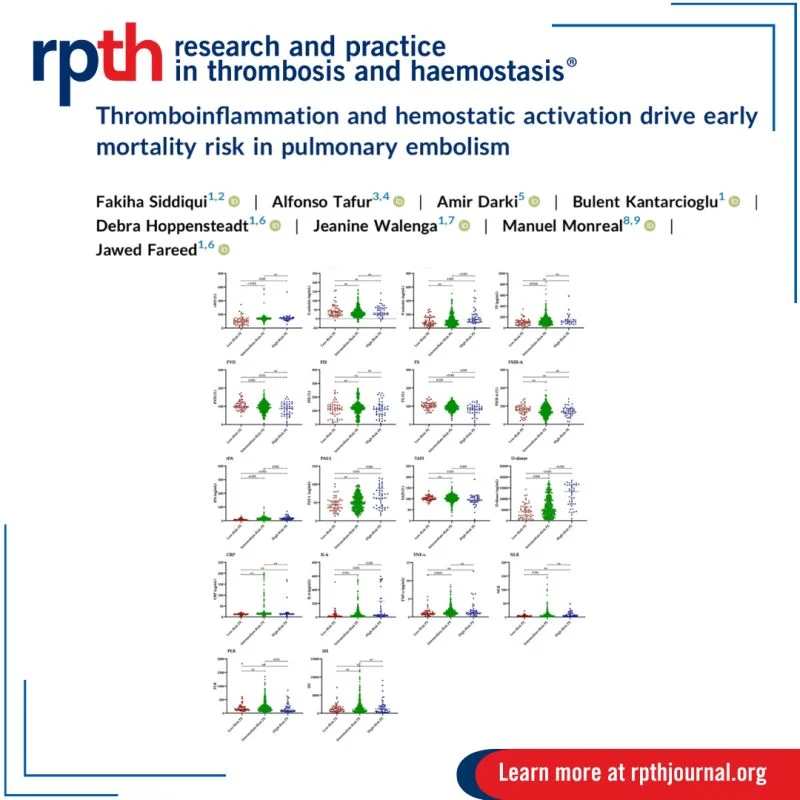
Key findings from 500 patients with PE (9.7% died within 30 days):
- Levels of vWF, P-selectin, tissue factor, tPA, PAI-1, D-dimer, CRP, IL-6, TNF-α, NLR, PLR, and SII were significantly higher in 30-day non-survivors
- FVII, FX, FXIIIA, and TAFI levels were significantly lower in non-survivors
- Multivariable analysis confirmed independent associations between these markers and 30-day mortality
- CHAID recursive partitioning identified NLR, PAI-1, and TNF-α as the key mortality predictors, with quantifiable thresholds established for each.”
Title: Thromboinflammation and hemostatic activation drive early mortality risk in pulmonary embolism
Authors: Fakiha Siddiqui, Alfonso Tafur, Amir Darki, Bulent Kantarcioglu, Debra Hoppensteadt, Jeanine Walenga, Manuel Monreal, Jawed Fareed
Stay updated on all scientific advances with Hemostasis Today.
-
Sep 19, 2026, 03:15Paulus Kirchhof: Europe’s Safe Hearts Plan to Reduce Cardiovascular Mortality
-
Sep 19, 2026, 03:10James Smith: Brain Training and Exercise for Cognitive Recovery After Stroke
-
Sep 19, 2026, 03:03Lesley Van Wyk: ASH Releases New Iron Deficiency Diagnosis Guidelines
-
Sep 19, 2026, 02:53Francisco Chacón-Lozsán: Acute Ischemic Stroke in 2026 – Expanding the Treatment Window
-
Sep 19, 2026, 01:53Thomas Dayspring: Understanding Genome and Lipid Interactions in Lipidology
-
Sep 19, 2026, 01:47Abdurrahman Tufan: Combination Targeted Therapy in Refractory Systemic Autoinflammatory Diseases
-
Sep 19, 2026, 01:44Patrick James Lynch: Mother of a Thousand Sons Premieres at BDC 2026
-
Sep 19, 2026, 01:41Genetic Fate Mapping Reveals Endothelial Cells During Venous Thrombus Resolution – RPTH Journal
-
Sep 19, 2026, 01:39Mostafa Hammam: Three Different Platelet Defects – One Common Symptom