


Amin Marashi: How Does the Microbiome Trigger the Immune System to Suddenly Turn Against the Body’s Own Blood-Clotting Regulators?
Amin Marashi, Medical Informatician and GxP Expert, shared a post on LinkedIn:
“How does the microbiome trigger the immune system to suddenly turn against the body’s own blood-clotting regulators?
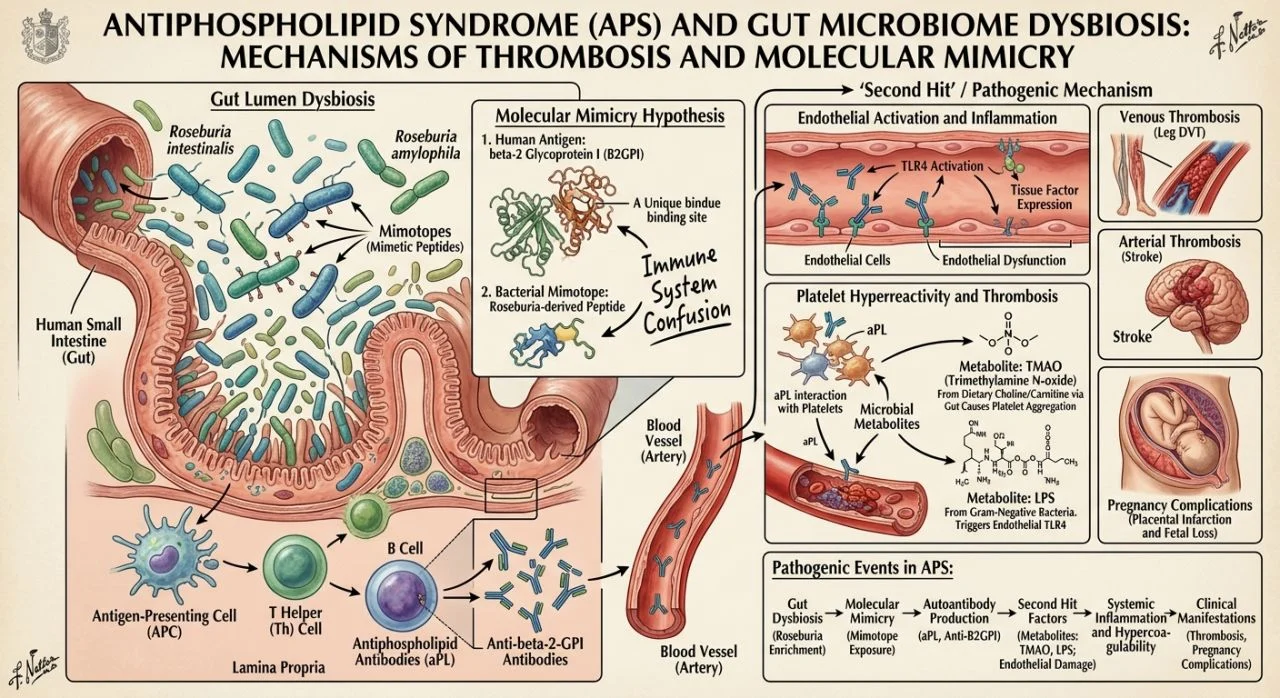
Antiphospholipid Syndrome (APS) is a systemic autoimmune disorder characterized by recurring arterial or venous blood clots (thrombosis) and pregnancy complications. At its core, the immune system produces antiphospholipid antibodies—primarily targeting a blood protein called beta_2-glycoprotein I (beta_2-GPI)—which pushes blood vessels and platelets into a dangerous prothrombotic state.
For decades, the root trigger behind these persistent autoantibodies remained elusive. Today, emerging research points directly to the gut microbiome as a chronic driver through two distinct mechanisms:
- Molecular Mimicry (The Autoimmune Spark) Common gut commensals—most notably Roseburia intestinalis and Roseburia amylophila—produce bacterial enzymes containing peptide sequences nearly identical to human beta_2-GPI. In genetically susceptible individuals with compromised gut barrier integrity, the immune system mounts a response against these microbial proteins and cross-reacts with human beta_2-GPI, sustaining chronic autoantibody production.
- Prothrombotic Metabolites (The ‘Second Hit’) Autoantibodies alone often don’t cause a clot without a vascular trigger. Gut-derived metabolites heavily influence that second hit:
- TMAO (Trimethylamine N-oxide): Produced from dietary choline and carnitine, TMAO heightens platelet hyperreactivity and accelerates clot formation.
- LPS (Lipopolysaccharide): Endotoxins from Gram-negative bacteria translocate across leaky gut barriers, activating TLR4 on endothelial cells and triggering coagulation cascades.
- SCFA Depletion: Loss of butyrate-producing bacteria weakens intestinal barrier integrity, fueling systemic inflammation.
Is it causal?
In preclinical animal models, introducing R. intestinalis directly triggers anti-beta_2-GPI antibodies and thrombosis, while depleting Gram-positive gut bacteria prevents clots.
In humans, ex vivo studies confirm patient antibodies cross-react with Roseburia proteins, and early microbiome-perturbation trials show measurable shifts in APS inflammatory and hemostatic biomarkers.
Understanding the gut–vascular–immune axis opens the door to moving beyond lifelong anticoagulation toward targeted microbiome and metabolic interventions.
What are your thoughts on molecular mimicry as a primary driver of systemic autoimmunity?”
Stay updated with Hemostasis Today.
-
Nov 21, 2026, 15:26Christina P.: Exploring Joint Involvement and Musculoskeletal Symptoms in Antiphospholipid Syndrome
-
Nov 21, 2026, 14:4410 Posts Not to Miss This Week
-
Nov 21, 2026, 14:21Two Emerging Mechanisms Linking Sickle Cell Disease to Thrombosis
-
Nov 21, 2026, 13:06Christine Faressa: Precision PRP and Platelet Biology in Musculoskeletal Care
-
Nov 21, 2026, 13:04Eyad Jamileh: Atrial Fibrillation – Bridging the Global Gaps in Diagnosis and Stroke Prevention
-
Nov 21, 2026, 12:49Thibault Veyron: Optimizing Bivalirudin Treatment in HIT
-
Nov 21, 2026, 12:44Paulus Kirchhof: Left Atrial Appendage Occlusion vs DOACs
-
Nov 21, 2026, 12:19Jiyeon Kim: Human Platelet Lysate – Advancing Cell Therapy and Space Research
-
Nov 21, 2026, 12:13Chaza Alaji: DVT in Early Pregnancy – Why Anticoagulation Decisions Matter