


Auston Cherbonneaux: Coffee-Associated Microbiome Alterations and Clinical Implications
Auston Cherbonneaux, Science Communicator, Author, Publisher, shared William Wallace’s post on LinkedIn:
“This is a problem.
As someone who has had significant medical around my gut, this post actually pisses me off.
The emphasis on how one presumed positive factor (microbiome shift) and the indifference to the suggested negative factor (reduced gut barrier efficacy), is willful scientific blindness.
IBS, colon cancer, and complications of the gut are on the rise.
This suggests that even decaf coffee can have significant negative impact on patients, with these kinds of conditions leading to increase in symptoms.
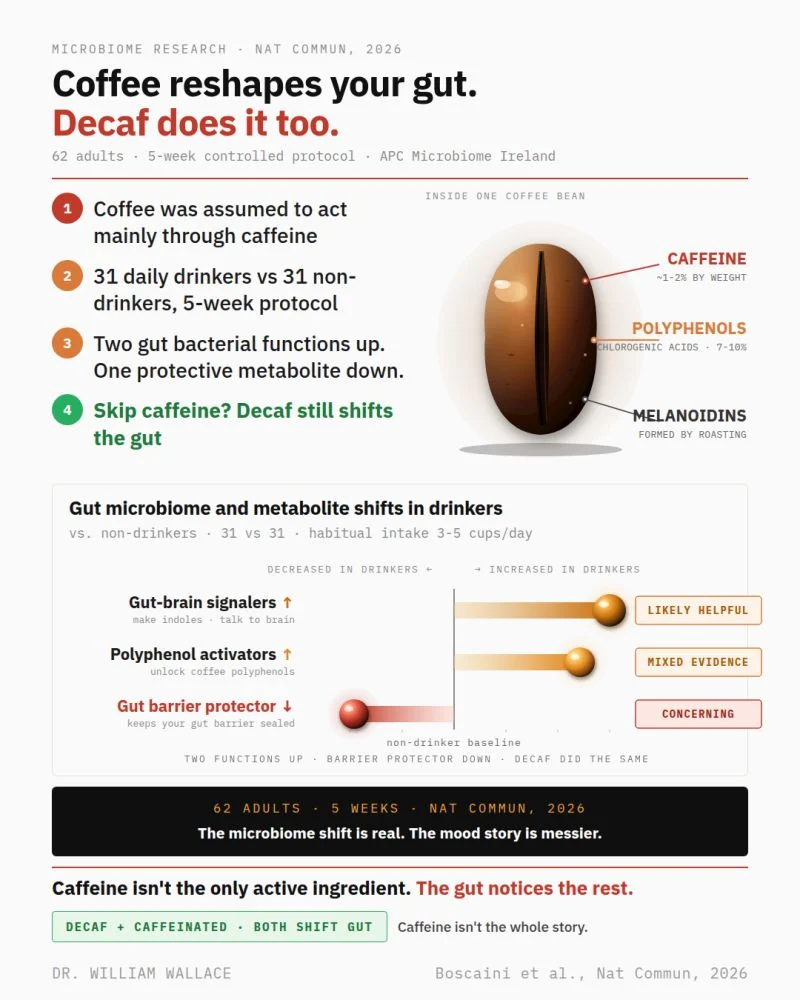
Look at the graph and the two bars to the right.
Think they are good associations on first glance, right?
It pushes the ‘Mixed Results’ to resemble ‘Likely Helpful’ … almost identical and hard to believe anything but intentionally misleading.
Look at the description, just nothing but praise for these potentially helpful chemicals in coffee with a few modifiers to save face.
One of the descriptions says the chemical helps the gut barrier, but the graph suggests the delivery vehicle (coffee) does not!
Only if you critically analyze this post can you start to understand its implications.
It’s bad visualization of science, bad interpretation, bad application, bad recommendations, all together is some terrible and misleading science communication.
Can we find these benefits in other food without the risks?
That’s a better question.”
William Wallace, Co-Founder and CSO of Supplement Success Solutions, shared a post on LinkedIn about a recent article by Serena Boscaini et al, published in Nature Communications, adding:
“Coffee contains roughly 1-2 percent caffeine by weight.
The other 98-99 percent is chlorogenic acids at 7-10 percent, melanoidins formed during roasting, trigonelline, and diterpenes.
The non-caffeine fraction is what does most of the work on the gut microbiome.
A new study quantified the shifts. 62 adults: 31 daily drinkers at 3-5 cups per day, 31 non-drinkers. 5-week controlled protocol.
APC Microbiome Ireland. Three findings stood out.
Cryptobacterium species increased in drinkers.
These bacteria produce indoles from tryptophan.
Indoles activate the aryl hydrocarbon receptor on intestinal cells, which supports gut barrier integrity and modulates immune tone.
Eggerthella species also increased.
These bacteria metabolize coffee polyphenols, breaking down chlorogenic acids into smaller bioactive metabolites the gut can absorb.
The increase is functionally relevant to coffee compound activation, though some Eggerthella species, particularly E. lenta, are linked to inflammation in inflammatory bowel disease and bloodstream infections in immunocompromised patients.
The genus has a mixed clinical profile. Indole-3-propionic acid decreased in drinkers.
IPA is a tryptophan-derived metabolite produced by bacteria like Clostridium sporogenes.
It’s anti-inflammatory and supports tight junction integrity in the gut barrier.
Lower IPA correlates with type 2 diabetes risk, gut barrier dysfunction, and inflammation across the literature.
A reduction is not a benefit.
The same directional shifts appeared in decaffeinated coffee drinkers.
Chlorogenic acids and melanoidins are present in decaf at similar concentrations.
Caffeine alone does not explain the microbiome changes.
A few qualifications. N=62 is small.
The findings are exploratory and need replication.
The behavioral component of the study reported a mix of effects.
Some measures of cognition shifted in expected directions.
Others, including impulsivity and emotional reactivity, also moved.
The picture on mood and cognition is more complicated than a single direction.
Whether the IPA reduction reflects a meaningful change in gut barrier function, or is a marker of broader bacterial community changes, isn’t resolvable from this data.
Practical framing: coffee changes the gut whether or not it contains caffeine.
If caffeine causes problems with sleep, anxiety, or blood pressure, decaf delivers most of the same microbiome effects.
The IPA reduction applies to both forms.”
Title: Habitual coffee intake shapes the gut microbiome and modifies host physiology and cognition
Auhtors: Serena Boscaini, Thomaz F. S. Bastiaanssen, Gerard M. Moloney, Federica Bergamo, Laila Zeraik, Caroline O’Leary, Aimone Ferri, Maha Irfan, Maaike van der Rhee, Thaïs I. F. Lindemann, Elizabeth Schneider, Arthi Chinna Meyyappan, Kirsten Berding Harold, Caitríona M. Long-Smith, Carina Carbia, Kenneth J. O’Riordan, José Fernando Rinaldi de Alvarenga, Nicole Tosi, Daniele Del Rio, Alice Rosi, Letizia Bresciani, Pedro Mena, Gerard Clarke, John F. Cryan
Stay updated on all scientific advances with Hemostasis Today.
-
Oct 9, 2026, 12:48Santiago Cepeda Chafla: CereBleed Simplifies Brain Hemorrhage Assessment
-
Oct 9, 2026, 12:34Abdul Muqtadir Abbasi: Pancytopenia Is a Finding, Not a Diagnosis
-
Oct 9, 2026, 12:24Mercy Lung’aho: When Diet Quality and Nutritional Biomarkers Tell Different Stories
-
Oct 9, 2026, 12:22Eugene Fan: Bridging Therapeutic Breakthroughs and Equitable Thalassaemia Care
-
Oct 9, 2026, 12:14Brittany Busse: A New Focus on Iron Deficiency Before Anemia
-
Oct 9, 2026, 12:13Akshat Jain: A New Textbook Bringing Global Perspectives on Sickle Cell Disease
-
Oct 9, 2026, 12:03Heather Case: Bridging Awareness and Action in Women’s Hemophilia Care
-
Oct 9, 2026, 11:58Brandon Luu: Can Iron Deficiency Cause Fatigue Without Anemia?
-
Oct 9, 2026, 11:51Sumaiya Dickens: Marginal Zone B Cells in Transfusion Medicine and Hemophilia A Research