


Claudio Carrubba on How Timing Truly Matters in Trauma Embolization
Claudio Carrubba, Medical Director – Vascular and Interventional Radiology Unit at AORN “A. Cardarelli”, shared on LinkedIn:
”Proud to share our latest publication in the Journal of Personalized Medicine (JPM).
This study explores how timing truly matters in trauma embolization.
We found that performing transarterial embolization within the first hour after CT — the so-called “golden hour” – can improve metabolic response and optimize outcomes, particularly in the most severely injured patients.
These findings highlight the importance of integrating interventional radiology into emergency pathways across a broader network of hospitals, ensuring that trauma patients can access these life-saving procedures as quickly as possible.
A heartfelt thank you to my colleagues Francesco Giurazza, Fabio Corvino, Federico Capozzoli, Raffaella Niola”
Read the full article here.
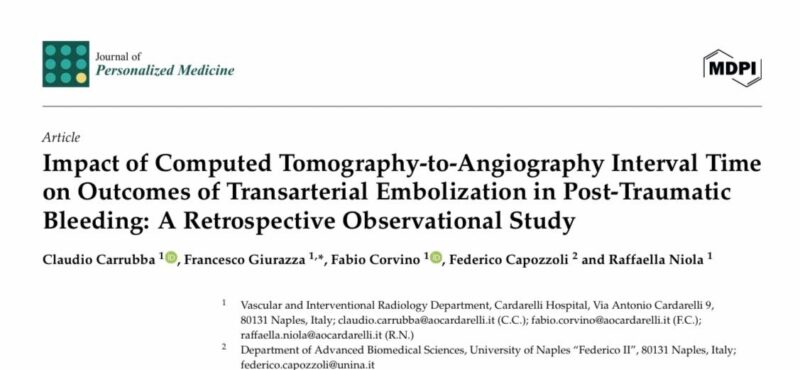
Article: Impact of Computed Tomography-to-Angiography Interval Time on Outcomes of Transarterial Embolization in Post-Traumatic Bleeding: A Retrospective Observational Study
Authors: Claudio Carrubba, Francesco Giurazza, Fabio Corvino, Federico Capozzoli, Raffaella Niola
Stay updated on all scientific advances with Hemostasis Today.
-
Oct 10, 2026, 10:07Maha Othman: Look Forward to an Amazing ISTH 2027 in Vancouver!
-
Oct 10, 2026, 10:02Rucha Patil: National Convening Highlights Opportunities for Equitable Hemophilia Care Across India
-
Oct 10, 2026, 09:52Yuria Ito: Should Ferritin Testing Become a Routine Part of Prenatal Care in Japan?
-
Oct 10, 2026, 09:48Ahmed Alotaibi: Can We “Remove” the ABO Problem from Group O Platelets?
-
Oct 10, 2026, 09:31Help Shape the New ASH Iron Deficiency Guidelines – American Society of Hematology
-
Oct 10, 2026, 09:05Wolfgang Miesbach: Moving from Bleed Control to Comprehensive Joint Health
-
Oct 10, 2026, 07:59Leila Caroline Souza Reis: Enoxaparin Dosing for VTE Prevention in Adults With Obesity
-
Oct 10, 2026, 07:41Adeeb Bazuhair: New Evidence for Catheter Directed Thrombolysis in Acute PE
-
Oct 10, 2026, 07:22Poppy Clarke: Turning Steps Into Support for Thrombosis Awareness