


Daniel Torrent: From Early Hemodynamic Recovery to Improved Survival in Pulmonary Embolism
Daniel Torrent, Vascular Surgeon at Longstreet Clinic, shared a post on LinkedIn about recent article by Ryan Nolan et al. published in Journal of Vascular and Interventional Radiology adding:
“The recent results from the STORM-PE trial have established a new benchmark in Pulmonary Embolism (PE) care, providing Level 1 evidence that mechanical thrombectomy (MT) significantly reduces right heart strain (RV/LV ratio) compared to anticoagulation alone.
However, as with many randomized controlled trials, critics often point to the use of surrogate endpoints and wonder: does this physiological recovery actually translate to saving lives?
A new retrospective analysis by Nolan et al. provides a compelling ‘real-world’ answer that further validates the STORM-PE findings.
While STORM-PE showed us that we can rapidly offload the failing right ventricle, this study demonstrates the downstream clinical impact: a significant 30-day mortality benefit.
The Key Findings: From Physiology to Survival
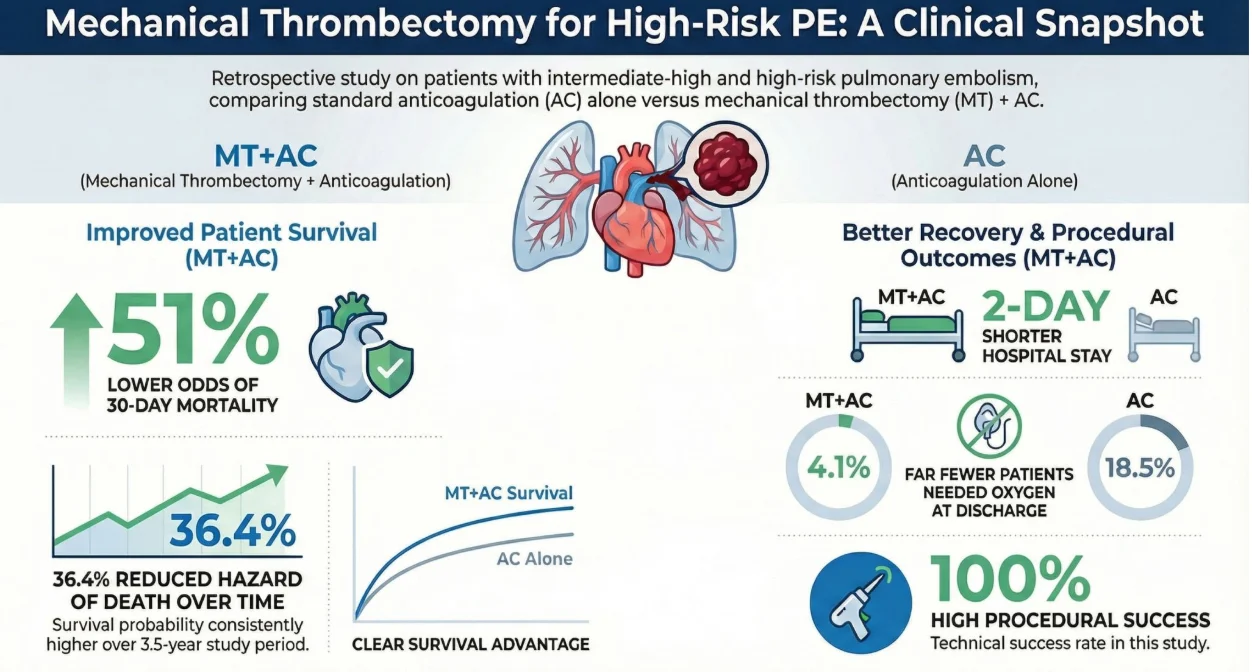
This retrospective study of 335 patients with intermediate-high and high-risk PE (evaluated by a Pulmonary Embolism Response Team) highlights why MT is becoming the frontline choice:
Mortality Benefit: The use of MT was associated with a 51% reduction in the odds of 30-day all-cause mortality (OR 0.49; 95% CI, 0.27-0.76; $P=.002).
Faster Recovery: Patients in the MT+AC cohort had a hospital length of stay (LOS) that was 2 days shorter on average (P<.001).
Reduced Morbidity: MT patients were significantly less likely to require supplemental oxygen at discharge (4.1% vs 18.5%, P<.001).
Long-Term Outlook: MT was associated with a 36.4% reduced hazard of death throughout the study period.
Bridging the Gap: STORM-PE and Real-World Evidence
STORM-PE proved that computer-assisted vacuum thrombectomy (CAVT) is superior at normalizing the RV/LV ratio within 48 hours. This retrospective data bridges the gap by showing that these early hemodynamic improvements correlate with the hard outcomes we care about most—keeping patients alive and getting them home sooner.
The combination of Level 1 surrogate data and large-scale retrospective survival data makes a powerful case: mechanical thrombectomy is no longer just an “option” for high-risk and intermediate high risk PE; it is a vital tool for improving survival.
The takeaway for PERT teams? The early physiological wins we see in the lab are translating into real-world lives saved.”
Title: Clinical Outcomes following Mechanical Thrombectomy in Pulmonary Embolism Response Team–Consulted Patients: A Retrospective Analysis
Authors: Ryan Nolan, Maanasi Samant, Suresh Vedantham, Westley Ohman, Nathan Droz, Kristen Sanfilippo, Pavan Kavali
Read the Full Article on Journal of Vascular and Interventional Radiology.

Find more posts featuring Daniel Torrent on Hemostasis Today.
-
Sep 22, 2026, 18:11Bharath Kumar V.։ Advancing Safer Anticoagulation for Cancer-Associated Thrombosis
-
Sep 22, 2026, 18:10Fatima Zahra: ASH Released New Guidelines on the Diagnosis of Iron Deficiency
-
Sep 22, 2026, 17:49Nirav Dhanesha: Targeting FXI for Safer Anticoagulation
-
Sep 22, 2026, 17:17Eric Lambert: Intravascular Imaging and the Future of Precision PCI
-
Sep 22, 2026, 16:45Claudiu Stoicescu: Are We Starting Cardiovascular Risk Assessment Too Late?
-
Sep 22, 2026, 16:35Complement – Coagulation Crosstalk in Thrombosis
-
Sep 22, 2026, 16:20Ila Bappa Ibrahim: Bringing Sickle Cell Innovation Closer to Communities
-
Sep 22, 2026, 16:02Ana Pedrero Gil: Peri-operative Management of Patients Undergoing Day Surgery
-
Sep 22, 2026, 15:27Zia Ullah: RBC-Derived Extracellular Vesicles as Potential Biomarkers of Thrombotic Risk in Dengue