

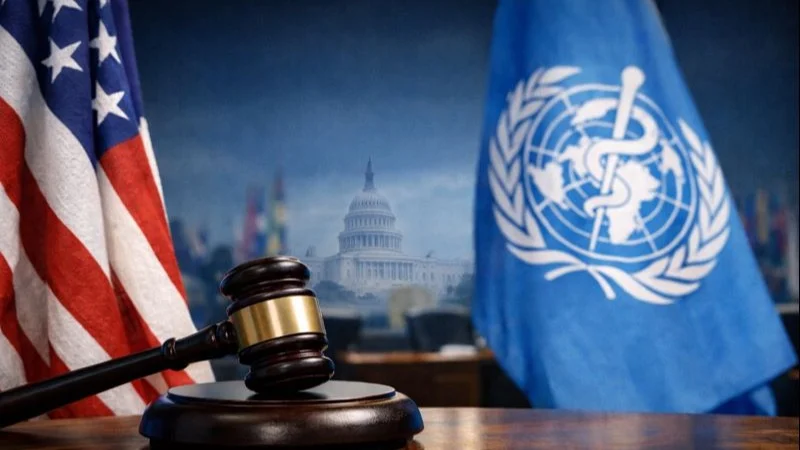
Anuoluwapo Babalola։ What The U.S. Exit from WHO Means for Global Health Leadership
Anuoluwapo Babalola, Associate at Banwo and Ighodalo, shared on LinkedIn :
“Introduction
After a one-year notice period that began on January 20, 2025, the United States (U.S.) withdrawal from the World Health Organization (“WHO” or “the Organization”) was finalised on January 22, 2026. This marks the second major reversal in the U.S. engagement with the WHO in just over half a decade, following a 2020 withdrawal that was later reversed in 2021.
The executive order mandates the withdrawal of the U.S. from the WHO and revokes prior actions to rejoin the Organization. It halts U.S. funding and participation, recalls U.S. personnel, ends involvement in WHO-related negotiations, directs formal notification of the withdrawal and shifts public health and biosecurity efforts toward alternative partners.
This development is not merely procedural, it represents a significant shift in how the U.S. intends to engage with global health governance.
Why It Happened
From the U.S. government’s perspective, the withdrawal centers on issues of sovereignty, cost and institutional accountability.
Officials have argued that the WHO failed to respond effectively and promptly during the early stages of the COVID-19 pandemic that began in Wuhan, China. Criticisms include alleged delays in declaring global emergencies, reliance on incomplete information from member states, perceived praise of China’s response, and early missteps regarding asymptomatic and airborne transmission, all of which, according to U.S. authorities, hindered global containment efforts.
The U.S. has also cited what it describes as the WHO’s failure to implement necessary reforms. The executive order initiating withdrawal asserts that longstanding concerns about governance, accountability, transparency and pandemic response mechanisms remain unresolved.
Additionally, U.S. officials have raised concerns that the WHO lacks sufficient independence from political pressures exerted by member states, arguing that this compromises its ability to act objectively and swiftly during public health emergencies.
Finally, the executive order highlights financial considerations. The U.S. has maintained that its contributions, estimated at roughly 15–20% of WHO’s total budget, are disproportionately high compared to those of other major member states, including China, whose assessed contributions are significantly lower.
WHO’s Response
The WHO sees the decision very differently. In a January 24, 2026 statement acknowledging the U.S. notification,Director-General Tedros Adhanom Ghebreyesus described the decision as one that ‘makes the United States and the world unsafe,’ warning that it weakens global disease surveillance, emergency response capacity and collective preparedness for future health threats.
The Organization rejected allegations that it had undermined or disrespected the U.S. or compromised its independence. It emphasised that it has consistently engaged with the U.S. in good faith and with respect for national sovereignty. WHO officials also stood by the Organization’s response to COVID-19, describing it as a response to an unprecedented global crisis, and firmly dismissed claims of politicisation, reiterating their commitment to impartiality and service to all member states.
Many global health experts and policy analysts align more closely with this perspective. Their concern is not merely symbolic but strategic, that the U.S. may be voluntarily relinquishing influence in global health governance, creating space for other powers, particularly China, to shape emerging norms, rules and priorities.
What the Real Impact May Be
In the short term, the consequences are already tangible. The WHO is facing a significant financial shortfall, prompting budget cuts, staff reductions and diminished capacity to monitor and respond to disease outbreaks worldwide.
Over time, the implications could be more profound. Programmes targeting polio eradication, HIV/AIDS, tuberculosis and pandemic preparedness may lose momentum. Infectious diseases do not respect national borders and disengagement from global health systems does not insulate any country from risk, rather, it can reduce visibility into emerging threats and limit opportunities for coordinated response.
Geopolitically, the withdrawal may create a leadership vacuum within global health governance. Other states are likely to step in, potentially reshaping global health priorities and institutional norms in ways that diverge from longstanding U.S. positions and values. This may transcend global health and extend to other global issues.
There is also the unresolved issue of approximately $260–$278 million in unpaid U.S. dues. The current administration has indicated it does not intend to settle these outstanding contributions, a decision that may carry diplomatic and reputational consequences in multilateral financing circles.
Final Reflections
At its core, this decision is less about budget lines and more about influence, leadership and the future architecture of global health cooperation. While the rhetoric emphasises sovereignty and savings, the longer-term implications may be felt in diminished global leadership, weaker collective health security and reduced ability to shape outcomes that ultimately affect populations at home and abroad.”
Stay updated on all scientific advances with Hemostasis Today.
-
Sep 30, 2026, 14:13Ashok Choudhury: Portal Vein Thrombosis and Outcomes in Cirrhosis
-
Sep 30, 2026, 13:57Leslye Conde Bazán: When Conventional Imaging Is Not Enough – The Role of IVUS
-
Sep 30, 2026, 13:41Huda Salah Eldin: The Challenge of Balancing Antithrombotic Therapy After PCI
-
Sep 30, 2026, 13:29Abdus Salam: What Can CT Venography Reveal About the Veins?
-
Sep 30, 2026, 13:03Amira Mohy: Diagnostic Flow Cytometry Panels for Hematological Malignancies
-
Sep 30, 2026, 12:52Paul Watton: Could Repetitive Head Impacts Leave a Molecular Memory?
-
Sep 30, 2026, 12:41The Journey to ISTH 2027 Starts in Vancouver
-
Sep 30, 2026, 11:36Basit Ali: A Closer Look at CT Venography
-
Sep 30, 2026, 11:16Christina Pohlman: Could aPL Levels Help Predict Stroke Recurrence?