


Wolfgang Miesbach on The 1st Case of Secondary Malignancy Triggered by Integrated AAV
Wolfgang Miesbach, Professor of Medicine at Frankfurt University Hospital, shared on LinkedIn:
”Is there evidence that integrated AAV can trigger oncogenesis in a clinical setting?
First case worldwide with molecular evidence linking AAV integration to human malignancy.
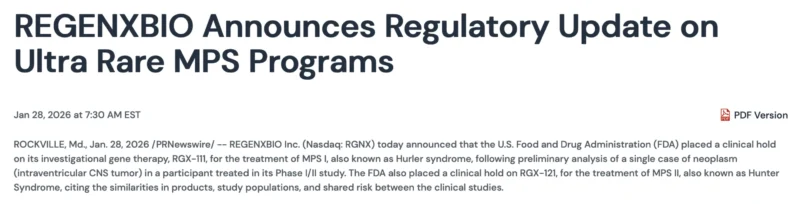
The FDA placed clinical holds on REGENXBIO’s AAV9-based gene therapies after detecting a CNS tumour in a 5-year-old with Hurler syndrome (MPS I).
The case:
Patient: 5-year-old with Hurler syndrome (MPS I)
Therapy: RGX-111 — AAV9 carrying IDUA gene (α-L-iduronidase)
Dose: 5.0×10¹⁰ vg/gram brain mass (~10¹³⁻¹⁴ total)
Route: Intracisternal injection (direct CSF)
Timeline: Brain tumour detected 4 years post-injection
Status: Asymptomatic; surgically resected; progressing developmentally
Critical context: No tumours in 9 other RGX-111 recipients or 32 RGX-121-treated patients (some followed ~7 years).
Pathogenic mechanism:
Finding: AAV integration in resected tumour with PLAG1 proto-oncogene overexpression.
Mechanism: PLAG1 (pleomorphic adenoma gene 1) is normally silenced in adult tissues. AAV integration may have created a promoter substitution event—placing the strong CMV/CB7 promoter near PLAG1, driving ectopic overexpression. This recapitulates the exact mechanism in spontaneous PLAG1-driven tumours (salivary adenomas, lipoblastomas).
Context: At clinical doses (~10¹⁴ vector genomes), even 0.1–1% integration frequency equals millions of integration events per patient.
Implications for haemophilia gene therapy:
Haemophilia therapies target the liver (AAV5/AAV8), not CNS (AAV9)—fundamentally different biology.
Evidence from >500 haemophilia patients treated with gene therapy:
8 cancer cases reported total: NO evidence AAV caused the cancer—
Adult hepatocytes are postmitotic; strong regenerative capacity dilutes integrated genomes
AAV5/AAV8 are liver-selective; minimal CNS penetration
This case increases uncertainty and awareness. Patient awareness and informed consent so importannt:
- Detailed baseline information before treatment
- Explicit shared decision-making
- Long-term surveillance protocols and registries”
Read the full announcement here.
Stay updated with Hemostasis Today.
-
Sep 11, 2026, 03:10Chris Oung: Anticoagulation for Atrial Fibrillation with Intermediate Stroke Risk
-
Sep 10, 2026, 21:33J. Meireles-Brandao: Lp(a)HORIZON and the Role of Inflammation in ASCVD
-
Sep 10, 2026, 21:31Alejandro González Veliz: Pregnancy is a Cardiovascular Stress Test
-
Sep 10, 2026, 21:30Tareq Abadl: Did You Know That the Type of Hemoglobin in Our Blood Changes Throughout Life?
-
Sep 10, 2026, 21:30Sumyea Kabir: Apheresis Awareness Day – One Donor, One Procedure, One Therapeutic Difference
-
Sep 10, 2026, 21:30Suhasini Sil: Excited to Share Our New Publication on HLA Beyond Histocompatibility
-
Sep 10, 2026, 21:29Michael Meneghini: Your Calves Are Not Just for Walking
-
Sep 10, 2026, 21:27One month until International Plasma Awareness Week – PPTA Europe
-
Sep 10, 2026, 21:26John Strouse: Supporting Research to Improve Lives in Sickle Cell Disease