


Danny Hsu: Are We Stopping at the First Diagnosis? The Hidden Complexity of VWD
Danny Hsu, President of THANZ, shared a post by RPTH Journal on LinkedIn:
“Are We Stopping at the First Diagnosis? The Hidden Complexity of VWD
Diagnostic anchoring may be causing us to miss up to one-third of combined hemostasis disorders in patients with von Willebrand Disease (VWD).
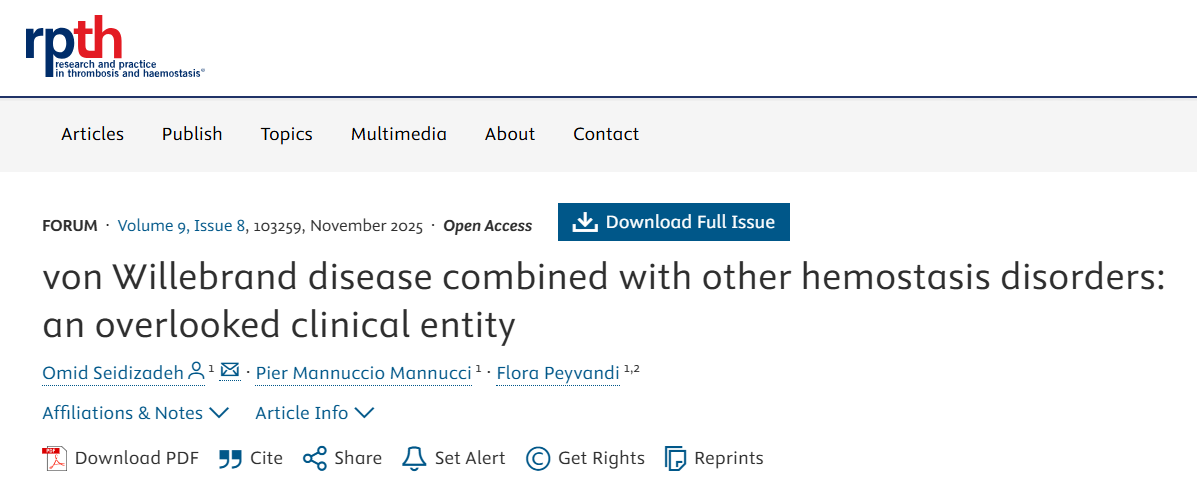
This Forum article in RPTH by Omid Seidizadeh, Pier Mannuccio Mannucci, and Flora Peyvandi highlights a critical blind spot in our diagnostic workflows: the co-inheritance of VWD with other bleeding disorders.
The Clinical Reality:
Because VWD affects ~1% of the population, the statistical probability of it co-occurring with other coagulation defects is significant. Yet, these combined defects remain largely underrecognized due to diagnostic anchoring—the tendency to halt investigation once a plausible explanation (like VWD) is found.
Key Findings & Prevalence:
* High Co-occurrence: In specific cohorts, up to 36% of patients with low VWF/Type 1 VWD had an additional hemostatic defect.
* Common Culprits: The most frequent co-occurring defects were platelet function disorders (22%), followed by deficiencies in FVII, FXII, and FXI.
* Genetic Drivers: Founder effects and consanguinity increase this risk, but multilocus variants are also emerging in broader populations via NGS.
Why It Matters:
Missing the second defect isn’t just an academic issue; it fundamentally alters risk stratification and therapy.
* Treatment Failure: A patient with VWD and a platelet function defect may require platelet transfusions, whereas standard VWD therapy (DDAVP/concentrates) would be insufficient.
* Altered Phenotypes: Interestingly, some combinations (like VWD + Antithrombin deficiency) can actually attenuate bleeding severity, while others (VWD + FXIII deficiency) significantly worsen it.
The Takeaway for Haematologists:
We must resist the urge to stop at the first abnormal lab result. If a patient’s bleeding phenotype is disproportionate to their VWF levels, or if they have a suboptimal response to treatment, we need to broaden our diagnostic scope.
Comprehensive phenotyping and, where appropriate, NGS panels are essential to unmask these “overlooked clinical entities”.
Quoting RPTH Journal‘s post:
“VWD is common, but that familiarity can work against us. This Forum article highlights how often VWD co-exists with other inherited bleeding disorders—and how anchoring on a single diagnosis can lead us to miss the full picture.”
Authors: Omid Seidizadeh, Pier Mannuccio Mannucci and Flora Peyvandi share their thoughts on this disease.
Stay updated on Hemostasis Today.
-
Sep 30, 2026, 11:16Christina Pohlman: Could aPL Levels Help Predict Stroke Recurrence?
-
Sep 30, 2026, 10:55Rana Al Hrout: Diagnostic Approach to Hypochromic Microcytic Anemia
-
Sep 30, 2026, 01:52Javed Anees: DADA2 – When a Young Stroke Is More Than a Stroke
-
Sep 30, 2026, 01:51How a Venous Thrombus Becomes Revascularized – ISTH
-
Sep 29, 2026, 22:45Victor Agunyego: Paracetamol – The Most Common Drug We Underestimate
-
Sep 29, 2026, 22:42Nova Sinclair: Advancing the Future of Hematology – Meet Our 2027 Organizing Committee
-
Sep 29, 2026, 22:41Lorenz Räber: Intracoronary Imaging in PCI – Why, When, How, and Which Modality?
-
Sep 29, 2026, 22:31Selma Turkovic: Pleased to Deliver the Opening Presentation at Kingston Hospital
-
Sep 29, 2026, 22:31Miguel Teran: Ultrasound and Simulation in Arterial Blood Sampling