


Elisa Rauseo: Could Cardiac CT Become the First-line Test to Exclude Left Atrial Appendage Thrombus in Acute Stroke?
Elisa Rauseo, Consultant Cardiologist at Barts Health NHS Trust and Clinical Senior Lecturer at Queen Mary University of London, shared a post on LinkedIn about a recent article by Annemarie Kirschfink et al., published in Therapeutic advances in neurological disorders, adding:
“Could cardiac CT become the first-line test to exclude left atrial appendage thrombus in acute stroke?
A new study evaluated photon-counting CT integrated into the emergency stroke imaging pathway and compared it with transoesophageal echocardiography (TEE).
The results are encouraging:
- 96% diagnostic accuracy
- 99% negative predictive value for excluding LAA thrombus.
The most interesting aspect isn’t replacing TEE – it’s the possibility of identifying or confidently excluding a major cardioembolic source during the initial stroke CT, without delaying acute treatment.
This was a retrospective single-center study, and larger prospective studies are still needed.
What also caught my attention is that the protocol relied on a single cardiac acquisition rather than dedicated delayed LAA imaging. It raises an interesting question: could adding a delayed acquisition further improve differentiation between slow flow and true thrombus while remaining practical in the acute stroke setting?
As photon-counting CT (PCCT) continues to evolve, it will be interesting to see whether future protocols move beyond simply detecting thrombus towards optimizing the balance between diagnostic accuracy, radiation dose and workflow.
What are your thoughts?”
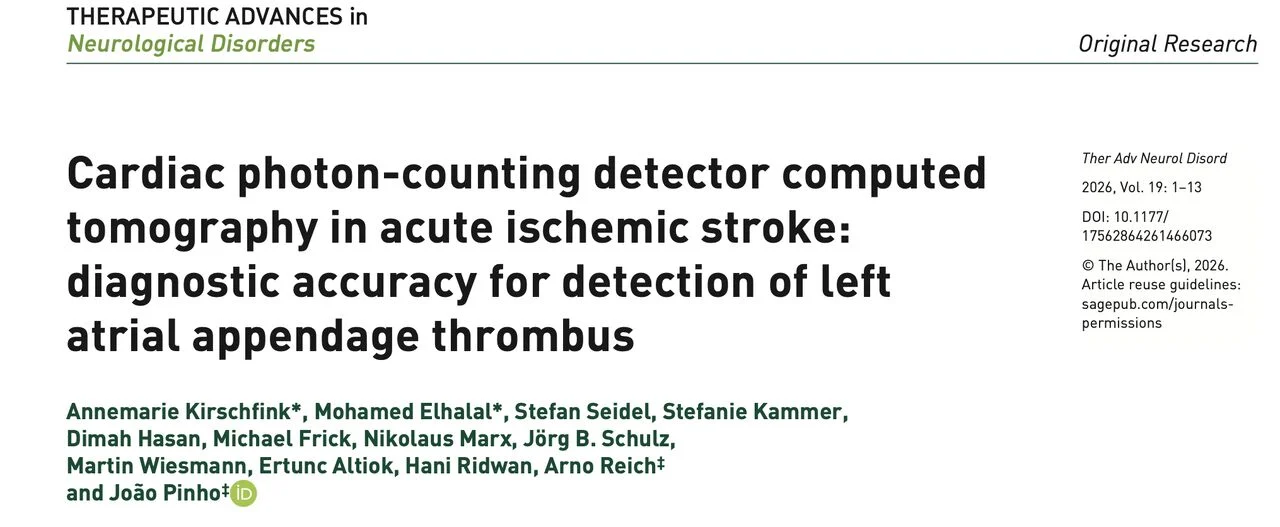
Title: Cardiac photon-counting detector computed tomography in acute ischemic stroke: Diagnostic accuracy for detection of left atrial appendage thrombus
Authors: Annemarie Kirschfink, Mohamed Elhalal, Stefan Seidel, Stefanie Kammer, Dimah Hasan, Michael Frick, Nikolaus Marx, Jörg B Schulz, Martin Wiesmann, Ertunc Altiok, Hani Ridwan, Arno Reich, João Pinho
Stay updated on all scientific advances with Hemostasis Today.
-
Oct 18, 2026, 08:02Neda Ashayeri: Global Perspectives on Hemophilia and Rare Bleeding Disorders in Abu Dhabi
-
Oct 18, 2026, 07:55Anu Thomas: A Stepwise Laboratory Approach to Positive IAT and Pretransfusion Compatibility
-
Oct 18, 2026, 07:49Matthew Hazell: Molecular Matching and the Future of Transfusion Practice
-
Oct 18, 2026, 07:05Behnood Bikdeli: Vasculearn Network Highlights Expert Perspectives on PE Risk Stratification and Advanced Therapies
-
Oct 18, 2026, 06:27Gregory Makris: NEJM Study Supports Earlier Catheter-Directed Intervention in Intermediate-High–Risk PE
-
Oct 18, 2026, 06:26Danny Hsu: BLOOD 2026 Return to Aotearoa
-
Oct 18, 2026, 02:43Priya Sriskandarajah: Diagnosis and Management of PV and JAK2-Unmutated Erythrocytosis
-
Oct 18, 2026, 02:41C. Michael Gibson: A Meta-Analysis of DOACs and DAPT After Left Atrial Appendage Closure
-
Oct 18, 2026, 02:27What Hematologists Should Remember About the Person Behind the Platelet Count – ASH