

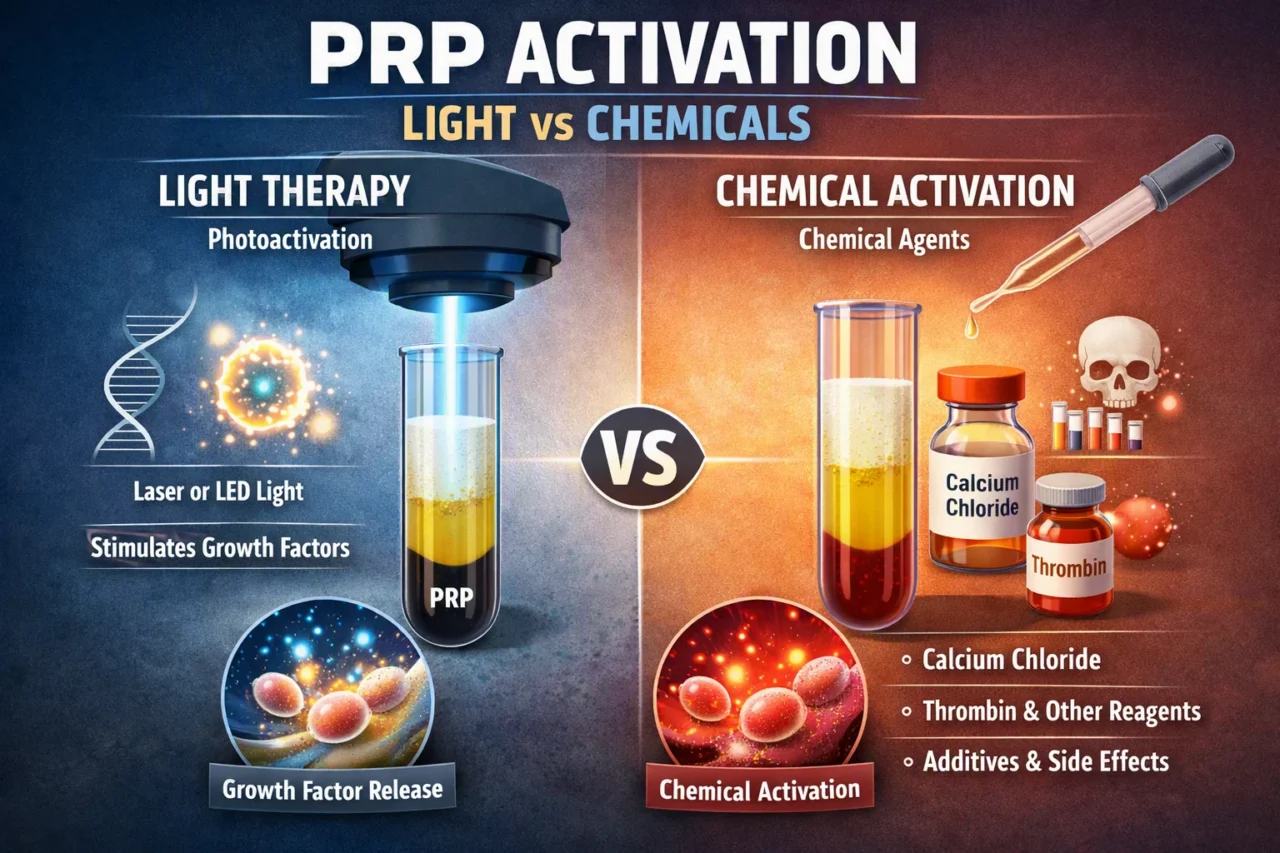
Eugenio Caradonna: Can Light Replace Chemicals in PRP Activation?
Eugenio Caradonna, Senior Scientific Advisor at CDI Centro Diagnostico Italiano, shared a post on LinkedIn about a recent article he and his colleagues co-authored, published in Journal of Biological Engineering, adding:
”PRP has been used in regenerative medicine for years, but there is still surprisingly little agreement on how it should be activated.
Most protocols rely on thrombin or calcium chloride. They work, but activation can be abrupt and difficult to control. That matters because the way platelets release their growth factors may influence the biological response.
So we tried a different approach: light.
We developed a compact device that irradiates PRP directly inside a standard syringe using LEDs at 660 and 830 nm. A large part of the work happened before the biological experiments even began. We measured the optical power, irradiance and transmission through the syringe so that the delivered fluence was defined and reproducible.
The results are now available in the Journal of Biological Engineering.
Photobiomodulation produced release profiles that differed from those obtained with calcium chloride. VEGF and PDGF increased progressively over 72 hours, while TGF-β1 rose earlier and remained elevated at the final time point. Calcium chloride, by comparison, caused a marked early release of TGF-β1 and PDGF.
What interests me most, however, is the Raman spectroscopy.
Using a portable Raman system, we detected molecular signatures at 72 hours that were consistent with the growth-factor trends measured by ELISA. This does not mean that real-time monitoring is ready for clinical use. We are not there yet. But it suggests that PRP activation could eventually be checked optically, on site, without consuming the sample for biochemical analysis.
There is an important limitation: this proof-of-concept study used PRP from a single healthy donor. We made that choice to reduce biological variability while testing the technology, but the next step is clear and we are working on it . We need to find out whether these patterns hold across a larger and more diverse group of donors.
For now, we have shown that light can be used as a defined parameter for PRP activation and that Raman spectroscopy may provide a way to verify the resulting molecular changes.
Proud of the team behind this work: Sarassunta Ucci, Valeria Iazzetta, Sara Spaziani, Antonio Iele, Giancarlo Luongo, Saverio Graziano, Eugenio Caradonna, Armando Ricciardi, Marco Pisco, Anna Aliberti and Andrea Cusano.
University of Sannio, CeRICT, Medical Service Taranto and Centro Diagnostico Italiano.”
Title: Light assisted activation of platelet-rich plasma for enhanced and controlled release of growth factors: a technology-driven proof-of-concept framework
Authors: Sarassunta Ucci, Valeria Iazzetta, Sara Spaziani, Antonio Iele, Giancarlo Luongo, Saverio Graziano, Eugenio Caradonna, Armando Ricciardi, Marco Pisco, Anna Aliberti, Andrea Cusano
Stay updated on all scientific advances with Hemostasis Today.
-
Oct 9, 2026, 11:51Sumaiya Dickens: Marginal Zone B Cells in Transfusion Medicine and Hemophilia A Research
-
Oct 9, 2026, 11:44Ayyappan V Nair: PRP and Rehabilitation – Can It Help Athletes with Partial Rotator Cuff Tears?
-
Oct 9, 2026, 11:29Jigesha Dholakia: Supporting the Hemophilia Community Through the Unite Walk
-
Oct 9, 2026, 11:06Nobles Green: How siRNA Therapy Helps the Body Form Stronger Clots
-
Oct 9, 2026, 10:53Switching From Emicizumab to Denecimig in Hemophilia A – Rare Disease Advisor
-
Oct 9, 2026, 10:40What New U.S. Data Reveal About GT – Glanzmann’s Research Foundation
-
Oct 9, 2026, 10:32Anjali Pandey: The Morphologic Clues to MDS With del(5q)
-
Oct 9, 2026, 10:13Reza Shojaei: 5 Leadership Responsibilities for a Sustainable Plasma Ecosystem
-
Oct 9, 2026, 08:38Johannes Gratz: Perioperative Care in Factor VII Deficiency – Treating the Patient, Not the Number